
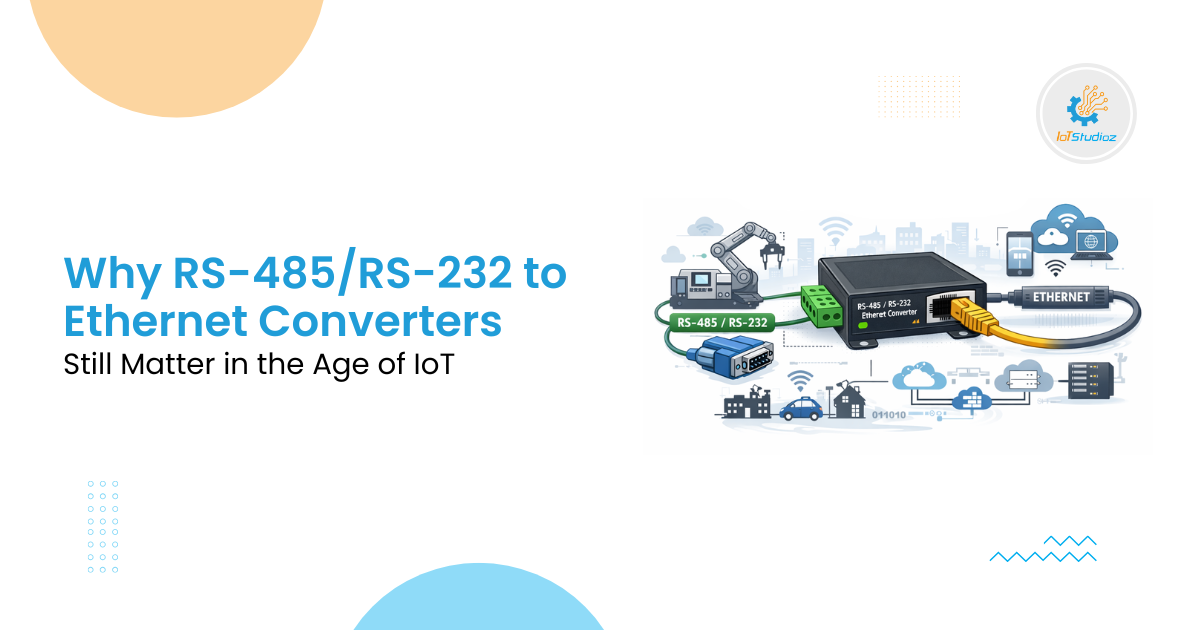
Why RS-485/RS-232 to Ethernet Converters Still Matter in the Age of IoT
In today’s world of industrial automation and the Internet of Things (IoT), modern communication technologies like Ethernet and wireless networking get most of the attention. Yet, many industrial, building automation, and utility systems still depend on decades-old serial interfaces such as RS-485 and RS-232. To bridge the gap between these legacy protocols and modern IP-based networks, RS-485/RS-232 to Ethernet Converters remain essential. This article explains why these converters matter, their technical benefits, and how they support the transition toward highly connected IoT environments.
Understanding Serial and Ethernet Communication
What RS-485 and RS-232 Are
RS-485 and RS-232 are serial communication standards used for low-level device communication in industrial and embedded systems. RS-232 provides point-to-point communication between two devices. RS-485 supports multi-drop networks, allowing many devices to share the same serial bus. Both standards are highly reliable under electrical noise and long cables.
However, these interfaces were not designed for modern networked systems that require IP-based communication, cloud connectivity, and global access. This limitation is why converters are needed in the first place.
Ethernet as the Modern Networking Standard
Ethernet is the most widely deployed networking technology for local and wide area networks. It supports high data rates, IP addressing, and a rich set of network services. Ethernet connects devices across corporate networks, remote cloud servers, and IoT platforms. Transmission speeds start at 10 Mbps and extend to gigabit rates or higher, enabling real-time data transfer and centralized control systems.
The challenge arises when legacy serial devices must send data into these IP-based networks. That is where RS-485/RS-232 to Ethernet Converters play a crucial role.
The Core Technical Role of Converters
1. Bridging Legacy Devices to Modern Networks
Many industrial controllers, sensors, meters, and actuators still use RS-485 or RS-232 as their communication interface. These devices cannot speak TCP/IP or integrate with Ethernet networks directly. Converters act as protocol translators. They receive serial frames, encapsulate them into TCP/IP or UDP packets, and send the data over Ethernet networks.
This process allows legacy hardware to communicate with modern systems like SCADA, MES, and IoT platforms without replacing existing equipment. Converters extend the functional life of installed devices while enabling them to operate in connected environments.
Why Converters Matter for IoT
1. IoT Growth and Legacy Integration
The global industrial IoT (IIoT) market is forecast to reach more than $1.7 trillion by 2030, driven by digital transformation in manufacturing, utilities, and smart infrastructure. At the same time, reports indicate that over 70% of industrial equipment still relies on serial communication standards like RS-485, meaning a huge installed base of devices exists that cannot directly connect to Ethernet or IoT systems.
Without converters, companies would face high costs replacing millions of devices. With converters, they can connect legacy systems to IoT platforms, central dashboards, analytics engines, and remote control systems. Converters thus become critical enablers for IoT adoption in real industrial environments.
2. Real-Time Monitoring and Control
IoT analytics, maintenance automation, and predictive operations depend on real-time data. Serial devices often collect continuous sensor readings, state information, or process data from remote equipment.
Converters allow this data to reach Ethernet networks in real time, enabling operators to:
- View machine states remotely
- Trigger alerts for threshold breaches
- Log historical data for trend analysis
This real-time connectivity drives faster decision-making and reduces onsite inspections, lowering operational costs.
Key Technical Advantages of Converters
1. Centralized Data Access
Converters allow serial data from many devices to be routed into centralized monitoring systems. For example, multiple RS-485 sensors might connect to a converter that forwards all device data to a single Ethernet-based SCADA server. This reduces the complexity of cable runs and consolidates data streams efficiently.
2. Supports Protocol Flexibility
Many converters support standard industrial protocols like Modbus RTU and Modbus TCP. Converters can translate Modbus RTU frames over serial to Modbus TCP/IP packets on Ethernet, allowing legacy devices to communicate with modern protocol stacks without altering their firmware or hardware.
3. Scalability Across Networks
Ethernet supports virtually unlimited device counts through switches and IP addressing. Legacy serial networks have physical limits on distance and the number of connected devices. Converters allow installations to scale beyond these limits, supporting distributed nodes across large sites or multiple facilities.
Practical Industry Examples
1. Manufacturing and Process Control
Factories use PLCs and sensors with serial interfaces to monitor assembly lines. Converters feed this data to centralized dashboards and analytics platforms. According to industrial case data, retrofitting older sensor networks with Ethernet converters cut maintenance time by roughly 30% and reduced HVAC system downtime by 25%.
2. Energy & Utilities
Utilities often have remote terminal units (RTUs) communicating via RS-485. Converters enable data from those units to reach SCADA systems over Ethernet networks. Some utilities report 99.7% data availability when connecting hundreds of remote units via converters.
3. Building Automation
Many HVAC controllers, lighting systems, and access control panels use RS-485. Converters tie these systems to Ethernet networks, enabling centralized control and analytics. In one facility, automation of over 1,000 zones reduced network maintenance by 40%.
4. Agriculture and Environment Monitoring
Environmental sensors using RS-485 can feed moisture, temperature, and soil data to cloud dashboards via Ethernet converters and backhaul links like cellular or satellite. This has helped farms reduce water usage by around 18% through better irrigation control.
Security and Reliability Considerations
1. Enhancing Security for Legacy Devices
Legacy serial lines typically lack encryption and authentication. Ethernet networks and converters support modern security protocols like TLS, VPNs, and firewall integration. This helps protect operational data from cyber threats and unauthorized access in IoT deployments.
2. Rugged Industrial Performance
Industrial converters are built to endure harsh environments. They often operate across wide temperature ranges and offer isolation to protect against electrical noise and surges. This ruggedness ensures reliable communication even on factory floors or remote installations.
Converter Market and Adoption Trends
The broader protocol and serial-to-Ethernet converter market remains strong. Serial-to-Ethernet converters account for nearly 45% of total revenue in the Ethernet protocol converters sector, reflecting their ongoing relevance as industrial networks modernize.
Estimates project that millions of protocol converters will be in operation worldwide by 2032, further reinforcing that such technologies will remain integral to industrial connectivity.
Overcoming Common Technical Challenges
1. Latency and Packet Integrity
Encapsulating serial data into Ethernet frames introduces minimal delay. Proper network design and quality converters keep latency below thresholds that affect real-time operations.
2. Network Configuration
Mapping RS-485 device identifiers to IP addresses requires configuration tools. Modern converters support centralized management and auto-discovery to simplify large deployments.
3. Security Policy Integration
Converters may need integration with VLANs, firewalls, and network segmentation to meet enterprise security policies. Choosing devices with built-in security features eases this task.
Conclusion
Even in the age of IoT, RS-485/RS-232 to Ethernet Converters play a vital role in industrial communication. They allow legacy devices to participate in modern, IP-based networks without costly hardware replacements. Converters support real-time monitoring, centralized control, and scalable network architectures while extending the life of existing infrastructure.
Their continued demand in sectors as diverse as energy, manufacturing, and building automation highlights their enduring relevance. As IoT systems grow, converters will remain essential in connecting the physical world of sensors and controllers with digital platforms and analytics engines.
FAQ
1. What is the main purpose of RS-485/RS-232 to Ethernet converters?
RS-485/RS-232 to Ethernet converters bridge the gap between legacy serial devices and modern IP-based networks. They translate serial communication protocols into Ethernet-compatible formats (TCP/IP or UDP), enabling older industrial equipment to connect to SCADA systems, IoT platforms, and cloud dashboards without replacing existing hardware.
2. Why are these converters still important in the age of IoT?
Despite IoT growth, over 70% of industrial equipment still relies on serial communication standards like RS-485 and RS-232. Converters allow these legacy devices to participate in modern networks, supporting real-time monitoring, predictive maintenance, centralized control, and integration with analytics platforms, all while avoiding costly equipment replacements.
3. Which industries benefit most from using serial-to-Ethernet converters?
Industries like manufacturing, energy and utilities, building automation, agriculture, and environmental monitoring rely heavily on converters. They enable older sensors, PLCs, HVAC controllers, RTUs, and environmental monitoring devices to communicate over Ethernet networks for centralized monitoring and data-driven operations.
4. How do converters enhance security and reliability for legacy devices?
Converters integrate legacy serial devices with modern Ethernet security protocols, including TLS encryption, VPN support, and firewall compatibility. Industrial-grade converters are rugged, with wide operating temperature ranges and electrical isolation, ensuring reliable communication in harsh factory floors, remote installations, and critical infrastructure.
5. Can RS-485/RS-232 to Ethernet converters handle large-scale IoT deployments?
Yes. Converters support protocol flexibility (e.g., Modbus RTU to Modbus TCP/IP), centralized data access, and scalability across networks. By connecting multiple serial devices to Ethernet, they enable large, distributed systems to send real-time data to centralized dashboards, cloud analytics, or remote monitoring systems without performance bottlenecks.