
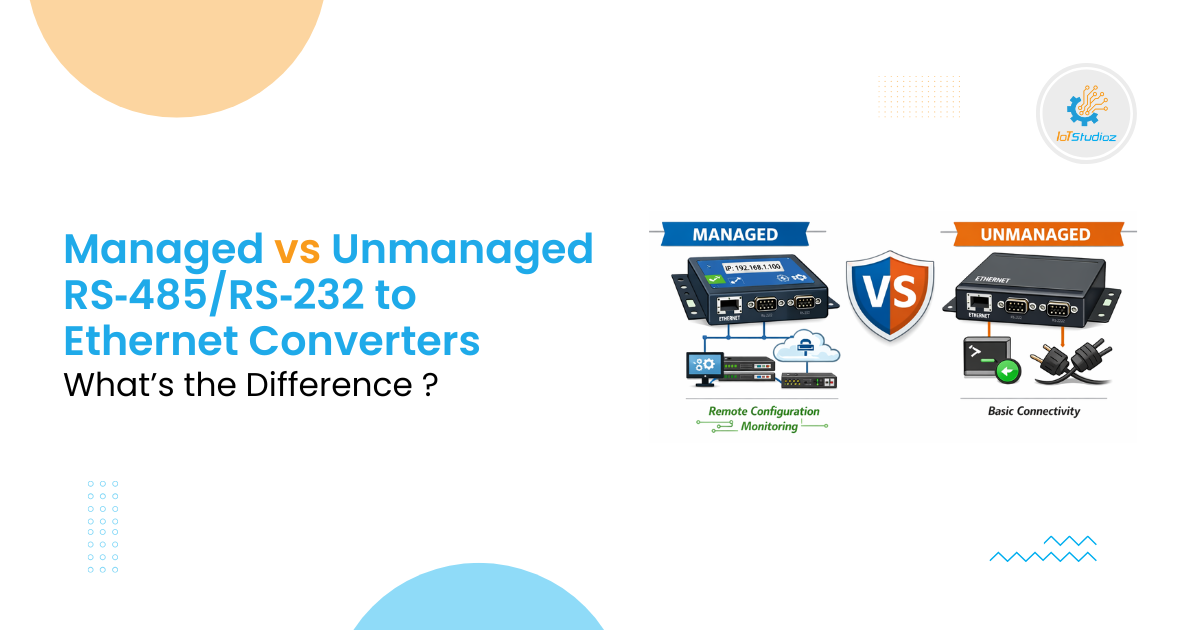
Managed vs Unmanaged RS‑485/RS‑232 to Ethernet Converters: What’s the Difference?
In industrial communication and automation, RS‑485/RS‑232 to Ethernet Converters play a crucial role. These devices bridge legacy serial interfaces like RS‑485 and RS‑232 to modern Ethernet networks. Connectivity is vital in manufacturing, energy systems, building automation, and IoT applications where serial devices must communicate with modern systems. However, not all converters work the same. This article explains, in clear technical terms, the key differences between managed and unmanaged converters. It also explores use cases, performance factors, and real‑world implications.
We focus on systems engineers, network architects, and technical managers who design or maintain industrial communications.
1. Introduction to RS‑485/RS‑232 to Ethernet Converters
Serial communication protocols such as RS‑485 and RS‑232 have existed for decades. They power sensors, motor controllers, PLCs, and telemetry equipment. However, Ethernet has become the dominant network technology. In fact, Ethernet‑based networks now represent about 76% of new industrial network installations.
Without converters, legacy serial devices cannot communicate on Ethernet or IP‑based systems. That is where RS‑485/RS‑232 to Ethernet Converters become essential. These devices translate serial signals into Ethernet‑compatible packets that travel across IP networks and reach servers, cloud platforms, or industrial control systems.
RS‑485 offers robust communication over long distances and in noisy environments. It supports multi‑drop configurations with many devices on the same bus and can extend up to 1200 meters.
Converters that support RS‑485 are often called RS‑485 to Ethernet Converters. They are widely used because many industrial systems are still serial‑based, even as Ethernet grows.
2. Basics of Managed and Unmanaged Converters
What Is a Converter?
An RS‑485/RS‑232 to Ethernet converter receives serial data and packages it into TCP/IP or UDP frames. It enables data from serial devices to be accessible on Ethernet networks. Managed converters add advanced control and monitoring features. Unmanaged converters operate without those controls and require minimal configuration.
3. Unmanaged RS‑485/RS‑232 to Ethernet Converters
Unmanaged converters are plug‑and‑play by design. They require little configuration and typically operate in a transparent mode. These solutions receive serial data and convert it to a network format with minimal intervention.
Key Traits
- Simple Operation: Most operate in automatic or predefined mode.
- Basic Protocol Support: They usually handle raw data and simple encapsulation (TCP Server/Client or UDP modes).
- Minimal Configuration: Setup often requires just IP and port assignments.
- Low Cost: Hardware costs are lower than managed models.
- Limited Monitoring: They provide little to no status reporting.
Typical Use Cases
- Small automation systems with a few serial devices.
- Temporary test setups where advanced control is unnecessary.
- Legacy installations requiring basic Ethernet bridging.
Strengths and Limitations
Strengths:
- Easy setup and deployment.
- Lower cost of ownership.
- Sufficient for basic connectivity needs.
Limitations:
- No traffic analytics or diagnostics.
- Lack of security controls.
- No remote configuration or monitoring.
Unmanaged devices are often chosen when budgets are tight or network complexity is minimal. They work well where stability and simplicity matter more than advanced features.
4. Managed RS‑485/RS‑232 to Ethernet Converters
Managed converters provide advanced capabilities beyond simple data translation. They offer configuration control, security, monitoring, and network management features. These converters may be integrated with protocols like Modbus TCP and can support edge computing functions.
Key Capabilities
- Advanced Configuration: Users can set up virtual interfaces, protocol mapping, and routing rules.
- Security Features: Firewalls, encryption (TLS/SSL), authentication, and access logs.
- Monitoring & Diagnostics: Network statistics, status reports, and alerts.
- Remote Management: Admins can change settings over the network.
- Protocol Translation: Some models translate protocols (Modbus RTU to Modbus TCP).
Typical Use Cases
- Large manufacturing plants with many serial nodes.
- Critical systems where uptime and diagnostics are required.
- Environments with cybersecurity requirements.
- Systems requiring centralized management of multiple devices.
Advantages and Challenges
Advantages:
- Better control over device behavior.
- Enhanced security and logging.
- Easier troubleshooting with status visibility.
Challenges:
- Higher cost than unmanaged models.
- Setup requires network and protocol knowledge.
- Complexity may be unnecessary in simple setups.
5. Technical Differences: A Closer Look
Network Configuration
- Unmanaged: Assign a static IP, netmask, and port. Default settings are often acceptable.
- Managed: Support VLANs, DHCP, SNMP, DNS, and network segmentation for large systems.
Protocol Support
- Unmanaged: Basic TCP/UDP encapsulation. Often transparent data transfer.
- Managed: Support protocol translation, advanced services such as Modbus TCP bridging, and API integration.
Security
- Unmanaged: No security controls. Devices are open once on the network.
- Managed: Support firewalls, VLAN isolation, access lists, and encrypted sessions.
Many modern industrial installations require security compliance. With Ethernet dominating new network installations, over 70% of legacy equipment still relies on serial protocols like RS‑485.
Monitoring and Logs
- Unmanaged: No event logs.
- Managed: Logs, alarms, and detailed event history for diagnostics.
Performance Metrics
Managed converters often include traffic shaping, protocol buffering, and throughput tuning. They can handle multiple simultaneous network connections, allowing better performance in complex systems.
6. Industry Trends and Adoption
Industrial Ethernet networks now represent about 76% of new nodes installed globally, up from 71% in the previous year. This highlights a shift toward IP‑based communication. However, serial communication remains deeply embedded. Estimates suggest that over 70% of industrial equipment still use RS‑485 or similar serial protocols.
The global market for serial to Ethernet device servers, which includes RS‑485 and RS‑232 converters, is growing rapidly at an estimated CAGR of over 8%. Furthermore, converters that support RS‑232 and RS‑485 form a significant share of the industrial protocol converter market.
These trends show that while Ethernet rises, converters remain necessary.
7. Practical Examples and Statistics
A survey of industrial installations finds that fieldbus technologies like RS‑485 still hold significant usage, even as Ethernet grows. Meanwhile, cost‑saving examples show that retrofitting RS‑485 systems with Ethernet converters can reduce capital expenses compared to full device replacement. One installation retrofit saved over 70% in equipment costs.
In building automation, linking 1,000 zones of HVAC controllers using converters resulted in a 40% reduction in maintenance network overhead.
Industrial networks using converters can achieve high uptime. Some reports show reliability above 99.9% in RS‑485 to Ethernet systems.
8. Choosing Between Managed and Unmanaged
Here’s a comparison to help engineers decide:
| Feature | Unmanaged Converters | Managed Converters |
| Cost | Low | Higher |
| Setup Complexity | Minimal | Requires expertise |
| Security | None | High |
| Diagnostics | Basic | Comprehensive |
| Remote Management | No | Yes |
| Protocol Support | Basic | Advanced |
| Best for | Small, simple systems | Large, critical systems |
When to Use Unmanaged
- Projects with tight budgets.
- Small installations with minimal network traffic.
- Basic connectivity without need for monitoring.
When to Use Managed
- Networks requiring security controls.
- Systems with multiple converters across sites.
- Centralized monitoring and diagnostics needs.
9. Deployment Considerations
Power and Environmental Factors
Converters must operate reliably in industrial conditions. Many support wide‑range power inputs and rugged enclosures.
Protocol Compatibility
Ensure the converter supports the serial protocol and baud rates used by devices. Protocol mismatch can lead to data errors or communication failure.
Maintenance and Support
Managed converters often come with longer support lifecycles and firmware updates. This matters for systems expected to run for years without frequent onsite intervention.
Conclusion
RS‑485/RS‑232 to Ethernet Converters form the backbone of many industrial communication systems. They translate serial data into IP network traffic. Managed and unmanaged converters differ in configuration flexibility, security, monitoring, and cost.
- Unmanaged converters provide simplicity and economy.
- Managed converters deliver control, security, and diagnostics.
The choice depends on system size, performance requirements, security needs, and budget. Given the continued prevalence of serial devices and the rapid growth of Ethernet networks in industrial arenas, understanding these differences is vital for engineers and network architects.
FAQs
Q1. Are unmanaged converters secure?
No. They lack built‑in security features and should be used only in trusted networks.
Q2. Can managed converters bridge Modbus protocols?
Yes. Some models support Modbus RTU to Modbus TCP conversion.
Q3. Do converters affect latency?
Yes. Conversions introduce processing time, but modern converters keep latency low (often under a few milliseconds).