
Proof-of-Concept (PoC) IoT Solution Using RS-485 Gateway
Industrial facilities depend on machines installed many years ago. These machines still work well and deliver value. Most of them communicate through RS-485 using Modbus RTU. However, modern industries need real-time data visibility.
Recent industry studies show that more than 70% of industrial equipment still uses serial communication. Manufacturing companies also report up to 25% efficiency improvement after adopting IoT-based monitoring. Global IoT device deployments are expected to exceed tens of billions within this decade. These numbers show a clear trend. Organizations want digital insights without replacing existing infrastructure.
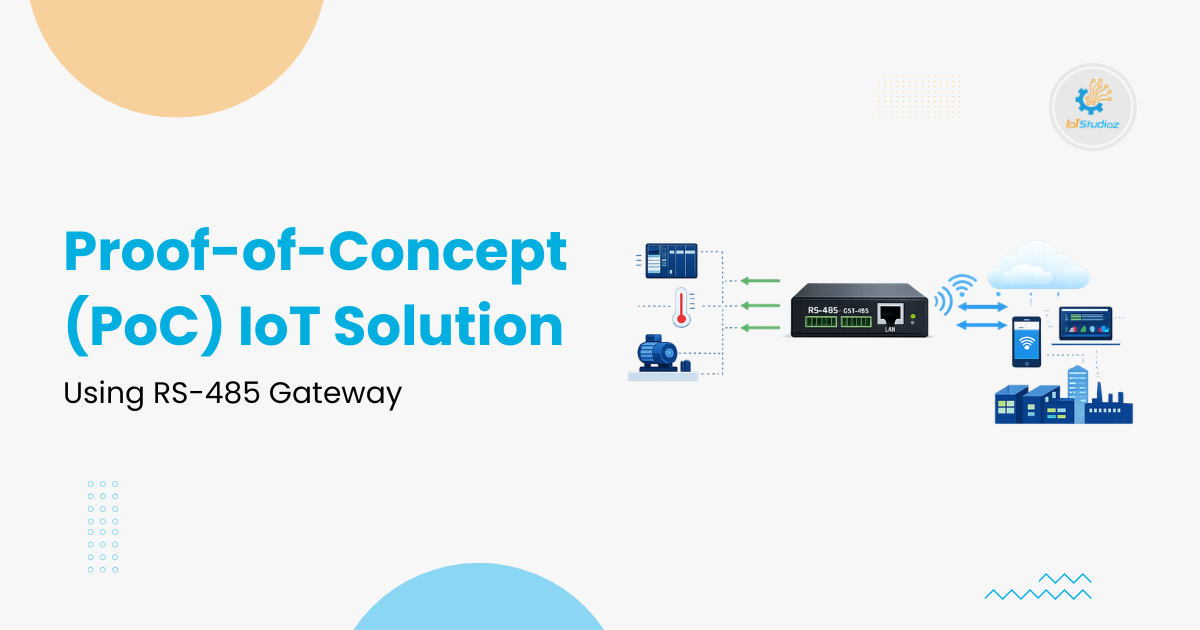
A Proof-of-Concept (PoC) using an RS-485 Modbus Gateway allows industries to test this transformation safely. It connects legacy devices to modern platforms, enabling data collection, monitoring, and analytics. The PoC validates performance before full-scale implementation.
What Is an RS-485 Modbus Gateway in an IoT PoC?
An RS-485 Modbus Gateway is a communication bridge. It connects Modbus RTU devices on a serial network to IP-based systems such as cloud platforms or SCADA software.
The gateway reads Modbus registers from field devices. It converts that data into protocols like Modbus TCP, MQTT, or HTTP. This translation allows legacy machines to participate in IoT ecosystems.
In a PoC environment, the gateway plays a central role. It enables testing without modifying existing equipment.
How the Gateway Connects Legacy Devices to Modern Platforms
Legacy industrial devices cannot speak modern network languages. They send raw data through serial frames. IT systems require structured data over Ethernet or cellular networks.
The Modbus Gateway performs three essential tasks:
- Collects data from multiple RS-485 devices
- Converts serial communication into network protocols
- Sends usable data to monitoring or analytics platforms
PoC Architecture Overview
A well-designed PoC uses a simple architecture. The goal is validation, not complexity.
1. Field Layer: This layer includes sensors, meters, and PLCs using Modbus RTU over RS-485.
2. Edge Layer: The RS-485 Modbus Gateway polls devices and gathers operational data.
3. Network Layer: Ethernet or cellular connectivity transfers data to higher-level systems.
4. Application Layer: Cloud dashboards or SCADA platforms visualize and analyze the data.
This layered structure separates responsibilities and simplifies troubleshooting.
Required Hardware and System Components
A PoC requires only a small number of components. This keeps deployment fast and affordable. The essential equipment includes Modbus-enabled sensors or energy meters, a PLC or controller with RS-485 interface, an RS-485 Modbus Gateway, an industrial power supply, an Ethernet switch or cellular router, and monitoring software or an IoT platform. Start with three to five devices. This number provides meaningful data without adding complexity.
Communication Flow: From Field Device to Cloud
Understanding the communication path helps validate system performance.
Step-by-Step Flow
- A field device measures a parameter such as temperature or power usage.
- The device sends data through RS-485 using Modbus RTU.
- The RS-485 Modbus Gateway polls the device at defined intervals.
- The gateway converts serial data into TCP/IP packets.
- Data travels through the network to the IoT platform.
- The platform stores, processes, and displays the information.
This cycle repeats continuously, often every few seconds.
Network and Configuration Best Practices
Correct configuration ensures stable communication during the PoC phase.
1. RS-485 Wiring Guidelines
Use shielded twisted-pair cables to reduce noise, install termination resistors at both ends of the bus, maintain a daisy-chain topology, avoid star connections to prevent signal reflection, and assign unique Modbus IDs to each device.
2. Communication Settings
Keep baud rate consistent across devices, use proper parity and stop-bit configuration, and set polling intervals to avoid network congestion.
3. Data Mapping
Each Modbus register must map to a meaningful engineering value. Accurate mapping ensures reliable analytics later.
4. Edge Processing Considerations
Many gateways provide local processing features, including data filtering to remove unnecessary values, local buffering to protect against network outages, and time stamping to improve data accuracy. These capabilities improve performance without adding extra hardware.
Real Example: Industrial Energy Monitoring PoC
Consider a manufacturing facility validating energy optimization. The objective was to monitor energy consumption across three production machines. For implementation, three Modbus energy meters were connected via RS-485, one RS-485 Modbus Gateway collected readings, and data was transmitted to a cloud dashboard every ten seconds. During observations, engineers noticed abnormal energy usage during idle periods, as machines consumed power even when not producing.
The outcome showed that adjusted machine scheduling reduced idle energy waste, the facility lowered electricity consumption by nearly 15%, and managers gained remote visibility without manual inspections.
Performance Validation and Scaling Considerations
The Proof of Concept (PoC) serves as the stress test for your integration. To ensure the system is production-ready, it must be evaluated against specific technical and operational benchmarks over a continuous two-week monitoring period.
1. Key Performance Indicators (KPIs)
Success is measured by the reliability of the data string from the physical sensor to the end-user dashboard.
| Metric | Description | Target Goal |
| Communication Success Rate | Percentage of successful polls vs. total requests. | > 99.5% |
| Data Latency | Time elapsed between device trigger and platform visualization. | < [X] Seconds |
| Packet Error Frequency | Rate of corrupted or dropped packets during transit. | Minimal / Trend Baseline |
| Data Accuracy | Variance between digital readings and manual physical audits. | ± 0.1% or Sensor Spec |
| Gateway Utilization | CPU and memory load on the edge gateway during peak polling. | < 70% Capacity |
| Network Stability | Consistency of the connection (uptime) over the 14-day window. | 99.9% Uptime |
2. Common Challenges & Troubleshooting
Most deployment failures are rooted in physical layer issues or configuration oversights. Identifying these during the PoC prevents costly site visits later.
- Documentation Discrepancies: Incorrect register maps (e.g., Zero-based vs. One-based indexing) often lead to “Offset Errors.”
- Signal Integrity: Wiring noise caused by improper grounding or lack of shielded twisted-pair cables can corrupt data packets.
- Addressing Conflicts: Overlapping Modbus IDs or IP addresses on a single segment will cause intermittent communication drops.
- Polling Inefficiency: Improperly configured scan rates can overwhelm the bandwidth of the serial bus or the gateway processor.
- Scaling Mismatches: Failure to apply the correct “multiplier” (e.g., reading a value as 1500 instead of 15.00) results in unusable data.
3. Phased Scaling Model
Once the PoC meets the defined KPIs, the system can be expanded through a structured rollout. This minimizes risk and ensures the infrastructure grows alongside the data load.
- Horizontal Expansion: Gradually increase the number of devices connected per gateway to determine the “breaking point” of the local network.
- Infrastructure Redundancy: Deploy secondary/failover gateways in mission-critical zones to ensure high availability.
- Standardized Templating: Develop “Gold Configurations” for device profiles to ensure rapid, error-free deployment of new hardware.
- Centralized Orchestration: Introduce a unified monitoring system to manage firmware updates and configurations across multiple sites.
- Advanced Analytics: Integrate AI-driven predictive maintenance tools to transition from reactive monitoring to proactive optimization.
Benefits of Using a Modbus Gateway for Industrial IoT
A Modbus Gateway brings clear advantages for industrial facilities, especially older (brownfield) setups.
Operational Benefits:
- Extends the life of existing machines.
- Saves money by avoiding expensive replacements.
- Enables real-time monitoring of equipment.
- Reduces the need for manual data collection.
- Helps plan maintenance more effectively.
Technical Benefits:
- Connects different industrial and IT systems through protocol translation.
- Works well in environments with both old and new equipment.
- Keeps communications reliable and predictable.
- Supports gradual digital upgrades without disrupting operations.
Overall, using a Modbus Gateway makes it easier and more cost-effective to modernize operations while keeping existing systems running smoothly.
Conclusion
Industries need digital visibility, but they cannot discard reliable equipment. A Proof-of-Concept IoT solution using an RS-485 Modbus Gateway provides a balanced approach. It connects legacy Modbus devices with modern analytics platforms while preserving operational continuity.
The PoC validates communication reliability, confirms data value, and measures performance before large investments. Organizations gain insights, improve efficiency, and prepare for broader Industry 4.0 initiatives without disrupting production.
Modernization does not always require replacement. In many cases, connection is the smarter first step. An RS-485-based PoC proves that legacy infrastructure can support future-ready operations when integrated with the right gateway strategy.
Frequently Asked Questions
1. What is an RS-485 Modbus Gateway and how does it work?
An RS-485 Modbus Gateway connects legacy Modbus RTU devices to modern IP-based systems. It reads data from RS-485 devices and converts it into protocols like Modbus TCP or MQTT, enabling real-time monitoring and analytics.
2. How can I connect legacy Modbus RTU devices to the cloud?
Legacy Modbus RTU devices can be connected to the cloud using an RS-485 Modbus Gateway, which translates serial communication into Ethernet or cellular-based protocols compatible with IoT platforms.
3. Do I need to replace old machines to implement Industrial IoT?
No. Industrial IoT can be implemented without replacing existing machines. RS-485 Modbus Gateways allow organizations to digitize legacy equipment while keeping current infrastructure intact.
4. What are the benefits of using an RS-485 Modbus Gateway for Industrial IoT?
Key benefits include real-time data visibility, extended machine life, reduced operational costs, improved efficiency, and seamless integration between legacy systems and modern analytics platforms.
5. Why should I start with an IoT Proof of Concept (PoC) for RS-485 devices?
An IoT PoC helps validate connectivity, data accuracy, performance, and ROI before full deployment. It reduces risk and ensures the RS-485 Modbus Gateway solution is production-ready.
