
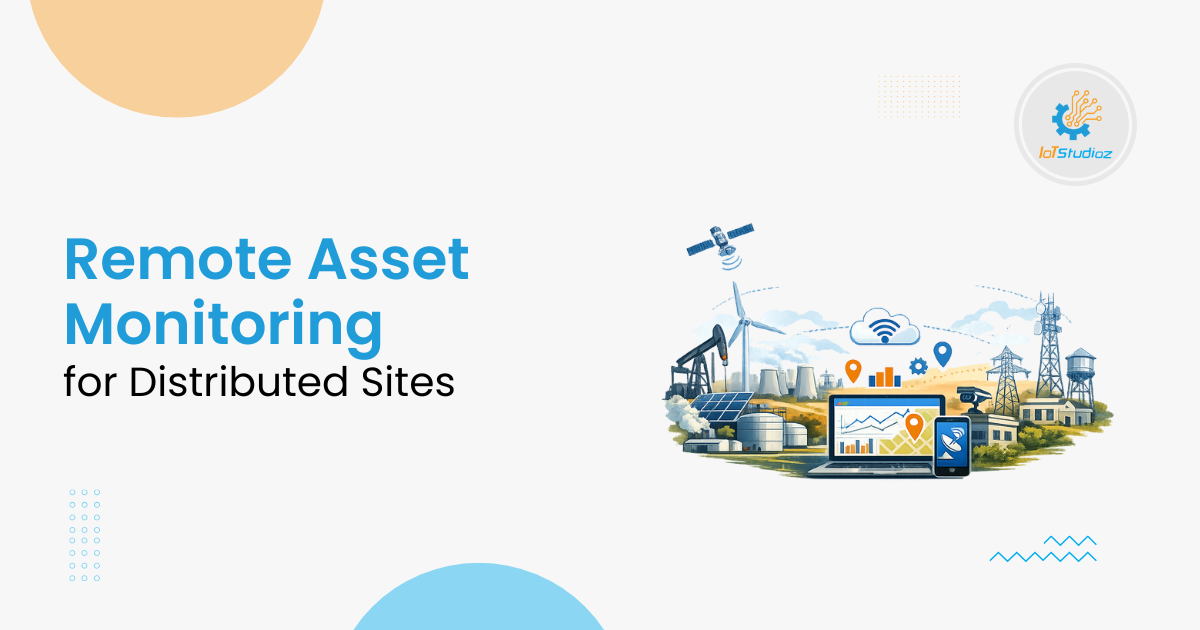
Remote Asset Monitoring for Distributed Sites
In modern industrial and commercial settings, monitoring assets across multiple locations has become essential. Remote asset monitoring goes beyond simple location tracking. It involves real-time condition checking, predictive alerts, and automated reporting so operators can manage distributed sites effectively.
Digital transformation and the rapid rise of the Industrial Internet of Things (IIoT) have made remote monitoring a standard practice, not a luxury. Global deployments of IoT devices surpassed 15 billion in 2023 and may reach nearly 30 billion by 2030. This growth highlights the need for robust systems to manage dispersed assets.
This blog explains how remote asset monitoring works, why it matters, and how key technologies such as IoT Gateway Solutions and Dual Sim Industrial Router systems enable reliable distributed site connectivity and data flow.
What is Remote Asset Monitoring?
Remote asset monitoring refers to collecting data from equipment, machinery, or infrastructure at distant or unmanned locations. Systems gather data on operational status, environmental conditions, and performance metrics. Data flows into centralized dashboards or analytics platforms for inspection and action.
Traditional monitoring required frequent site visits and manual checks. Remote monitoring replaces most of that work with automated sensing and networking. It increases uptime, improves safety, and cuts maintenance costs.
Why Remote Monitoring Matters
1. Productivity and Efficiency
Remote monitoring immediately reports issues from field sites. Operators no longer need a technician to visit a site to diagnose problems. In fact, remote troubleshooting resolves about 30% of issues without any physical visit.
This capability improves first‑time resolution rates and boosts operational efficiency. Downtime from equipment failures dropped by an average of 27% in several manufacturing plants after deploying remote monitoring analytics.
2. Extending Equipment Life
Continuous monitoring detects trends in performance. Instead of reactive maintenance, organizations shift to predictive maintenance. Predictive maintenance helps extend asset lifecycle and reduces unplanned stoppages. Many IIoT systems now include condition‑based monitoring to alert operators before a failure occurs.
Remote diagnostic tools can extend equipment life by up to 20%.
3. Operational Visibility
Remote monitoring consolidates data from all sites into one view. Operators see performance metrics, alerts, and trends on dashboards. This visibility leads to faster decision‑making, better capacity planning, and improved resource allocation.
Key Components of Remote Monitoring Systems
Remote asset monitoring systems have several layers and components:
1. Sensors and Edge Devices
Sensors capture physical states like temperature, vibration, pressure, and motion. These devices often communicate over industrial protocols such as Modbus, OPC UA, or MQTT. Sensors collect raw data, and edge devices preprocess it.
2. Connectivity Infrastructure
Connectivity is the backbone of any remote monitoring setup. Two key technology layers here are:
- IoT Gateway Solutions: Act as intermediaries collecting sensor data and routing it to cloud or central servers.
- Dual Sim Industrial Router: Provides robust network access with failover capability to ensure connectivity remains active even when one cellular network fails.
3. Data Transport and Storage
Collected data moves to analytics platforms through secure channels. It can go to cloud servers, private data centers, or hybrid environments depending on regulatory requirements.
4. Analytics and Visualization
Data must be processed to be useful. Predictive analytics, trending analysis, and anomaly detection give context to collected data. Visual dashboards help operators view performance trends and alerts.
IoT Gateway Solutions: The Technical Foundation
IoT Gateway Solutions form the core of remote monitoring networks. These gateways sit at the edge of a site’s network and serve several critical functions:
1. Protocol Translation
Industrial environments often use a mix of communication standards. IoT gateways can read data from legacy systems (such as PLCs and industrial sensors) and translate it into formats compatible with modern analytics platforms.
2. Local Preprocessing
Sending all raw data to the cloud is inefficient. Advanced gateways can preprocess data, filtering noise and performing edge analytics. This reduces bandwidth use and accelerates alert generation.
3. Security and Access Control
IoT gateways can encrypt data at the edge, authenticate devices, and enforce network segmentation. These functions lower the risk of threats reaching central systems.
4. Connectivity Support
Gateways support diverse network interfaces like Ethernet, Wi‑Fi, cellular, and LPWAN. Many gateways today embed 4G/5G modem support, helping sites where wired connectivity is unavailable.
5. Market Growth and Adoption
The global IoT gateway devices market was valued at over USD 5.1 billion in 2025 and is expected to grow significantly by 2031. Growth reflects continued investment in connectivity between physical devices and analytics platforms.
Industrial applications account for a major share of IoT gateway deployment. More than 40% of new industrial automation systems now rely on IoT gateways for real‑time data capture and processing.
Dual Sim Industrial Router: Ensuring Network Reliability
Remote monitoring systems depend on continuous connectivity. Sites in remote areas may not have stable broadband, Wi‑Fi, or wired networks. Here enters the Dual Sim Industrial Router.
1. What is a Dual Sim Industrial Router?
A dual sim industrial router is a ruggedized network device that supports two SIM cards from different mobile network operators. This setup ensures uninterrupted data connectivity. If one network fails, the router automatically switches to the second SIM network.
2. Why Dual SIM Matters
Remote sites often depend on cellular connectivity. Single network dependency can lead to data gaps using a single carrier. A dual SIM design ensures:
- Failover Support: Automatic switching if signal drops.
- Network Redundancy: Reduces the risk of lost data.
- Coverage Diversity: Operators with wider rural coverage can be paired with faster networks.
3. Industrial Grade Features
These routers typically offer:
- Robust metal housing and wide temperature tolerance.
- Support for protocols like VPN, NAT, and remote management.
- Multiple Ethernet ports and sometimes Wi‑Fi access points.
- Firewall and secure tunneling for secure data transport.
4. Example Applications
- Oil & Gas Pipelines: Constant monitoring of pressure and flow data.
- Wind Farms: Transmission of turbine performance metrics.
- Remote Solar Installations: Power output and weather monitoring.
Industrial routers reduce site visits and support remote configuration of connected sensors. They make remote monitoring reliable in areas where signal strength may fluctuate.
Use Cases Across Industries
Remote asset monitoring has wide applications in multiple sectors.
1. Energy and Utilities
Utilities use remote monitoring for grid fault detection, load balancing, and substations. Distributed renewable assets like solar and wind farms send performance and weather data back to control centers for analysis.
Energy markets have seen a 28% increase in remote asset monitoring adoption since 2022, driven by the need for real‑time visibility.
2. Manufacturing and Industrial Plants
Manufacturers gather machine health data to reduce unplanned downtime. Data from machines flows to central dashboards, helping predict failures and plan maintenance. About 80% of manufacturers consider remote monitoring essential for continuity.
3. Agriculture
Remote systems monitor soil moisture, temperature, and irrigation systems. These systems improve yields and reduce water waste.
4. Logistics and Fleet Management
Assets such as containers and vehicles send GPS and condition data. Companies use this information for better route planning, temperature control in cold chains, and theft detection.
More than 33% of logistics providers use IoT for real‑time fleet operation insights.
Benefits of Using IoT Gateways and Dual SIM Routers
1. Higher Uptime and Resilience
By combining IoT gateways with dual SIM routers, systems achieve high availability. Gateways collect data reliably, while routers ensure connectivity even under changing signal conditions.
2. Lower Operational Costs
Remote monitoring reduces travel time and labor costs. Remote diagnosis can reduce service response times by up to 50%.
3. Predictive Maintenance Capabilities
Early detection of anomalies helps technicians act before failures occur. Predictive maintenance enabled by remote analytics can improve maintenance productivity by up to 25%.
4. Enhanced Safety and Compliance
In hazardous environments such as oil rigs or chemical plants, remote monitoring reduces human presence and improves worker safety. Automated alerts also help enforce compliance with safety standards.
Implementation Considerations
1. Security Requirements
When data flows from remote sites to cloud or central systems, security is critical. Encryption, firewall policies, and secure authentication are essential features of IoT gateways and routers.
2. Scalability and Maintenance
Systems should scale as the number of sensors increases. Consider cloud‑native platforms that can onboard new devices with minimal configuration.
Conclusion
Remote asset monitoring transforms how businesses manage distributed locations. Solutions built on IoT Gateway Solutions and Dual Sim Industrial Router technologies provide resilient connectivity, real‑time data capture, and predictive insights.
Industry adoption continues to grow. The remote monitoring segment alone may exceed USD 218 billion by 2030 with a CAGR of about 20.6%.
With structured planning and technology selection, organizations can gain real visibility, reduce risks, and enhance operational efficiency across distributed environments.
FAQ
1. What is the difference between an IoT gateway and a standard router?
An IoT gateway is designed for industrial environments. It collects data from sensors, translates protocols, preprocesses data, and secures traffic before sending it to the cloud.
A standard router primarily focuses on connecting devices to the internet and does not handle protocol conversion, edge analytics, or industrial sensor data.
2. Why is a Dual Sim Industrial Router important for remote sites?
Remote sites often have unreliable cellular coverage. A dual SIM router ensures connectivity by switching between two network providers automatically. This prevents data loss, maintains uptime, and supports continuous monitoring of critical assets.
3. Can remote monitoring systems work in areas without internet?
Yes, but they require local processing and temporary storage. IoT gateways can store and preprocess data locally. Once connectivity is restored (via cellular, satellite, or wired network), the gateway uploads the collected data to the central system.
4. How does remote monitoring improve maintenance?
Remote monitoring enables predictive maintenance. Sensors detect equipment anomalies early. Operators receive alerts before failures occur, reducing downtime, maintenance costs, and extending equipment life. Studies show predictive monitoring can improve maintenance productivity by up to 25%.
5. What security measures are needed for remote monitoring?
Critical measures include:
- Data encryption during transmission
- VPN or secure tunneling between the site and central servers
- Device authentication for all connected sensors and gateways
Network segmentation to prevent unauthorized access
These measures ensure both the safety of sensitive data and the integrity of the monitoring system.