
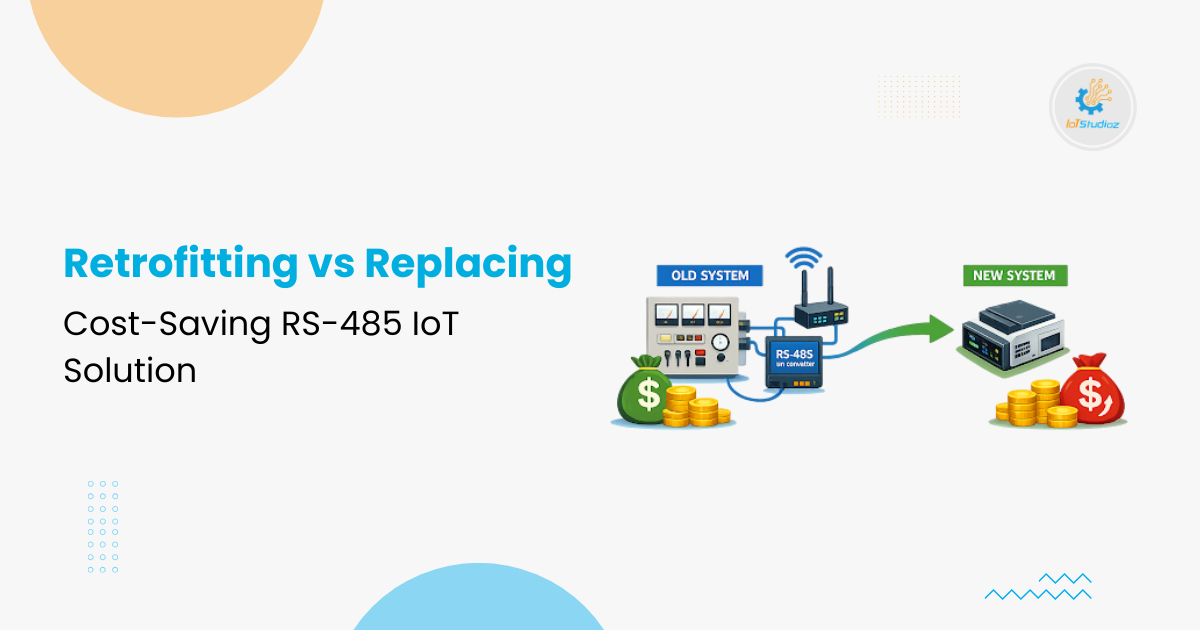
Retrofitting vs Replacing: Cost-Saving RS-485 IoT Solution
Industrial companies face pressure to modernize operations. They must improve visibility, efficiency, and sustainability. At the same time, they must control capital spending.
Global research shows that over 65% of industrial assets still operate in brownfield environments, where legacy equipment remains in use for decades (Source: McKinsey & Company – The Internet of Things: Catching up to an accelerating opportunity).
Studies also indicate that industrial IoT retrofit projects can reduce upgrade costs by up to 60% compared to full equipment replacement (Source: Deloitte – Connecting the physical world: IoT adoption in industrial operations).In addition, connected monitoring and predictive maintenance improve maintenance efficiency by 20–30% and reduce downtime significantly (Source: McKinsey & Company – Predictive maintenance: Transforming asset performance).
These numbers explain why many organizations now choose modernization through connectivity rather than replacement. The RS-485 Modbus Gateway plays a central role in this strategy. It connects legacy equipment to modern digital platforms without major redesign.
The Modernization Dilemma in Industrial Facilities
Factories depend on long-life machinery. Equipment often runs for 20 years or more. Digital technologies evolve much faster. This creates a gap between operational reliability and data visibility. Legacy systems often lack real-time monitoring, cloud connectivity, predictive maintenance insights, centralized analytics, and energy performance tracking. Replacing such machines can cost millions. Retrofitting provides a practical alternative.
What Is an Industrial IoT Retrofit?
An industrial IoT retrofit adds connectivity to existing equipment. Engineers install sensors, interface modules, and communication gateways while the machine itself remains unchanged. This approach supports brownfield IoT deployment and allows organizations to modernize without disrupting production. Typical retrofit data points include machine runtime, energy consumption, process temperature, equipment vibration, and fault signals.
The RS-485 Modbus Gateway gathers this information and forwards it to higher-level systems for monitoring and analysis.
What Does Equipment Replacement Mean?
Equipment replacement involves removing existing machinery and installing new, digitally enabled systems. This process is not limited to hardware changes. It requires procurement, engineering redesign, and full-scale commissioning.
While new equipment provides advanced capabilities, it introduces several challenges:
- High CAPEX: Massive upfront costs for new machinery.
- Extended Production Downtime: Long outages while removing legacy systems and commissioning new ones.
- Learning Curves: Heavy operator retraining for totally new interfaces.
- Testing Loops: Complex integration cycles to sync new gear with existing site workflows.
- Slow ROI: It takes much longer to see a return on investment compared to a quick fix.
For most plants, the operational risk exceeds acceptable thresholds to justify a full replacement strategy.
Why RS-485 Remains Relevant in Modern Industry
RS-485 continues to serve as a dependable communication standard in industrial environments. Many existing PLCs, sensors, drives, and field devices still rely on this protocol for daily operations. Its durability and simplicity have allowed it to remain in use even as newer communication technologies have emerged.
Several technical strengths support its continued relevance:
- It supports communication distances approaching 1200 meters when properly terminated and configured at suitable baud rates, making it suitable for large factory layouts.
- It offers strong resistance to electrical noise, which is common in industrial settings.
- It allows multiple devices to communicate on a single network, reducing wiring complexity.
- It uses a simple and cost-effective wiring infrastructure.
- It has proven reliability in harsh environments such as manufacturing plants, utilities, and processing facilities.
These characteristics make RS-485 a practical foundation for connecting legacy equipment to modern monitoring and control systems. Because Modbus is a simple register-based protocol, gateways or edge processing are often used to structure and contextualize the data for higher-level applications.
Role of the RS-485 Modbus Gateway in Digital Transformation
The RS-485 Modbus Gateway bridges serial industrial communication and modern IP networks. It converts Modbus RTU signals into protocols such as Modbus TCP or MQTT.
Core Functions
- Collects data from multiple field devices
- Performs Modbus RTU to TCP conversion
- Enables connectivity to edge systems, SCADA platforms, or cloud environments depending on architecture
- Allows centralized monitoring
- Supports industrial protocol integration
This device transforms isolated machines into connected assets.
Retrofitting vs Replacing: A Technical Comparison
The decision between retrofitting and replacing depends on measurable technical and financial factors.
| Factor | Retrofitting with RS-485 Modbus Gateway | Full Equipment Replacement |
| Cost | Low to moderate | Very high capital expense |
| Deployment Time | Days to weeks | Several months |
| Production Downtime | Minimal | Significant |
| Infrastructure Changes | Limited | Extensive redesign |
| ROI Timeline | Fast | Slow |
| Operational Risk | Low | High |
This comparison highlights why retrofit strategies dominate global modernization projects.
Financial and Operational Benefits of Retrofitting
Retrofitting reduces expenses by reusing existing assets while adding digital capabilities.
Key Advantages
- Lower upfront investment compared to full replacement
- Faster project approval and deployment timelines
- Minimal disruption to production operations
- Extended equipment lifecycle and improved utilization
- Reduced engineering and installation complexity
Beyond cost savings, retrofitting strengthens operational intelligence. Facilities gain real-time production visibility, data-driven maintenance planning, and improved resource management.
Retrofitting also supports sustainability initiatives. Connected RS-485 devices enable energy monitoring, helping organizations identify inefficiencies and reduce unnecessary consumption.
In addition, connected infrastructure creates a foundation for future technologies such as predictive analytics, remote diagnostics, and AI-driven optimization without requiring another major upgrade.
Architecture of a Connected Legacy System
A retrofit deployment follows a layered architecture.
1. Field Layer: Legacy machines communicate through RS-485 networks using Modbus RTU.
2. Connectivity Layer: The Modbus Gateway aggregates and converts device data.
3. Network Layer: Ethernet or cellular networks transmit data securely.
4. Application Layer: Cloud platforms provide dashboards, alerts, and analytics.
This structure supports gradual expansion without infrastructure replacement.
Example: Smart Manufacturing Retrofit
A global manufacturer operated stamping machines installed in 2010. The machines lacked digital monitoring but remained mechanically stable.
Challenge
- No visibility into energy usage
- Unexpected equipment failures
- Manual maintenance planning
Solution
Engineers deployed energy meters and I/O modules connected through RS-485. A centralized RS-485 Modbus Gateway transmitted data to a cloud dashboard.
Results
- Energy consumption dropped by 17%
- Maintenance shifted to condition-based schedules
- Downtime decreased significantly
- No machinery replacement required
This example demonstrates the value of connecting old machines to cloud systems.
When Replacement Is Still Necessary
Retrofitting cannot solve every challenge. Replacement becomes necessary when machines reach physical or regulatory limits.
Consider replacement when:
- Equipment suffers severe mechanical degradation
- Spare parts are unavailable
- Safety standards cannot be met
- Control systems cannot support integration
Most facilities, however, operate machines suitable for connectivity upgrades.
Challenges in Retrofitting Projects
Retrofitting requires careful planning and technical assessment. Common challenges include:
- Limited documentation of legacy equipment
- Modbus register mapping differences
- Integration with existing SCADA environments
Modern gateway solutions address these issues through flexible configuration and standardized communication support.
Scalability for Future Smart Factory Initiatives
Retrofitting with an RS-485 Modbus Gateway does not limit future expansion. It creates a foundation that supports gradual digital transformation. Organizations can begin with a few connected machines and expand the system over time.
This approach allows factories to scale without redesigning the entire infrastructure. Engineers can add new sensors, controllers, or analytics platforms as operational needs grow. The existing RS-485 network continues to function while new technologies integrate at the edge or cloud level.
Key scalability advantages include:
- Easy addition of new devices to the same communication bus
- Support for hybrid environments that combine legacy and modern equipment
- Compatibility with SCADA, MES, and cloud-based platforms
- Incremental investment instead of large one-time spending
- Reduced risk during expansion phases
A Modbus Gateway acts as the bridge between operational technology and digital systems. It ensures that older machines remain part of future smart factory strategies. This makes retrofitting a long-term solution, not a temporary fix.
Interoperability with Existing Industrial Systems
Retrofit solutions must function smoothly with existing automation platforms already running in the facility. The RS-485 Modbus Gateway integrates with SCADA platforms for visualization, MES systems for production tracking, and PLC environments that already use Modbus RTU communication. It also connects to cloud IoT platforms through protocol conversion, allowing operational data to move beyond the factory floor. This approach enables modernization without replacing control logic or redesigning established workflows, which reassures automation engineers and reduces implementation complexity.
Why Decision Makers Prefer Retrofitting
Executives evaluate modernization based on risk and return. Retrofitting aligns with both operational continuity and financial responsibility. It allows gradual investment, fast measurable outcomes, minimal disruption, and long-term scalability. This balance explains its strong global adoption. It also helps leadership validate results before expanding deployment. Budget planning becomes more predictable because upgrades occur in controlled phases.
Security Considerations in Retrofit Deployments
Retrofitting legacy gear bridges the gap between isolated “air-gapped” machines and the modern web, but it also opens up new attack vectors. You have to treat the OT (Operational Technology) side like a high-security vault to ensure connectivity doesn’t equal vulnerability.
The core of a secure rollout depends on Network Segmentation. By using VLANs or firewalls to create a “DMZ” between the factory floor and the corporate IT network, you prevent a breach in the office from reaching critical production assets.
Further hardening includes:
- Encrypted Uplinks: The Modbus Gateway should use MQTT over TLS or HTTPS to protect sensitive operational data during cloud transmission.
- Role-Based Access (RBAC): Restricting dashboard visibility and control commands to authorized personnel only.
- Protocol Proxying: Ensuring the gateway only allows “read” operations, blocking unauthorized external “write” commands to machine registers.
- Anomaly Monitoring: Tracking data patterns to catch unauthorized access or hardware tampering in real-time.
Conclusion
Industrial modernization does not always require replacing working machinery. Retrofitting offers a practical path to digital transformation. It connects proven equipment to modern analytics platforms while controlling cost and risk.
The RS-485 Modbus Gateway enables this transition by linking legacy communication networks with today’s connected infrastructure. Organizations gain visibility, efficiency, and scalability without halting operations.
As industries move toward smarter manufacturing, retrofit strategies provide a balanced approach. They preserve existing investments while building a strong digital foundation for the future.
Frequently Asked Questions
1. What is the difference between retrofitting and replacing industrial equipment?
Retrofitting adds connectivity to existing machines. Replacement installs entirely new equipment.
2. Can legacy machines connect to modern IoT systems?
Yes. An RS-485 Modbus Gateway enables data transmission to cloud or SCADA platforms.
3. Is Modbus still suitable for smart factories?
Yes. Modbus remains widely used due to reliability and compatibility with industrial devices.
4. How long does a retrofit project take?
Most installations take days or weeks, depending on system size.
5. Which industries benefit most from this approach?
Manufacturing, utilities, oil and gas, logistics, and water treatment see strong results.