
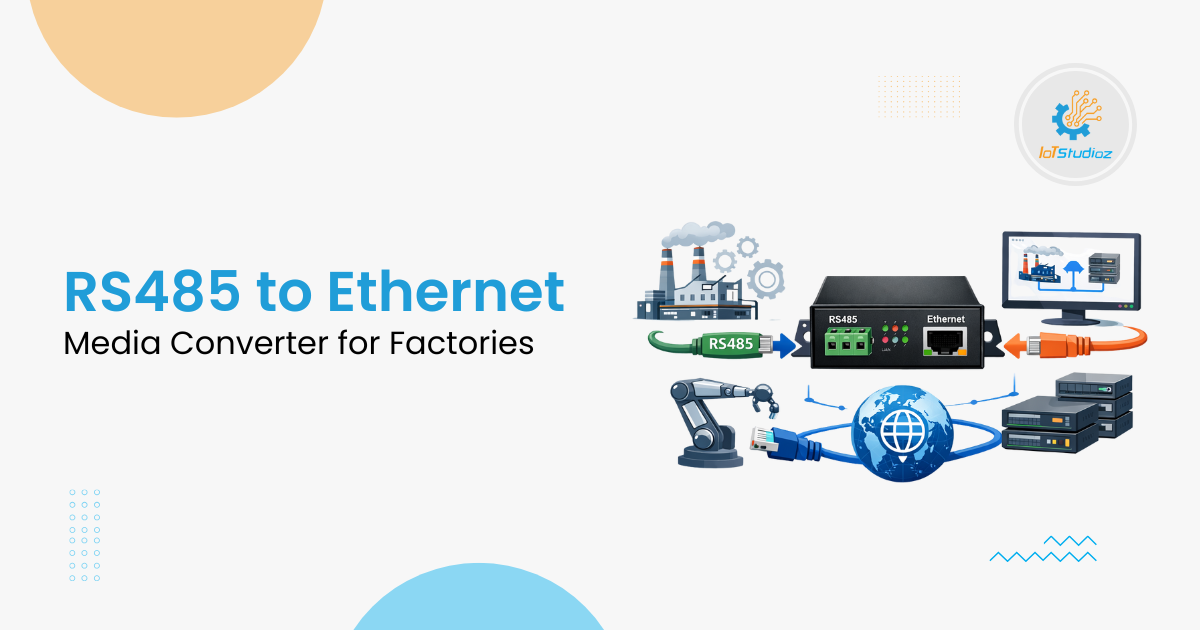
RS485 to Ethernet Media Converter for Factories
Modern factories depend on reliable data networks. Industrial automation, sensors, and control systems require clear paths for data. Many industrial devices use RS485 communication. Yet, factory networks now use Ethernet. Here, the RS485 to Ethernet Media Converter becomes critical. It bridges legacy industrial systems and modern network infrastructures. This article explains how these converters work, their benefits, applications, design needs, challenges, and best practices.
We will use clear technical language, real-world examples, and factual support. The aim is to equip engineers, plant managers, and automation technicians with solid knowledge.
What is RS485 Communication?
RS485 is a standard for serial communication. It supports half-duplex data transmission over long distances. It uses differential signals on twisted pair cabling.
Key facts about RS485:
- It supports speeds up to 10 Mbps at short distances and lower at long range.
- It can reach up to 1,200 meters (4,000 feet) at 100 kbps.
- It allows up to 32 devices on one bus without repeaters.
This standard fits factory environments where sensors, motor controllers, and PLCs need simple, robust links.
What is Ethernet in Industrial Networks?
Ethernet is a family of wired networking technologies. In factories, Ethernet supports high-speed data across many devices. Industrial Ethernet variants like PROFINET, EtherNet/IP, and Modbus TCP add real-time control features.
Ethernet brings these advantages:
- Data rates up to 1 Gbps or more.
- Standardized protocols and network management tools.
- Support for TCP/IP, UDP, and other network layers.
Ethernet allows central servers, cloud data flows, and advanced machine monitoring.
Why Bridges are Needed: RS485 to Ethernet
RS485 and Ethernet use different physical layers and protocols. A direct cable link won’t let them communicate. The RS485 to Ethernet Media Converter maps data from one domain to the other. It accepts RS485 signals and outputs Ethernet frames. The converter then reverses the process.
Example Scenario
A factory has 200 temperature sensors on RS485 buses. A central SCADA server runs on Ethernet. Without a converter, the server cannot read the RS485 sensors directly. With a media converter, the server polls sensors over Ethernet. The converter fetches RS485 data and presents it in Ethernet format.
What is an RS485 to Ethernet Media Converter
An RS485 to Ethernet Media Converter is a device. It has at least one RS485 port and one Ethernet port. It performs these core functions:
- Physical signal translation.
- Protocol conversion.
- Traffic management and buffering.
It operates at layer 1 and layer 2 of the OSI model. Some advanced models also support layer 3 functions like static routing.
Core Components
Typical components inside a converter include:
- RS485 transceivers with fail-safe features.
- Ethernet MAC and PHY chips.
- A microcontroller or FPGA for data handling.
- Memory buffers to store packets.
- Power supply circuits with surge protection.
How the Converter Works
The converter continuously reads data from the RS485 bus. It packages this data into Ethernet frames. It may use protocols such as Modbus TCP for compatibility. The reverse also happens. Ethernet data is unpacked and sent as serial bits on RS485.
Frame Translation Process
- RS485 frame enters the converter.
- The converter checks the checksum and address.
- It wraps the data into an Ethernet payload.
- The device sets appropriate headers for TCP/IP or UDP.
- It sends the frame to the Ethernet switch or server.
This process happens in milliseconds. Modern converters manage thousands of frames per second.
Benefits in Factory Installations
RS485 to Ethernet converters bring measurable benefits:
1. Extend Legacy Systems
Many factories still operate equipment 10–20+ years old. These devices use RS485. Replacing all gear with Ethernet-only units costs millions. Converters let plants keep legacy sensors online while modernizing networks.
2. Increase Data Visibility
Ethernet provides a unified view of plant data. Central systems can monitor all field devices. One report by IDC found that 67% of manufacturers cite real-time data access as a top priority in 2025. This means converters play a role in data access goals.
3. Support Network Topology Growth
Factories grow over time. Adding Ethernet switches and VLANs is easier than extending RS485 buses. Ethernet supports large star and ring topologies. RS485 buses require careful planning to avoid signal loss.
4. Improve Remote Access
Ethernet links connect to VPNs and secure remote systems. Maintenance teams can access device data without being on the factory floor. This reduces downtime and travel costs.
Typical Industrial Use Cases
1. Machine Control
Many CNC machines and robotic cells use RS485 for local control. A converter lets these cells report status to a central MES (Manufacturing Execution System).
2. Environmental Monitoring
Temperature, humidity, and vibration sensors often use RS485. Converters help bring sensor data into SCADA or Industrial IoT platforms.
3. Energy Management
Energy meters connected via RS485 feed data to a building management system. The converter enables the system to log and analyze usage trends.
4. Conveyor and Material Handling
Conveyor controllers use RS485 for speed and position data. Ethernet integration allows centralized sequencing and tracking across shifts.
Design Considerations
Selecting a converter requires careful analysis. Here are key factors to evaluate.
1. Supported Protocols
Not all converters handle the same protocols. Many standard devices support raw TCP/UDP translation. Others include built-in support for Modbus RTU to Modbus TCP. Choose based on system needs.
2. Data Rate and Latency
Ensure the converter can manage required throughput. In high-speed applications, latency must remain low. For example, motion control loops may require sub-10 ms response times.
3. Network Security
Converters on Ethernet must support security features. Options include:
- VLAN tagging
- IEEE 802.1X authentication
- Firewall rules
- TLS encryption
Security is essential when converters face public networks or remote access.
4. Environmental Ratings
Factories expose devices to heat, dust, vibration, and electrical noise. Look for:
- IP ratings (e.g., IP30, IP40)
- Operating temperature ranges (e.g., −40°C to 75°C)
- Compliance with EN 61000-6-2/4 for EMC immunity
5. Redundancy
Critical systems benefit from redundant converters or paths. Some converters support parallel links and failover modes.
6. Power Supply
Industrial power systems vary. Choose converters that accept wide input ranges (9–36 VDC or 24–48 VDC). Also consider power protection and isolation.
Installation Best Practices
Good installation improves reliability and performance. Here are practices technicians should follow.
1. Grounding and Shielding
RS485 signals are differential but still require proper grounding and cable shielding. Poor grounding can lead to noise and data corruption.
2. Termination Resistors
RS485 buses need end-of-line termination resistors to avoid reflections. Place resistors only at bus ends.
3. Cable Selection
Use twisted-pair cables with the right impedance (typically 120 ohm) for RS485. For Ethernet, use Cat5e or better.
4. Network Segmentation
Keep industrial traffic separate from office networks using VLANs or separate physical networks. This prevents broadcast storms and limits cybersecurity exposure.
5. Clock Synchronization
When precise timestamps matter, use network time protocols such as NTP or PTP. Some converters include time synchronization support.
Performance Challenges
Converters bring benefits but also challenges.
1. Protocol Mismatch
Some RS485 devices use custom protocols. Standard converters may not interpret them correctly. In such cases, protocol gateways or custom firmware may be needed.
2. Buffer Overflows
High traffic can trigger buffer overflows. This can cause dropped packets. Monitor traffic and choose devices with sufficient memory.
3. Addressing Conflicts
RS485 uses simple addressing. Ethernet uses IP addresses. Misconfiguration can cause address conflicts or routing issues.
4. Latency in Real-Time Systems
For time-critical systems, latency matters. Ethernet adds packet overhead and collision domains. Use quality of service (QoS) and real-time Ethernet standards if required.
Comparison with Other Solutions
It helps to compare media converters with alternative approaches.
1. RS485 to Ethernet Converter vs Protocol Gateway
A protocol gateway understands and translates specific application protocols. A media converter simply passes data between layers. If protocol translation is required, choose a gateway.
2. RS485 to Ethernet Converter vs Native Ethernet Devices
Replacing RS485 devices with native Ethernet devices removes conversion needs. But this often costs more upfront and risks downtime during retrofit.
Case Example: Automotive Factory
At an automotive plant in Europe, hundreds of PLCs communicated over RS485. The plant decided to implement a centralized quality system. Engineers installed RS485 to Ethernet converters at key junctions. These converters fed data to MES via Modbus TCP.
As a result:
- Data collection delays decreased by 40%.
- Production line anomaly detection improved.
- Maintenance teams saved 30% of manual reporting time.
This case shows how converters support data-driven improvements without replacing existing field assets.
Safety and Compliance
Factories must meet safety and regulatory standards. Converters should comply with:
- CE marking for EMC and safety.
- UL certification for components.
- RoHS for material safety.
Proper documentation and labeling help audits and maintenance.
Future Trends
Factories move toward digital operations. Standard Ethernet and IP-based communication remains central. Trends affecting converters include:
1. Industrial IoT Integration
More devices connect to cloud systems. Converters may include MQTT or REST interfaces to support IoT platforms.
2. Edge Computing
Edge devices perform data processing close to machines. Converters may integrate edge compute to filter or preprocess RS485 data.
3. Time-Sensitive Networking (TSN)
TSN adds deterministic features to Ethernet. Future converters might support TSN to improve real-time performance.
Selecting the Right Converter
To choose a converter, follow these steps:
- Define Network Requirements: Determine data rates, number of RS485 devices, and network topology.
- List Protocol Needs: Identify application protocols like Modbus RTU and Modbus TCP.
- Check Environmental Conditions: Assess temperature, vibration, and contamination at installation points.
- Review Security Needs: Plan for secure access and network isolation.
- Test Before Deployment: Perform lab tests with real devices to verify performance.
This selection process avoids guesswork and mitigates risk.
Conclusion
The RS485 to Ethernet Media Converter plays a vital role in modern factories. It bridges legacy field devices and current network standards. Proper use improves data flow, system visibility, and network scalability.
Converters must be selected with clear technical criteria. They must support needed protocols, withstand harsh conditions, and fit network security plans. When installed and maintained correctly, these converters deliver reliable and high-speed communication.
Industry statistics show the growing demand for real-time data and network convergence. As factories evolve, converters will remain a key component of industrial communication systems.