
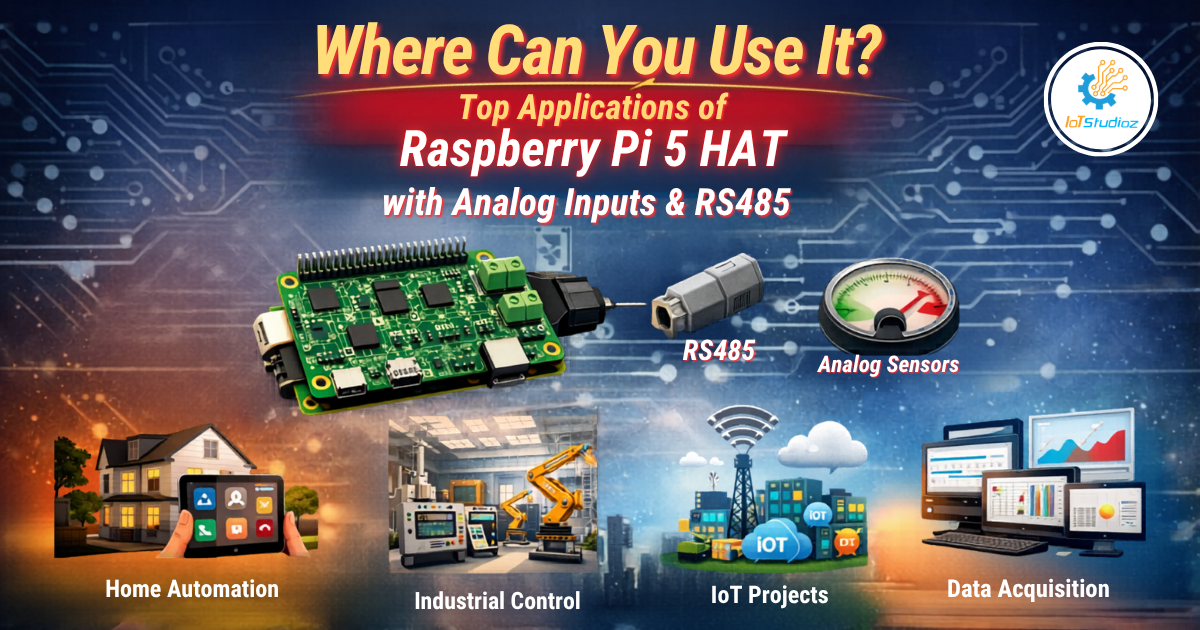
Where Can You Use It? Top Applications of Raspberry Pi 5 HAT with Analog Inputs & RS485 Leave a comment
As industries rapidly move toward automation and data-driven decision-making, the need to connect field devices with modern computing systems has never been greater. A Raspberry Pi 5 HAT with 8 Analog Inputs (4–20mA) and dual RS485 ports is designed exactly for this purpose—bridging the gap between industrial sensors, legacy equipment, and modern IoT platforms.
But the real question is: where can you actually use it in the real world?
Let’s explore the most impactful applications in detail.
Understanding the Value of This HAT
Before diving into applications, it’s important to understand why this hardware is so powerful in industrial environments:
- 4–20mA Analog Inputs (8 Channels): The 4–20mA current loop is the industry standard for transmitting sensor data because it is highly resistant to electrical noise and signal loss, even over long distances.
- Dual RS485 Ports: RS485 enables robust, long-distance, multi-device communication, making it ideal for connecting PLCs, energy meters, and industrial controllers.
- Raspberry Pi 5 Processing Power: With improved CPU and memory, the Raspberry Pi 5 allows real-time data processing, edge computing, and cloud integration—all on a compact platform.
Together, these features make this HAT a complete industrial interface solution.
1. Industrial Automation & Process Control
Industrial automation is one of the most critical applications of this HAT.
How It Works:
- Sensors (pressure, temperature, flow) send signals via 4–20mA inputs
- Machines and controllers communicate via RS485 (Modbus RTU, etc.)
- Raspberry Pi processes the data and takes action or logs it
Real-World Scenario:
In a manufacturing plant, this setup can:
- Monitor machine parameters in real time
- Detect anomalies (e.g., overheating or pressure spikes)
- Trigger alerts or automated shutdowns
Why It Matters:
It reduces downtime, improves safety, and increases operational efficiency—without requiring expensive industrial PCs.
2. IoT Gateway for Smart Systems
This HAT transforms Raspberry Pi 5 into a powerful IoT gateway capable of connecting field devices to the cloud.
Key Functions:
- Data aggregation from multiple sensors
- Protocol conversion (RS485 → MQTT/HTTP)
- Edge-level filtering and preprocessing
Example Use Case:
A smart factory can:
- Collect data from legacy machines using RS485
- Convert it into cloud-friendly formats
- Send it to platforms like AWS, Azure, or private dashboards
Benefit:
You get real-time visibility and analytics without replacing existing infrastructure.
3. Water & Wastewater Management
Water systems rely heavily on accurate and continuous monitoring, making this HAT an ideal fit.
Applications:
- Tank level monitoring
- Flow rate measurement
- Chemical dosing control
- pH and turbidity analysis
Practical Implementation:
Sensors installed across pipelines and tanks send data to the Raspberry Pi via 4–20mA. The system:
- Logs and analyzes data
- Sends alerts in case of leaks or contamination
- Enables remote monitoring
Why It’s Effective:
The noise immunity of 4–20mA signals ensures accurate readings even in electrically noisy environments like pumping stations.
4. Energy Monitoring & Smart Grid Systems
Energy management is essential for cost control and sustainability.
Use Cases:
- Monitoring voltage, current, and power consumption
- Integrating with smart meters via RS485
- Tracking energy usage across multiple units
Example:
In a commercial building:
- RS485 connects energy meters
- Analog inputs capture additional sensor data
- Raspberry Pi provides dashboards and analytics
Outcome:
Organizations can:
- Identify inefficiencies
- Optimize power usage
- Reduce electricity bills
5. Smart Agriculture & Precision Farming
Agriculture is becoming increasingly data-driven, and this HAT plays a crucial role.
What It Enables:
- Soil moisture and nutrient monitoring
- Irrigation automation
- Environmental condition tracking
Real-World Use:
Farmers can deploy sensors across fields that:
- Send moisture and nutrient data via 4–20mA
- Use RS485 for long-distance communication
- Automatically trigger irrigation systems
Impact:
- Improved crop yield
- Reduced water usage
- Smarter farming decisions
6. Building Automation Systems (BMS)
Smart buildings rely on integrated systems for efficiency and comfort.
Applications:
- HVAC monitoring and control
- Indoor air quality sensing
- Lighting automation
System Workflow:
- Sensors send environmental data
- RS485 connects controllers and actuators
- Raspberry Pi centralizes control and analytics
Benefit:
Better energy efficiency, improved occupant comfort, and reduced operational costs.
7. Remote Monitoring in Harsh Environments
Industries such as oil & gas, mining, and marine operate in extreme conditions.
Challenges:
- Long-distance communication
- High electrical noise
- Limited connectivity
How This HAT Helps:
- 4–20mA ensures stable sensor readings
- RS485 supports long cable runs
- Raspberry Pi enables local processing without constant cloud access
Example:
Monitoring offshore equipment where reliability is critical and connectivity is intermittent.
8. Edge Computing & Predictive Maintenance
With Raspberry Pi 5, this HAT becomes a powerful edge computing device.
Capabilities:
- Real-time data processing
- Running machine learning models locally
- Detecting anomalies and predicting failures
Example:
In a factory:
- Sensors track vibration and temperature
- Data is analyzed locally
- System predicts equipment failure before it occurs
Result:
Reduced maintenance costs and minimized downtime.
9. Legacy System Integration
Many industries still rely on legacy systems that use analog signals and RS485 communication.
The Challenge:
These systems are not directly compatible with modern cloud platforms.
The Solution:
- Use 4–20mA inputs to capture analog data
- Use RS485 to communicate with legacy controllers
- Convert data into modern protocols
Benefit:
You modernize your system without replacing existing infrastructure, saving significant costs.
10. Data Logging & Custom SCADA Systems
This HAT is ideal for building custom monitoring and control systems.
Features:
- Local data storage
- Real-time dashboards
- Integration with SCADA software
Example:
A small manufacturing unit can:
- Build a low-cost SCADA system
- Monitor all machines from a single interface
- Store historical data for analysis
Advantage:
A highly cost-effective alternative to traditional SCADA solutions.
Conclusion
The Raspberry Pi 5 HAT with 8 Analog Inputs and RS485 ports is not just a hardware accessory – it’s a complete industrial solution enabler.
It empowers businesses to:
- Collect accurate sensor data
- Communicate reliably across long distances
- Process data locally with edge intelligence
- Integrate seamlessly with cloud platforms
Whether you’re building a smart factory, an energy monitoring system, or an IoT gateway, this HAT provides the flexibility and power needed to bring your ideas to life.
FAQs
1. What makes 4–20mA better than voltage signals?
It is more noise-resistant and reliable over long distances, making it ideal for industrial environments.
2. Can I connect multiple RS485 devices at once?
Yes, RS485 supports multi-drop communication, allowing multiple devices on the same bus.
3. Is Raspberry Pi 5 powerful enough for industrial use?
Yes, especially for edge computing, data logging, and IoT gateway applications.
4. Do I need additional hardware for cloud integration?
No, Raspberry Pi 5 can directly connect to the internet via Ethernet or Wi-Fi.
5. Is this suitable for startups and small industries?
Absolutely. It provides a low-cost yet powerful alternative to traditional industrial systems.