
Why Daisy-Chain Is Still the Best: Optimizing RS-485 Bus Topology in Gateway-Driven IoT Systems Leave a comment
In the evolving world of IoT (Internet of Things), reliable and efficient communication between devices remains a critical challenge. When it comes to industrial IoT gateways and sensor networks, the RS-485 bus topology remains popular — especially the daisy-chain configuration. Despite newer networking methods, the daisy-chain topology continues to stand out for its simplicity, cost-effectiveness, and robustness. This blog explores why the daisy-chain RS-485 topology is still the best choice for gateway-driven IoT systems and how to optimize it for maximum performance.
- The RS-485 transceiver IC market reached $500 million in 2025, projecting a 7% CAGR through 2033, driven by daisy-chain topologies in industrial IoT gateways.
- Isolated RS-485 transceivers hit $500 million in 2024, with an 8.5% CAGR forecast to 2033, supporting noise-immune bus networks in Industry 4.0.
- Global connected IoT devices near 21.1 billion in 2025 (14% YoY growth), where RS-485 daisy-chain enables reliable multi-drop communication for manufacturing and infrastructure.
What is RS-485 and Why Is It Important in IoT?
RS-485 is a long-standing communication standard designed for serial data transmission. It allows multiple devices (up to 32 or even more with additional hardware) to communicate on the same bus over distances up to 1200 meters. In IoT, RS-485 acts as a backbone for sensor networks, industrial controllers, and gateways, providing:
- Noise immunity: Differential signaling reduces interference, crucial for industrial environments.
- Long distance communication: RS-485 supports longer wiring runs without losing signal quality.
- Multi-drop capability: Multiple devices can connect on the same bus, enabling scalability.
What is Daisy-Chain Topology?
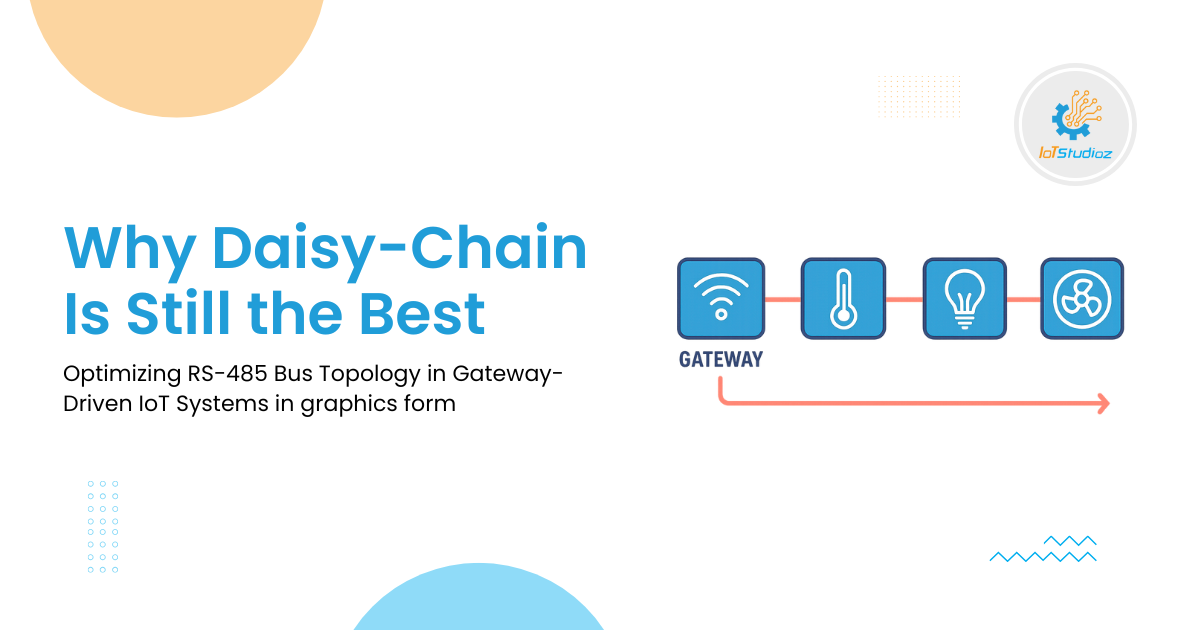
A daisy-chain topology connects devices sequentially in series – one device connected to the next in a linear chain. For RS-485 networks, this means the signal travels from the master device (usually a gateway) along a single cable that passes through every slave device.
Why Daisy-Chain Topology Still Reigns Supreme
Even with advances in network topologies, the daisy-chain remains the preferred RS-485 wiring technique due to several key reasons:
1. Simplicity and Ease of Installation
- Daisy-chain wiring is straightforward; cables run device-to-device without complex branching.
- Installation errors and troubleshooting are easier compared to star or bus topologies with multiple branches.
- It reduces the amount of cabling required, lowering material and labor costs.
2. Signal Integrity and Reduced Reflections
- RS-485 communication requires termination resistors at the ends of the bus line to avoid reflections.
- Daisy-chain topology ensures a single, continuous cable run with termination at both ends, maintaining signal clarity.
- Avoiding stubs and branches prevents unwanted signal echoes common in star topologies.
3. Reliability in Industrial Environments
- Fewer cable branches reduce the risk of wiring faults.
- Easier to isolate and maintain devices individually, improving uptime.
- Physical layout can match typical industrial sensor deployments along a production line or corridor.
4. Cost-Effectiveness
- Minimizes the need for additional network switches or repeaters.
- Less cabling and fewer connectors translate directly into lower hardware costs.
- Easier maintenance lowers ongoing operational expenses.
Optimizing Daisy-Chain for Gateway-Driven IoT Systems
To get the most out of your RS-485 daisy-chain topology in gateway-driven IoT setups, consider these optimization strategies:
1. Proper Termination and Biasing
- Always place 120-ohm termination resistors at both ends of the RS-485 bus to minimize reflections.
- Use bias resistors if your system experiences idle line issues to maintain a stable logic level.
2. Cable Selection and Length Management
- Use twisted pair shielded cables designed for RS-485 to enhance noise immunity.
- Keep stub cables as short as possible (ideally under 30 cm) to avoid signal distortion.
- Limit total bus length within RS-485 specifications (up to 1200 meters).
3. Device Addressing and Communication Protocols
- Assign unique device addresses to avoid communication conflicts.
- Implement robust communication protocols with error checking and retry mechanisms to handle noisy environments.
4. Gateway Configuration and Monitoring
- Ensure the gateway supports multi-drop RS-485 communication and can handle the number of connected devices.
- Use gateways with diagnostic capabilities to monitor line status and detect faults early.
Tips for Optimizing Daisy-Chain RS-485 Networks in IoT
While the fundamental benefits of daisy-chain RS-485 topology are clear, optimizing these networks involves several nuanced considerations, especially as IoT ecosystems grow more complex.
1. Implementing Repeaters for Extended Networks
For IoT systems requiring connection beyond the 1200-meter limit, RS-485 repeaters can regenerate signals and boost communication range. Strategically place repeaters to maintain signal integrity without introducing excessive latency or complexity.
2. Ensuring Electrical Isolation for Enhanced Stability
Industrial environments often expose IoT devices to voltage spikes and ground loops. Integrating galvanic isolation modules or isolated RS-485 transceivers helps protect sensitive devices and prevents communication errors caused by electrical noise.
3. Leveraging Software Tools for Network Diagnostics
Modern gateways and network controllers often include software utilities to monitor RS-485 bus health. Using these tools, engineers can quickly detect line faults, measure signal strengths, and even perform remote device resets – key for minimizing downtime.
4. Designing for Future Scalability
Plan your daisy-chain architecture with spare capacity in mind. Leave physical room and address space for additional devices, use modular connectors, and keep network documentation updated to simplify future upgrades or expansions.
Integrating Daisy-Chain Topology with IoT Gateways: Best Practices
IoT gateways are the bridge between field devices and cloud or local control systems. Proper integration ensures that RS-485 daisy-chain networks perform optimally within larger IoT frameworks:
- Protocol compatibility: Verify that gateway firmware supports protocols commonly used over RS-485, such as Modbus RTU, PROFIBUS, or custom protocols.
- Data aggregation and filtering: Use gateway capabilities to preprocess data, reducing bandwidth usage and improving system responsiveness.
- Security considerations: Implement encryption and authentication at the gateway to protect RS-485 network data in transit.
The Future of Daisy-Chain RS-485 in Gateway-Driven IoT Systems
As IoT technologies rapidly advance, the fundamental principles of daisy-chain RS-485 topology remain strong, but new developments will further enhance its role in the future.
1. Integration with Smart and Autonomous Gateways
Future IoT gateways will become smarter by integrating advanced AI-driven diagnostics and adaptive signal conditioning directly on the RS-485 bus. These gateways will automatically detect and resolve communication issues, optimize data flow, and enable predictive maintenance—reducing human intervention and downtime.
2. Enhanced Security Protocols for Industrial IoT
Security will be paramount as RS-485 networks connect critical infrastructure. Future implementations will adopt stronger encryption protocols and hardware-based authentication at the physical layer, ensuring data integrity even in distributed daisy-chain networks.
3. Hybrid Topologies Combining Wired and Wireless
While wired daisy-chain configurations provide reliability, future IoT systems will increasingly blend wired RS-485 links with low-power wireless mesh networks. This hybrid approach combines the robustness of wired buses with the flexibility of wireless, enabling dynamic, scalable IoT deployments.
4. Increased Scalability with Modular Expansion Units
IoT devices and gateways will feature plug-and-play modular RS-485 expansion units that allow seamless network growth without redesigning the entire bus. These units will simplify adding sensors or actuators in complex industrial environments.
5. Improved Materials and Cable Technologies
Next-generation shielding and conductor materials will enhance noise immunity and cable lifespan in harsh environments. Innovations such as fiber-optic RS-485 converters may extend bus length and immunity beyond current limits.
Conclusion
Daisy-chain topology for RS-485 remains a highly effective, reliable, and cost-efficient choice for gateway-driven IoT systems. Its simplicity and inherent strengths in maintaining signal integrity make it indispensable for industrial IoT deployments. By following best practices in wiring, termination, and device management, IoT developers can build scalable, robust sensor networks that stand the test of time.
At IoTStudioz, we specialize in optimizing IoT communication architectures. If you are planning to design or enhance your RS-485 based systems, partnering with experts can ensure seamless integration and maximum performance across your IoT deployment.
FAQ’s
1. Why is termination important in RS-485 daisy-chain networks?
Termination resistors match the cable impedance at both ends of the bus, preventing signal reflections that cause data corruption and communication errors.
2. Can I use a star topology instead of daisy-chain for RS-485 networks?
While possible, star topology can introduce stubs – short branches off the main line – that create signal reflections and noise. Daisy-chain wiring minimizes these issues and is generally more reliable for RS-485.
3. How many devices can I connect to an RS-485 daisy-chain?
Standard RS-485 supports up to 32 devices per segment. Using RS-485 repeaters or specialized transceivers can increase this number for larger networks.
4. What type of cable is best suited for RS-485 daisy-chain networks?
Twisted pair cables, preferably shielded and with low capacitance, provide the best noise immunity and signal integrity for RS-485 communication.
5. How do I troubleshoot communication problems in a daisy-chain RS-485 setup?
Start by checking termination resistors, ensuring proper device addresses, minimizing stub lengths, verifying cable integrity, and using diagnostic tools in IoT gateways to identify faults on the bus.