
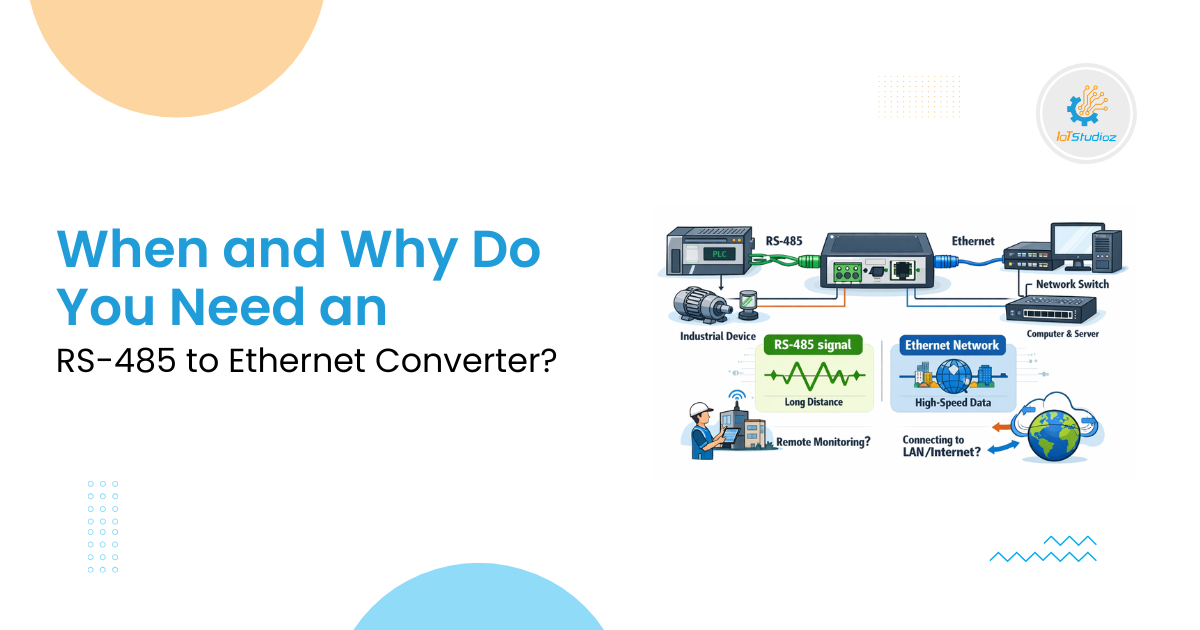
When and Why Do You Need an RS-485 to Ethernet Converter?
In industrial automation, communications standards play a crucial role in system performance and data visibility. RS-485 has long been a preferred serial standard for industrial control networks. However, modern systems increasingly depend on Ethernet and TCP/IP connectivity. An RS-485 to Ethernet Converter bridges this gap, allowing legacy serial devices to communicate over IP networks.
In this article, we explain when and why you need an RS-485 to Ethernet converter. We cover technical details, real industry uses, practical examples, and key statistics that support informed decisions in automation environments.
What Is RS-485 and Why It Matters in Industry
RS-485 is a differential serial communications standard that uses twisted-pair wiring to send signals. Its differential design improves resistance to electrical noise, making it ideal for industrial environments with heavy machinery. RS-485 supports communication distances up to 1,200 meters (about 4,000 feet) and speeds up to around 10 Mbps, depending on cable quality and length. It also supports multi-drop networks with many devices on a single bus.
This combination of noise immunity, long reach, and multi-device support explains why RS-485 still appears in PLCs, sensors, energy meters, and machine controllers. Despite newer technologies, much industrial infrastructure continues to rely on RS-485 interfaces.
What Is an RS-485 to Ethernet Converter?
An RS-485 to Ethernet Converter is a hardware interface that connects RS-485 serial networks to Ethernet-based IP networks. The converter translates serial data into TCP/IP or UDP packets. It then sends those packets over a local area network (LAN), wide area network (WAN), or even the internet. Similarly, it converts incoming Ethernet packets back into RS-485 signals for serial devices.
These devices may also be called serial-to-Ethernet converters, serial device servers, or Modbus gateways, especially when performing protocol mapping between Modbus RTU and Modbus TCP.
When You Need an RS-485 to Ethernet Converter
Industrial engineers and system architects typically consider converters in several specific scenarios:
1. Integrating Legacy Devices Into Modern Networks
Many machines and controllers were designed before Ethernet became standard. They communicate exclusively over RS-485 serial links. If your control systems, sensors, or PLCs use RS-485, you cannot directly connect them to Ethernet networks.
In such cases, an RS-485 to Ethernet converter for industrial automation provides a cost-effective way to integrate these devices without replacing legacy hardware.
Example: A production line uses RS-485 sensors for temperature monitoring. Using converters, these sensors can feed data into a SCADA server over Ethernet.
2. Centralized Monitoring and Control
Ethernet networks support centralized monitoring systems and supervisory control and data acquisition (SCADA) applications. When devices are scattered across a plant floor, RS-485 alone cannot connect them easily to a centralized dashboard.
An RS-485 to Ethernet converter enables all data to flow into one central network. This helps operators monitor device status, alarms, or performance from a single location.
Statistic: Industrial sites using RS-485 to Ethernet solutions report reductions in manual data collection time by up to 60%.
3. Remote Access Over IP Networks
Ethernet connectivity allows remote access from control rooms, headquarters, or cloud platforms. If you have geographically dispersed sites, Ethernet enables remote data acquisition and control without physical presence.
Without the converter, RS-485 devices are limited to local connections that require direct interfaces, such as serial ports. A converter helps extend reach using TCP/IP networks.
4. Scaling Networks Beyond Serial Limits
RS-485’s technical limits include support for only a set number of devices per bus (typically up to 32), and distance constraints. Ethernet networks scale more easily, with switches and routers extending reach and device counts into the hundreds or thousands.
Using an RS-485 to Ethernet converter for industrial automation lets you add devices across multiple sites without re-wiring each segment. Ethernet bandwidth also supports faster data rates, enabling real-time analytics.
5. Cloud and IIoT Connectivity
The Industrial Internet of Things (IIoT) and cloud platforms require IP-based data delivery. Legacy industrial sensors cannot natively speak IP protocols. A converter provides this missing link, enabling data to flow from legacy devices into IoT gateways, cloud services, and analytics systems.
Why You Should Use an RS-485 to Ethernet Converter
Below are key technical and operational benefits that explain why converters are essential in many industrial environments.
1. Integrate Without Replacing Hardware
Replacing decades of serial-based machinery can cost millions. Converters offer a lower-cost alternative. They integrate existing RS-485 devices into modern network architecture, preserving valuable hardware investments.
2. Centralized Data Access
With Ethernet connectivity, RS-485 device data can be aggregated and routed to SCADA, HMI (Human-Machine Interface), or enterprise systems. This supports real-time decision-making and performance dashboards.
3. Extended Communication Range
While RS-485 reaches about 1,200 meters, Ethernet networks can span vast distances using routers, fiber optics, and VPNs. This enables central systems to talk to remote field devices located kilometres apart.
4. Proven Reliability
Industrial RS-485 to Ethernet converters are built for tough conditions. Many support wide temperature ranges (typically −40°C to +85°C) and provide isolation against electrical noise.
Example: Devices designed for factory automation or energy management frequently include DIN-rail mounting and robust electrical protections.
5. Support for Standard Protocols
Converters may support protocol translations. The most common case is converting Modbus RTU over RS-485 to Modbus TCP over Ethernet. Some models also support transparent serial tunneling or MQTT for IIoT applications.
6. Faster Diagnostics and Reduced Downtime
Ethernet networks support diagnostic tools, remote configuration, and monitoring software. These capabilities reduce the need for physical intervention, decreasing downtime and maintenance costs.
Statistic: Some companies report up to 25% less downtime in HVAC systems when using converters for remote monitoring.
Technical Considerations Before Deployment
When selecting an RS-485 to Ethernet converter, engineers should evaluate several factors:
1. Interface and Protocol Support
Check if the converter supports the protocols you require, such as Modbus RTU to Modbus TCP conversion, TCP, UDP, or MQTT. Protocol mismatches can cause communications failures.
2. Baud Rate and Data Format
Serial devices may operate at different baud rates and data frames (e.g., parity, stop bits). Ensure the converter supports your RS-485 network’s configuration.
3. Number of Ports
Converters come in single-port and multi-port models. Choose based on how many RS-485 segments you must connect.
4. Environmental Ratings
Industrial environments impose heat, dust, and vibration. Select converters designed for harsh conditions with applicable protection ratings.
5. Network Configuration
Plan IP addressing, subnetting, and firewall rules to ensure secure network integration. Lack of network security can expose devices to cyber threats.
Real-World Examples
1: Factory Floor Integration
A manufacturer used RS-485 sensors for vibration monitoring. Each sensor cluster connected to a converter that linked into the plant’s Ethernet backbone. This allowed operators to view real-time sensor data from the central control room and identify abnormalities early.
2: Remote Energy Metering
A utility deployed RS-485 energy meters across substations. By connecting them through RS-485 to Ethernet converters, data flowed into a central SCADA server. Remote technicians accessed meter status without visiting each substation.
Common Pitfalls and How to Avoid Them
1. Incorrect Serial Configuration
Mismatch in baud rate or data format can prevent communication. Always configure converters and devices with identical serial settings.
2. Network Security Gaps
Exposing converters directly to public networks without encryption or firewalls can allow unauthorized access. Use secure network practices, VPNs, or converters with built-in security features.
3. Latency Considerations
Ethernet conversion introduces slight latency. For time-critical control loops, evaluate converters with real-time performance features.
Future Outlook of RS-485 to Ethernet Converters
RS-485 will remain widely used in industry for at least the next decade. Many machines and sensors have life cycles of 20 – 40 years, making replacement costly. Converters will continue bridging these legacy devices to Ethernet networks.
Future RS-485 to Ethernet converters will support hybrid architectures, combining local RS-485 communication with Ethernet backbones. They will integrate edge processing, protocol translation, and improved diagnostics, reducing network load and downtime.
Security will become more critical. Future converters will include encrypted configuration, authentication, and access controls to meet industrial standards. Reliability features like redundant power, dual Ethernet ports, and failover will also expand.
Converters will play a key role in energy management, IIoT, and centralized monitoring. They will remain essential for industrial automation, preserving existing RS-485 equipment while enabling modern Ethernet connectivity.
Conclusion
Legacy serial networks such as RS-485 remain widespread in industrial automation thanks to their noise resistance, long reach, and multi-drop capability. However, these advantages cannot offset the growing need for IP-based connectivity. An RS-485 to Ethernet converter provides a practical, cost-efficient solution for integrating legacy devices into modern Ethernet and IIoT environments.
Use cases span centralized monitoring, remote access, scalability, protocol translation, and more. With proper configuration and network planning, converters help extend the life of existing equipment, improve data access, and support modern automation strategies with minimal disruption.