
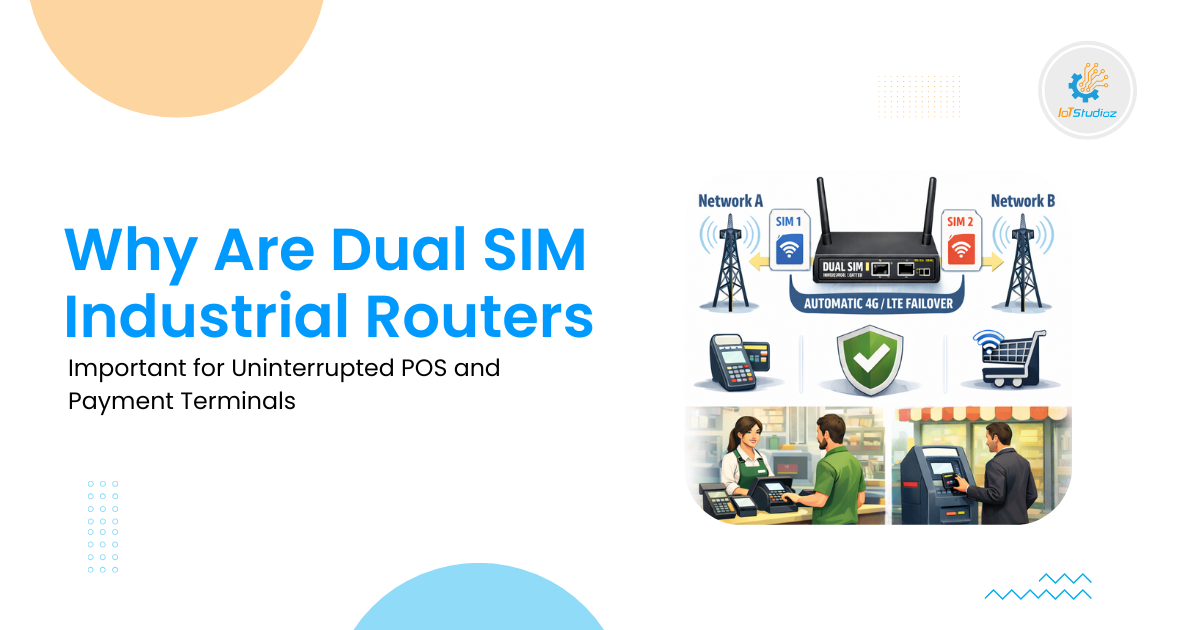
Why Are Dual SIM Industrial Routers Important for Uninterrupted POS and Payment Terminals
Digital payments are now a core part of daily business operations. Retail stores, restaurants, fuel stations, kiosks, and mobile vendors depend on POS and payment terminals to process transactions. These systems must stay connected at all times. Any network interruption can stop payments, delay service, and reduce customer trust.
A Dual SIM Industrial Router is designed to solve this challenge. It ensures continuous network availability by using two cellular connections instead of one. When combined with cellular technology, such as in a Dual SIM 4G LTE Industrial Router, it delivers both reliability and speed.
The Growing Dependence on Digital Payment Systems
Electronic payments have experienced rapid growth over the past decade, fundamentally transforming the way consumers and businesses exchange value. As digital wallets, mobile payments, and card transactions become the norm, cash usage continues to decline in many regions. This shift is reshaping the retail and service industries, forcing organizations to adapt to a more connected, digital-first financial ecosystem.
Key Industry Trends
Several trends highlight the increasing reliance on digital payment systems:
1. High Adoption of Card and Digital Payments: Over 70% of retail transactions in developed markets now involve cards or digital payment methods. Consumers are increasingly choosing convenience, speed, and contactless options over cash, driving retailers to ensure robust payment processing capabilities.
2. Rapid Growth of Mobile and Wireless POS Terminals: Mobile and wireless point-of-sale (POS) terminals are growing at over 10% annually. These terminals allow businesses to accept payments anywhere, from pop-up shops to delivery services, making connectivity critical for uninterrupted operation.
3. Shift Toward Cellular Networks for Small Businesses: Small businesses are moving away from fixed-line connections in favor of cellular and wireless networks. This flexibility supports mobility, remote sales, and online operations, but also increases dependence on stable network infrastructure.
How POS and Payment Terminals Communicate
Modern point-of-sale (POS) and payment terminals rely heavily on IP-based communication to process transactions securely and efficiently. These terminals connect to payment gateways and financial networks using encrypted data channels, ensuring that sensitive payment information is transmitted safely.
Common Connectivity Options
POS terminals can connect to payment networks through several methods:
1. Wired Ethernet: Reliable and consistent, Ethernet connections are ideal for fixed-location terminals such as in-store checkout counters. They provide stable bandwidth but require physical cabling.
2. Wi-Fi: Wireless connectivity offers flexibility and reduces wiring needs. Wi-Fi is commonly used in retail environments, restaurants, and temporary setups. However, signal interference or network congestion can impact reliability.
3. Cellular Networks: Cellular connectivity is increasingly preferred for POS systems due to fast deployment, mobility, and independence from wired infrastructure, ensuring uninterrupted payment processing across locations.
4. Faster Deployment: Cellular POS terminals can be set up quickly without new cabling, allowing businesses to start accepting payments immediately in any location.
5. Location Flexibility: Supports mobile, temporary, or pop-up payment points, including delivery services and outdoor kiosks, enabling business operations in multiple or changing locations.
6. Reduced Infrastructure Dependence: Eliminates reliance on wired networks or Wi-Fi availability, providing continuous connectivity even in areas with weak or unavailable local network infrastructure.
Challenges with Cellular Connectivity
Despite its advantages, cellular networks are not immune to disruptions. Terminals may experience signal loss, network congestion, or carrier outages, which can temporarily prevent transaction processing. Businesses relying on cellular connections must plan for these risks, using strategies such as multi-carrier SIMs, failover networks, or hybrid connectivity solutions to ensure continuous operation.
Common Causes of POS Network Downtime
POS connectivity issues usually come from predictable sources.
1. Cellular Network Congestion
During peak hours, mobile towers may overload, causing delayed or dropped data packets. POS terminals can fail to process payments, frustrating customers and reducing revenue.
2. Carrier Outages
Telecom networks sometimes experience maintenance or unexpected failures. Even short interruptions can prevent POS systems from connecting, causing transaction delays or temporary business downtime.
3. Signal Coverage Gaps
Weak signals in indoor locations, rural areas, or near metal structures can disrupt connectivity. This leads to slow or failed transactions and affects customer satisfaction.
4. Hardware Limitations
Consumer-grade routers are not built for continuous, demanding operation. Overheating, crashes, or poor reliability can cause network downtime and interrupt POS transaction processing.
What Is a Dual SIM Industrial Router
A Dual SIM Industrial Router is a network device designed for high availability environments. It supports two SIM cards from the same or different carriers.
The router actively manages both connections and switches automatically when needed.
Key Characteristics
- Dual cellular interfaces
- Automatic failover logic
- Industrial-grade components
- Continuous operation capability
- Advanced network monitoring
These features make the device suitable for mission-critical applications like POS systems.
Understanding Dual SIM Failover
Failover is the core function that protects POS connectivity.
How Failover Works
Failover is a critical feature in modern payment and POS networks, ensuring continuous connectivity even when the primary connection experiences issues. Routers or communication devices monitor the health of the primary connection using several key parameters:
1. Signal Strength: Indicates the quality of the wireless signal from the network provider.
2. Latency: Measures the delay in data transmission, helping detect slow or congested connections.
3. Packet Loss: Tracks whether data packets are failing to reach their destination, which can disrupt transactions.
4. Network Registration Status: Confirms that the SIM is actively connected to the cellular network.
When any of these parameters exceed pre-defined thresholds such as weak signal, high latency, or lost network registration the router automatically switches traffic to the secondary SIM. This seamless transition ensures uninterrupted connectivity and prevents payment disruptions.
Why Industrial-Grade Design Matters
POS terminals are often installed in environments that are far from ideal for standard networking equipment. These conditions can affect both the reliability and lifespan of a router. Industrial-grade routers are specifically designed to handle such challenges, ensuring continuous operation of payment systems.
Common Environmental Challenges
1. High Temperature and Heat: Kitchens, bakeries, and factories generate significant heat. Consumer-grade routers may overheat, leading to unexpected shutdowns or hardware failure. Industrial routers are built with components rated for wide temperature ranges, often between -40°C to 75°C, allowing them to operate reliably even in extreme heat.
2. Electrical Noise and Interference: Fuel stations, manufacturing plants, and industrial sites often have heavy machinery and high-power equipment. These create electromagnetic interference that can disrupt wireless signals or damage sensitive electronics. Industrial routers include shielding and robust circuitry to maintain stable performance.
3. Exposure to Weather: Outdoor kiosks, parking lot terminals, and event booths face rain, humidity, dust, and temperature fluctuations. Industrial routers often feature IP-rated enclosures (e.g., IP30, IP65) to resist moisture and dust ingress, protecting internal components.
Role of Dual SIM 4G LTE Industrial Router in POS Systems
A Dual SIM 4G LTE Industrial Router ensures both reliable connectivity and fast performance. LTE provides sufficient bandwidth for secure transactions, low latency for quick authorizations, and broad coverage across regions. Most POS data is small, so consistent reliability matters more than speed, making LTE ideal for uninterrupted payment processing.
Advantages of 4G LTE
1. Sufficient Bandwidth for Encrypted Transactions: 4G LTE provides enough bandwidth to securely transmit payment data. Encrypted transactions require reliable data transfer, and LTE ensures that each transaction is processed without delays or data loss.
2. Low Latency for Fast Authorization: Payment systems need quick response times for customer convenience. LTE’s low latency allows POS terminals to receive transaction approvals almost instantly, reducing wait times at checkout.
3. Wide Geographic Coverage: LTE networks cover both urban and rural areas, ensuring POS terminals remain connected in multiple locations. This broad coverage is essential for mobile vendors, outdoor kiosks, and multi-location retail operations.
4. Mature and Stable Technology: LTE is a well-established, stable technology. It minimizes connectivity interruptions and provides predictable performance, which is crucial for payment terminals that must operate continuously.
Importance of Carrier Diversity
Using two SIM cards from different carriers improves resilience.
Benefits include:
1. Reduced Risk of Regional Outages: Using SIM cards from different carriers ensures that if one network experiences an outage, the other can maintain connectivity. This prevents complete service disruption for POS terminals.
2. Better Coverage Across Locations: Different carriers may have stronger signals in different areas. Dual SIM setups provide more consistent connectivity across urban, suburban, and rural locations.
3. Improved Performance During Congestion: If one carrier’s network is busy or overloaded, traffic can switch to the other SIM. This maintains transaction speed and reduces payment delays.
This diversity is critical for businesses operating across multiple sites.
POS Availability and Revenue Protection
POS downtime directly affects revenue.
Consider a store processing 200 transactions per day:
- Average transaction value: $25
- One hour outage during peak time
- Estimated loss: $500 or more
Over time, repeated outages reduce customer confidence. Customers may abandon purchases or choose competitors. Dual SIM routers protect against these losses by maintaining connectivity.
Transaction Success Rate Improvement
Network reliability improves transaction success rates.
Industry observations show:
- Single SIM setups experience higher retry rates
- Dual SIM configurations reduce failed authorizations
- Faster recovery improves user experience
Even a 1% improvement in transaction success can significantly impact high-volume businesses.
Security Considerations in Payment Connectivity
Payment data must remain protected at all times.
Dual SIM industrial routers support security features such as:
- Encrypted VPN tunnels
- Stateful firewalls
- Access control rules
- Secure remote management
These features help meet compliance requirements for payment processing.
Security remains active during failover events. This ensures no data exposure during network switching.
Remote Monitoring and Management
Retailers often manage many POS locations.
Dual SIM routers support centralized management through:
- Web dashboards
- SNMP monitoring
- Alert notifications
- Remote configuration updates
This reduces operational costs and improves response time.
Technicians can identify connectivity issues before they impact transactions.
Use Cases Across Industries
1. Retail Stores
Supermarkets and convenience stores require fast checkout. Dual SIM industrial routers maintain stable connectivity, reducing network-related delays and preventing long queues during peak shopping hours.
2. Restaurants and Cafes
During busy meal times, stable payment processing is critical. Cellular redundancy ensures POS terminals remain online, preventing transaction failures and maintaining smooth service flow.
3. Fuel Stations
Payment terminals at pumps operate in harsh environments and constant use. Industrial-grade dual SIM routers handle heat, electrical interference, and vibration while ensuring continuous connectivity.
4. Mobile Vendors
Food trucks, delivery vehicles, and mobile service units travel across regions. Dual SIM routers adapt to changing network conditions, keeping payment systems connected and operational.
5. Unattended Terminals
Parking meters, vending machines, and kiosks must operate independently. Dual SIM routers ensure connectivity remains uninterrupted without requiring manual monitoring or on-site intervention.
Deployment Considerations for POS Networks
1. SIM Selection: Choose carriers with complementary coverage. Avoid using two SIMs from the same network when possible.
2. Data Plans: Ensure adequate data limits. Payment traffic is small but continuous.
3. Router Configuration: Set failover thresholds carefully. Avoid unnecessary switching.
4. Power Backup: Use uninterruptible power supplies to protect against power loss.
Scalability and Future Readiness
Dual SIM industrial routers support long-term growth.
Benefits include:
- Easy addition of new POS locations
- Compatibility with future cellular upgrades
- Software-based feature expansion
As digital payments continue to grow, scalable network design becomes essential.
Statistical Perspective on Network Reliability
Industry measurements show:
- Cellular networks experience short outages several times per year
- Multi-carrier redundancy reduces downtime by over 80%
- Businesses with redundant connectivity report higher customer satisfaction
These figures highlight the value of dual SIM architecture.
Comparison with Single SIM Routers
| Feature | Single SIM Router | Dual SIM Industrial Router |
| Network redundancy | No | Yes |
| Carrier diversity | No | Yes |
| Uptime reliability | Limited | High |
| POS suitability | Moderate | Excellent |
This comparison explains why single SIM routers are no longer sufficient for critical payment systems.
Conclusion
Uninterrupted connectivity is vital for POS and payment terminals, as network failures impact revenue and customer experience. Dual SIM Industrial Routers provide automatic failover, carrier diversity, and industrial reliability, ensuring consistent LTE connectivity across locations. For businesses relying on continuous digital transactions, these routers are not optional; they are essential infrastructure for secure, stable, and resilient payment processing.
Frequently Asked Questions
1. How do Dual SIM Industrial Routers prevent POS downtime?
They automatically switch between two network carriers if one fails, keeping payment terminals online without manual intervention.
2. Why can’t businesses rely on a single network for POS?
Single networks can fail due to congestion, outages, or weak signals, risking lost sales and disrupted transactions.
3. What makes industrial-grade routers different from regular ones?
They are rugged, vibration- and temperature-resistant, designed for harsh environments like retail kitchens, fuel stations, or outdoor kiosks.
4. Can these routers support mobile or temporary POS setups?
Yes, cellular connectivity and dual SIM failover allow reliable operation anywhere, from delivery vehicles to pop-up stores.
5. Do Dual SIM routers help businesses adapt to increasing digital payments?
Absolutely they provide resilient, always-on connectivity, essential for growing cashless and online transaction volumes.