
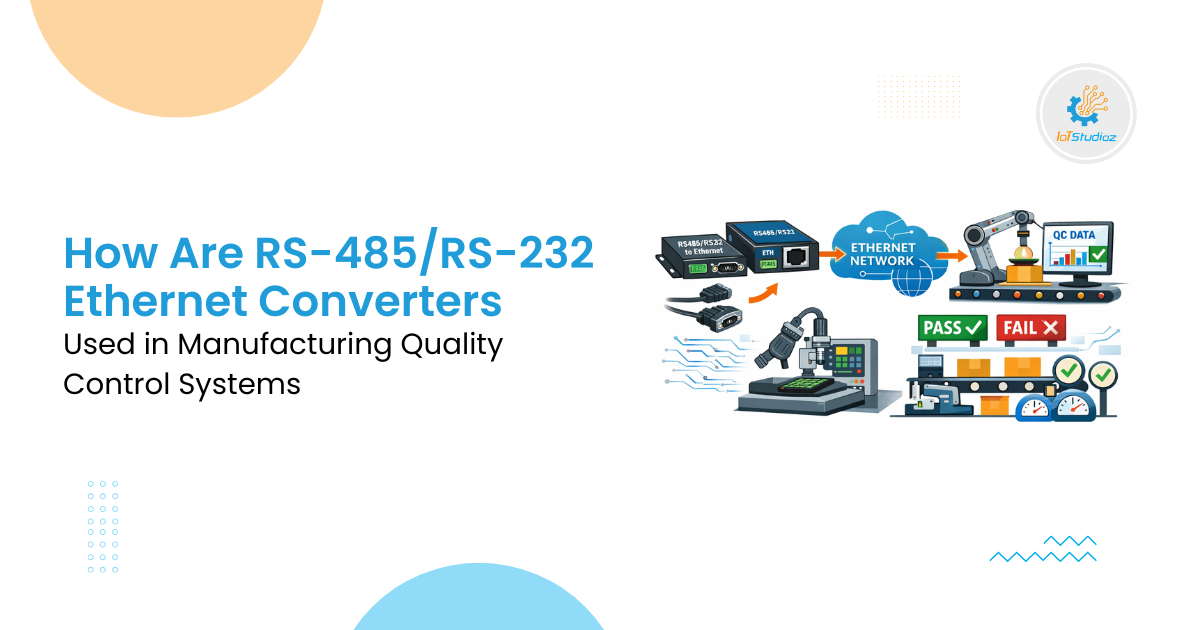
How Are RS-485/RS-232 Ethernet Converters Used in Manufacturing Quality Control Systems
In modern manufacturing, ensuring product quality is a top priority. Factories rely on accurate data collection and communication between machines to maintain high-quality standards. Many industrial devices still use serial communication protocols like RS-485 and RS-232. However, the rise of Ethernet networks in manufacturing plants has created a need for devices that bridge the gap between legacy serial devices and modern network systems. This is where RS-485 / RS-232 to Ethernet Converter devices become essential.
Understanding RS-485 and RS-232 in Manufacturing
RS-232 Protocol
RS-232 is a serial communication standard widely used since the 1960s. It allows data transfer between computers, sensors, and industrial machines. RS-232 typically connects a single device to a computer and supports distances up to 15 meters.
Key Features:
- Single-ended signaling
- Point-to-point communication
- Supports baud rates up to 115.2 kbps
- Common in older sensors and PLCs (Programmable Logic Controllers)
RS-485 Protocol
RS-485 is an improvement over RS-232, designed for industrial environments. It allows multiple devices to communicate over the same bus. RS-485 is especially valuable in manufacturing due to its robustness and long-range capabilities.
Key Features:
- Differential signaling reduces electrical noise
- Supports up to 32 devices on one network
- Communication distances up to 1200 meters
- Speeds up to 10 Mbps for shorter distances
- Common in industrial automation, CNC machines, and measurement devices
Role of Ethernet in Modern Manufacturing
Ethernet networks have become the backbone of industrial communication. Unlike serial protocols, Ethernet allows high-speed, reliable, and scalable communication between devices across large facilities.
Advantages in manufacturing:
- High data transfer rates (up to 10 Gbps in modern networks)
- Long-distance communication using switches and routers
- Easy integration with software for monitoring and control
- Supports modern Industrial IoT (IIoT) applications
Despite Ethernet’s advantages, many machines still use RS-232 or RS-485. Connecting them directly to an Ethernet network is impossible without a converter.
What Are RS-485 / RS-232 to Ethernet Converters?
An RS-485 / RS-232 to Ethernet Converter is a device that bridges serial devices and Ethernet networks. It translates serial data into TCP/IP or UDP packets and vice versa. This allows legacy devices to communicate with modern networked systems without modifying the original hardware.
Common Features:
- Converts RS-232 or RS-485 signals to Ethernet packets
- Supports TCP Server/Client and UDP modes
- Provides stable communication over industrial distances
- Often includes surge protection and isolation for industrial environments
RS485 to Ethernet Converters are particularly popular in manufacturing because many sensors, PLCs, and testing devices rely on RS-485 for multi-device networks.
Applications in Manufacturing Quality Control
Quality control in manufacturing requires precise measurement, monitoring, and reporting. RS-485 / RS-232 to Ethernet converters enable integration of serial devices into digital quality control systems. Here’s how they are used:
1. Connecting Legacy Testing Machines
Many older testing machines, such as tensile testers or coordinate measuring machines, communicate via RS-232. Using a converter allows these machines to send test data directly to a central monitoring system over Ethernet.
Example: A factory with 10 legacy hardness testers can use RS-232 to Ethernet converters to collect data in real-time. Operators can monitor test results from a central dashboard, reducing manual data entry errors by 90%.
2. Sensor Data Acquisition
RS-485 networks are widely used to connect multiple sensors. Converters can integrate these sensors into Ethernet-based quality monitoring systems.
Example: Temperature, humidity, and vibration sensors along an assembly line communicate over RS-485. A converter collects all data and sends it to the quality control server. The system can detect anomalies instantly, preventing defective products from moving to packaging.
3. Supervisory Control and Data Acquisition (SCADA) Integration
SCADA systems are used to monitor and control industrial processes. Many SCADA installations rely on serial devices. RS485 to Ethernet Converters enable these devices to be integrated into the SCADA network without replacing existing hardware.
Benefit: A study by ARC Advisory Group shows that integrating legacy devices using converters can reduce system upgrade costs by 40–60%.
4. Real-Time Monitoring of Production Lines
Ethernet networks allow centralized monitoring of production lines. Converters ensure that data from serial devices reaches real-time dashboards, enabling immediate corrective action.
Example: In electronics manufacturing, in-circuit testing machines send pass/fail signals over RS-485. Converters transmit this data to the central system, allowing managers to adjust production parameters instantly. This reduces defect rates by approximately 15–20%.
5. Remote Quality Reporting
With Ethernet, quality data can be accessed remotely. Using RS-485 / RS-232 to Ethernet converters, factories can monitor production across multiple plants from a central office.
Benefit: Remote monitoring reduces on-site inspection costs and allows faster decision-making. According to a 2022 Industrial IoT survey, companies using remote monitoring reported a 25% improvement in defect detection efficiency.
Advantages of Using RS485 to Ethernet Converters in Quality Control
1. Cost Efficiency
Replacing all legacy devices with Ethernet-compatible ones is expensive. Converters allow continued use of existing equipment while upgrading network connectivity.
2. Reliability
Converters support industrial-grade environments, including high temperatures, dust, and electrical noise. This ensures consistent data transfer without loss or errors.
3. Scalability
RS-485 networks can connect multiple devices. Converters can send data from all devices on the bus to Ethernet-based systems. This allows scalable monitoring of large production lines.
4. Real-Time Data Access
Ethernet networks provide faster data transmission than serial protocols. Converters enable near real-time access to sensor and testing data.
5. Ease of Integration
Most RS-485 / RS-232 to Ethernet Converters support standard protocols like Modbus TCP/IP and TCP/UDP. This simplifies integration with SCADA, MES (Manufacturing Execution Systems), and quality reporting software.
Technical Considerations When Choosing Converters
1. Baud Rate and Data Format Compatibility
Ensure the converter supports the baud rate, parity, and stop bits used by the serial device. Mismatched settings can lead to communication errors.
2. Protocol Support
Industrial devices may use Modbus RTU, ASCII, or custom protocols. Choose a converter that supports the protocol for seamless integration.
3. Network Configuration
Converters can operate in TCP client, TCP server, or UDP modes. Selecting the right mode depends on the network architecture.
4. Isolation and Protection
Industrial environments often experience electrical noise and surges. Converters with isolation protect both the serial devices and the Ethernet network.
5. Multi-Device Support
RS-485 can connect many devices on one bus. Ensure the converter can handle multiple nodes efficiently without latency.
Examples of Real-World Implementation
- Automotive Manufacturing: RS-485 sensors measure torque and vibration on engine assembly lines. Converters transmit this data to a quality monitoring server, reducing assembly defects by 18%.
- Pharmaceutical Industry: Lab testing devices use RS-232 to measure chemical compositions. Converters allow lab data to feed directly into a central quality database, ensuring compliance with FDA standards.
- Food Processing: Temperature and humidity sensors on storage racks communicate via RS-485. Converters send real-time alerts over Ethernet when conditions exceed limits, maintaining product safety.
Future Trends
The use of RS-485 / RS-232 to Ethernet Converters is likely to increase due to:
- Expansion of Industrial IoT in manufacturing
- Demand for centralized quality monitoring
- Continued reliance on legacy serial devices
- Growing need for data-driven decision-making in production
By 2028, analysts predict that over 60% of industrial plants will integrate legacy serial devices with Ethernet networks using converters.
Conclusion
RS-485 / RS-232 to Ethernet converters play a crucial role in modern manufacturing quality control. They allow factories to integrate legacy serial devices into Ethernet networks, enabling real-time monitoring, remote reporting, and improved defect detection.
These converters offer cost efficiency, reliability, scalability, and ease of integration. Industries ranging from automotive to pharmaceuticals rely on them to maintain high-quality standards while minimizing downtime and operational costs.
For manufacturing quality control, investing in RS485 to Ethernet Converters is no longer optional – it is a technical necessity.
FAQ
1. What is an RS-485 / RS-232 to Ethernet Converter?
An RS-485 / RS-232 to Ethernet Converter is a device that translates serial data from RS-232 or RS-485 devices into Ethernet signals. This allows legacy machines to communicate over modern network systems.
2. Why are these converters important in manufacturing quality control?
Many industrial sensors, testing machines, and PLCs still use RS-232 or RS-485. Converters enable these devices to send real-time data to centralized monitoring systems, improving defect detection and reducing manual errors.
3. Can multiple devices connect through one RS485 to Ethernet Converter?
Yes. RS-485 supports multi-device networks. A single converter can handle multiple devices on the bus and transmit their data over Ethernet, depending on its specifications.
4. Are RS-485 / RS-232 to Ethernet Converters suitable for harsh industrial environments?
Most industrial converters include electrical isolation, surge protection, and durable casing. They are designed to handle high temperatures, dust, and electrical noise common in factories.
5. Can these converters integrate with SCADA and MES systems?
Yes. Most converters support standard industrial protocols like Modbus TCP/IP, TCP, or UDP, allowing seamless integration with SCADA, MES, or other quality monitoring software.