
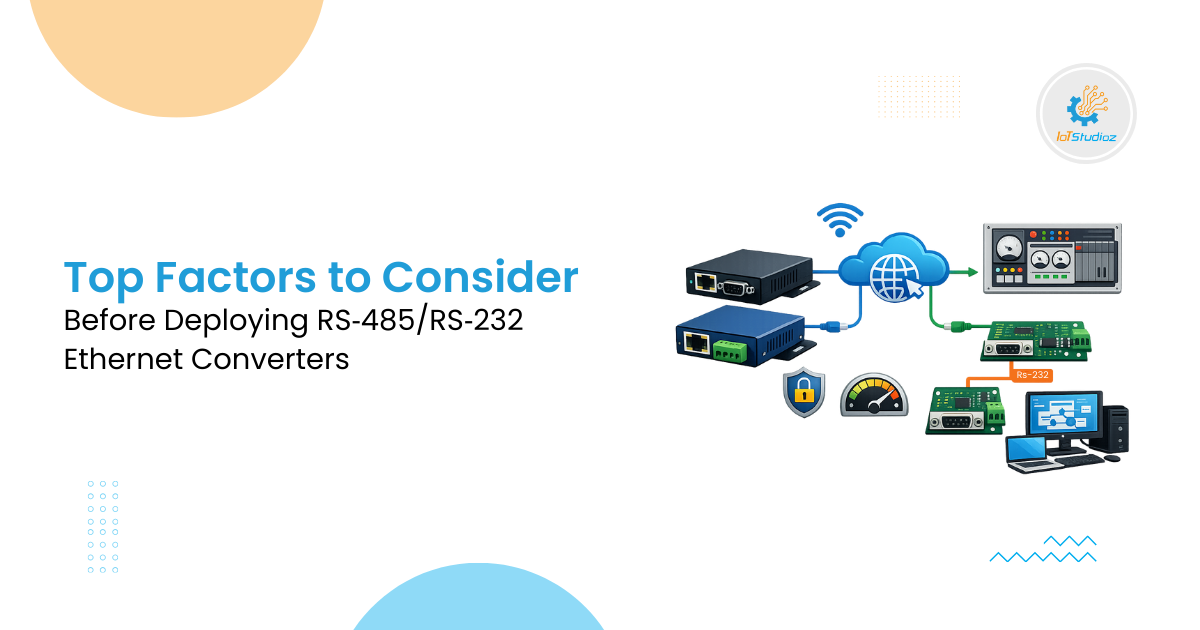
Top Factors to Consider Before Deploying RS‑485/RS‑232 Ethernet Converters
In modern industrial networking, connecting legacy serial devices to Ethernet systems is essential. RS‑485/RS‑232 Ethernet Converters and related devices make this possible. These converters help bridge older serial protocols with modern network infrastructures, enabling better control, monitoring, and data collection.
- 76% of newly installed industrial nodes now use Ethernet.
- Around 70% of industrial equipment still relies on RS‑485 or RS‑232 communication.
- The global serial device server market reached USD 410.2 million in 2024.
- Over 35 million active serial-port devices globally need Ethernet connectivity solutions.
- Retrofit projects report 22% productivity improvement and 17% reduced maintenance time.
What Are RS‑485/RS‑232 Ethernet Converters?
RS‑485/RS‑232 Ethernet Converters are hardware devices that connect serial communication equipment to Ethernet networks. They allow data from RS‑485 or RS‑232 devices to communicate over TCP/IP networks. These converters can support industrial protocols such as Modbus RTU over Ethernet and help integrate legacy systems with modern networked automation platforms.
Why Consider Converters in Industrial Systems?
Even today, over 70% of industrial equipment uses serial protocols like RS‑485 for control and monitoring. This is especially true in factories, utilities, and energy systems where long‑distance and multi‑drop communications are common.
Ethernet, by contrast, offers broader connectivity, faster data rates, and simplified network management. RS‑485 to Ethernet Converters ensure that legacy serial devices remain useful even as networks modernize.
Key Technical Factors
1. Serial Interface Compatibility
- RS‑232: Designed for short-distance, point-to-point communication (typically up to 15 m). Only one device communicates at a time. The voltage levels range from ±3V to ±15V.
- RS‑485: Differential signaling allows multi-drop networks (up to 32 devices per line) and distances up to 1200 m. It is more robust in electrically noisy industrial environments.
Why it matters: Using the wrong converter type can lead to communication failures or even damage to devices. For example, connecting an RS‑485 network to an RS‑232-only converter without proper hardware adaptation will fail.
Example: A factory wants to connect multiple temperature sensors on a long RS‑485 bus to a central monitoring system. Using an RS‑485 to Ethernet Converter ensures correct differential signaling and multi-drop support.
2. Protocol Support and Conversion
- Converters may operate in transparent mode, simply passing serial data as-is to Ethernet without interpreting it.
- Some support protocol conversion, such as Modbus RTU to Modbus TCP, Profibus to TCP/IP, or proprietary serial protocols to Ethernet.
Why it matters: Industrial equipment often uses specific protocols. A converter that doesn’t understand the protocol may transmit corrupted data or cause errors in automation systems.
Example: A water treatment plant uses Modbus RTU sensors. An RS‑485 to Ethernet Converter with Modbus TCP support allows integration with a central SCADA system, avoiding manual intervention.
3. Baud Rate and Data Throughput
- Serial devices have various baud rates (e.g., 1200, 9600, 19200, 115200 bps).
- Converters must match these rates to prevent data loss.
Why it matters: Mismatched speeds result in dropped or corrupted data, especially in high-volume monitoring applications.
Example: A conveyor belt automation system sends 10 kB/sec data. A converter with slow processing speed introduces latency, causing delayed responses and potential system stoppage.
4. Ethernet Interface Standards
- Standard 10/100 Mbps Ethernet ensures compatibility with most switches and routers.
- Some converters support full-duplex communication, reducing collisions and improving reliability.
Why it matters: Using a converter without proper Ethernet standard support can reduce network speed or cause connection failures.
Example: In a factory network with multiple switches, a 10 Mbps-only converter could bottleneck the system, while a 100 Mbps capable converter integrates seamlessly.
5. Addressing and Management
- Converters often allow static or dynamic IP configuration.
- Web interfaces or dedicated software simplify device setup and monitoring.
- SNMP support allows remote status monitoring.
Why it matters: Without proper management, troubleshooting or scaling the network becomes difficult.
Example: In a building management system, IP address conflicts caused HVAC sensors to stop reporting. Converters with web-based management enabled quick reconfiguration.
6. Isolation and Electrical Protection
- Galvanic isolation separates the converter’s Ethernet side from serial circuits, preventing ground loops.
- Surge protection prevents damage from lightning strikes or industrial transients.
Why it matters: Industrial environments have high electromagnetic interference (EMI). Protection ensures reliability and device longevity.
Example: In a steel plant, lightning induced voltage spikes. A converter without isolation failed, whereas a protected converter continued operation uninterrupted.
7. Operating Environment
- Industrial converters are rated for –40 °C to +85 °C and often have humidity tolerance up to 95%.
- Some devices are resistant to dust and vibration.
Why it matters: Using office-grade converters in harsh environments can result in frequent failures and maintenance costs.
Example: Outdoor utility substations need wide-temperature-rated converters. Devices rated only to 60 °C would fail in summer heat.
8. Form Factor and Mounting
- DIN-rail mounting: Standard in industrial panels.
- Panel mount: Useful for enclosed control rooms.
- Standalone box: Flexible for scattered installations.
Why it matters: Proper mounting simplifies installation, reduces wiring clutter, and protects equipment from physical damage.
Example: A factory retrofit used DIN-rail converters inside control cabinets for neat cable management and easy replacement.
9. Power Requirements
- Industrial converters often accept wide-range DC input (5–30 V).
- Some models provide redundant power input for backup.
Why it matters: Incorrect or unstable power can damage converters or cause communication interruptions.
Example: A conveyor system with intermittent power spikes requires a converter with surge-tolerant DC input.
10. Security and Network Safety
- Ethernet networks are more exposed than isolated serial lines.
- Features like VLAN support, firewall compatibility, and secure network protocols help prevent unauthorized access.
Why it matters: A compromised converter can expose critical industrial systems to cyberattacks.
Example: A water treatment SCADA system connected via Ethernet saw increased security risk. Converters with VLAN and IP filtering prevented unauthorized network access.
11. Network Topology Planning
- RS‑485 to Ethernet networks must consider switch placement, cable lengths, and redundancy.
- Star, ring, or bus topologies impact latency and reliability.
Why it matters: Poor network planning can lead to packet loss, collisions, or unresponsive devices.
Example: In a manufacturing line, poorly designed Ethernet topology caused intermittent sensor failures. Planning a ring topology with managed switches solved the issue.
12. Legacy Device Limitations
- Some older serial devices may not support high baud rates or modern signaling standards.
- Converters may require firmware or protocol adjustments for compatibility.
Why it matters: Ignoring legacy limitations can make the whole system fail or require device replacement.
Example: A 1990s PLC required RS‑485 voltage levels not supported by some low-cost converters, necessitating a properly rated industrial model.
13. Cost and ROI Considerations
- RS‑485/RS‑232 Ethernet Converters typically cost a few hundred dollars each.
- Full system upgrades replacing legacy devices can cost thousands per device.
Why it matters: Proper deployment minimizes expenses while extending the life of existing equipment.
Example: Retrofitting 200 RS‑485 sensors with converters saved 70% versus full replacements.
14. Maintenance and Troubleshooting Ease
- Converters with diagnostic LEDs, web-based management, or software monitoring tools simplify troubleshooting.
- Real-time status indicators (link, data flow, error) help quickly identify network or serial issues.
Why it matters: Industrial networks often run 24/7, and minimizing downtime saves both time and money.
Example: A factory reported reducing troubleshooting time from hours to minutes after deploying converters with built-in diagnostics.
15. Scalability for Future Expansion
- Consider converters that support multiple serial ports or easy network daisy-chaining for future growth.
- Ability to add devices without replacing existing infrastructure ensures long-term flexibility.
Why it matters: Industrial systems evolve over time; scalable converters reduce future costs and complexity.
Example: A building automation system added 50 more sensors without replacing the original RS‑485 to Ethernet Converters, maintaining network stability and saving on equipment costs.
Conclusion
Deploying RS‑485/RS‑232 Ethernet Converters or RS‑485 to Ethernet Converters requires careful planning. Each factor – from serial compatibility to network security – directly impacts performance, reliability, and ROI.
By following detailed guidelines, industries can integrate legacy systems into modern networks safely, efficiently, and cost-effectively, avoiding common pitfalls like communication errors, downtime, or security risks.
FAQ
1. What is the difference between RS‑485 and RS‑232?
RS‑232 is a short-distance, point-to-point serial communication standard, while RS‑485 supports multi-drop networks over longer distances and is more robust in industrial environments.
2. Why do I need an RS‑485 to Ethernet Converter?
It allows legacy RS‑485 or RS‑232 devices to communicate over modern Ethernet networks, enabling remote monitoring, centralized control, and integration with industrial automation systems.
3. Can one converter support multiple protocols?
Some converters operate in transparent mode for basic serial forwarding, while advanced models support protocol conversion, such as Modbus RTU to Modbus TCP, for seamless integration.
4. What environmental factors should I consider?
Industrial converters should meet temperature, humidity, and vibration requirements. Devices rated for –40 °C to +85 °C and industrial EMI protection ensure reliable operation.
5. How do I ensure network security with Ethernet converters?
Use converters with VLAN support, IP filtering, and compatibility with firewalls. Secure network design prevents unauthorized access while maintaining reliable data communication.