
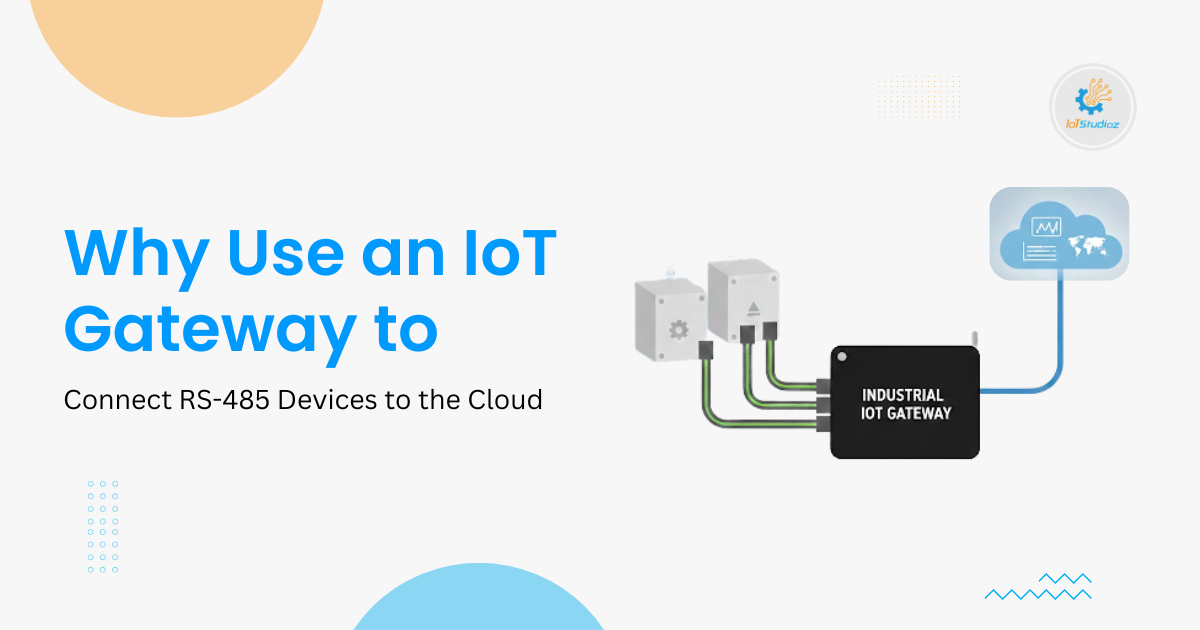
Why Use an IoT Gateway to Connect RS-485 Devices to the Cloud
Industrial automation relies on reliable data exchange. Over 70% of industrial field devices including sensors, meters, drives, and controllers still use RS-485 for communication. RS-485 is robust, supports distances up to 1,200 meters, and performs well in harsh industrial environments.
However, RS-485 lacks native cloud connectivity, limiting real-time analytics and remote monitoring. An RS485 IoT Gateway bridges this gap, enabling seamless data collection, monitoring, and analysis in the cloud without replacing existing equipment.
What Is an RS-485 IoT Gateway?
An RS485 IoT Gateway connects legacy industrial devices to modern networks, translating serial RS485 signals into IP-based protocols for the cloud. Key features include:
1. Protocol Translation: Converts RS485 and industrial protocols like Modbus RTU or BACnet MS/TP into cloud-compatible formats.
2. Data Aggregation: Collects data from multiple devices and reduces network congestion.
3. Edge Processing: Filters and analyzes data locally to reduce cloud load.
4. Secure Data Transfer: Encrypts and protects data from unauthorized access.
By bridging operational technology (OT) and IT systems, IoT gateways enable real-time monitoring, predictive maintenance, and remote management for industrial operations.
Understanding RS485 Communication in Industrial IoT
RS485 is a serial communication standard widely used in industrial automation due to its reliability:
- Supports communication over distances up to 1,200 meters
- Resists electrical noise in industrial environments
- Supports multi-drop networks, allowing multiple devices on one bus
- Low power consumption for extended deployments
RS485 devices often use higher-level protocols like Modbus RTU, BACnet MS/TP, or proprietary formats, which are designed for local networks, not cloud connectivity.
Challenges of RS485 in Modern Industrial IoT Systems
RS485 has been a reliable communication standard in industrial automation for decades, thanks to its robustness, long-distance capability, and noise immunity. However, as industrial systems move toward Industry 4.0, RS485 faces several limitations that make it inadequate for modern IoT requirements.
1. No Native IP or Cloud Connectivity
RS485 is a serial communication standard that operates over twisted-pair cables. It is designed for local, point-to-point or multi-drop networks within a facility, not for direct internet or cloud connections.
- Devices cannot transmit data to cloud platforms without intermediary devices, such as an IoT gateway.
- Real-time monitoring, remote access, or centralized data collection is not possible natively.
- Lack of IP support limits integration with modern IT systems and cloud-based analytics.
2. Limited Security Features
RS485 networks were developed long before cybersecurity became a critical concern in industrial environments. As a result, they lack:
- Encryption for data in transit
- Authentication mechanisms to verify devices
- Built-in protections against network attacks or unauthorized access
This makes RS485 networks vulnerable if directly exposed to external networks or the internet, which is increasingly common in modern IoT setups.
3. Low Scalability
RS485 operates as a bus-based network, meaning multiple devices share a single communication line. While efficient for small setups, it has limitations:
- Adding more devices requires careful network planning to avoid signal degradation.
- Bus-based networks can experience collision issues as the number of devices increases.
- Compared to Ethernet or wireless IoT networks, RS485 cannot easily scale to support large industrial facilities or multiple locations.
4. Limited Data Speed
RS485 is typically slower than modern industrial network standards like Ethernet or Wi-Fi:
- Standard RS485 speeds range from 9.6 kbps to 115.2 kbps, depending on cable length and device compatibility.
- This limits the ability to stream high-frequency data for real-time analytics or advanced predictive maintenance.
5. Lack of Standardized Cloud Integration
RS485 devices often use legacy protocols such as Modbus RTU, BACnet MS/TP, or proprietary formats. While reliable locally, these protocols:
- Are not designed for internet transmission
- Require complex middleware or gateways to interface with cloud services
- Make it difficult to implement centralized dashboards or AI-driven in
How an RS485 IoT Gateway Works
An RS485 IoT Gateway serves as a critical bridge between legacy field devices and modern cloud platforms, enabling industrial operators to monitor, control, and optimize their operations in real time. It converts traditional RS485 serial communication into IP-based data that can be accessed, analyzed, and acted upon remotely.
Step-by-Step Data Flow
- RS485 Devices Send Serial Data: Industrial devices such as sensors, meters, or controllers generate data in RS485 serial format. This data typically includes measurements like temperature, vibration, energy usage, or machine status.
- Gateway Buffers and Reads Data: The IoT gateway collects incoming serial data from multiple devices and temporarily stores it. Buffering ensures that no data is lost, even during short network interruptions.
- Serial Data is Converted into IP Formats: The gateway translates the RS485 serial signals into IP-based protocols compatible with modern IT systems and cloud platforms. Common protocols include MQTT, HTTP/HTTPS, and WebSocket.
- Data is Sent to Cloud Platforms: Once converted, the data is transmitted to cloud applications for real-time analytics, visualization, and reporting. Operators can access dashboards to track energy consumption, machine performance, or operational metrics.
- Cloud Commands Control Devices Remotely: The communication is bidirectional: commands from the cloud can flow back through the gateway to RS485 devices, enabling remote control, configuration updates, or automated responses.
Benefits of This Process
- Real-Time Monitoring: Operators can track machines, meters, or sensors instantly.
- Predictive Maintenance: Anomalies are detected early, reducing unplanned downtime.
- Improved Operational Efficiency: Data-driven decisions optimize production and energy usage.
- Scalability: Multiple devices across different locations can be integrated without replacing existing infrastructure.
- Secure Cloud Access: Encrypted data transfer protects sensitive industrial information.
Benefits of Using an RS485 IoT Gateway
1. Real-Time Monitoring & Analytics
IoT gateways send live data to cloud dashboards, providing instant insights into energy usage, production metrics, or equipment health.
2. Predictive Maintenance
Edge processing and cloud analytics detect anomalies in vibration, temperature, or load, helping prevent downtime. Predictive systems reduce machine failures by up to 30%.
3. Faster Billing & Data Collection
IoT gateways automate data uploads from energy meters or utility devices, enabling accurate, faster billing cycles without manual meter reading.
4. Scalability & Flexibility
RS485 to Ethernet converters offer scalability and flexibility, allowing new devices to be added without redesigning networks. They support multiple RS485 buses and enable multi-cloud, multi-tenant architectures, making industrial and IoT systems more adaptable and efficient.
5. Security & Compliance
IoT gateways provide encrypted communication, device authentication, and secure logs, helping industries meet strict regulatory requirements.
Real-World Industrial IoT Examples
1. Smart Energy Metering
Smart energy metering without an IoT gateway relies on manual readings, resulting in delayed billing and limited insights. An RS485 IoT gateway uploads data to the cloud for real-time dashboards and faster, more accurate billing.
2. Industrial Machine Monitoring
Industrial machines equipped with RS485 sensors continuously track their health, while an IoT gateway uploads the data for predictive maintenance and real-time alerts, helping to identify issues early and reducing unplanned downtime by 30%.
Network Flexibility & Cloud Integration
Modern industrial environments require flexible network options and seamless cloud integration to support real-time monitoring, predictive maintenance, and smart decision-making. RS485 IoT Gateways provide both, bridging legacy devices to modern, connected infrastructures.
1. Network Flexibility
RS485 IoT Gateways support multiple network types, enabling connectivity even in remote or challenging locations:
- Ethernet: Reliable wired connections for factory floors and production lines.
- Wi-Fi: Wireless networking for facilities where cabling is difficult or expensive.
- Cellular (4G, LTE, 5G): Connects remote sites, outdoor equipment, or temporary installations without relying on existing networks.
This flexibility allows industries to integrate legacy RS485 devices into modern industrial networks without costly rewiring or infrastructure upgrades.
2. Cloud Integration Benefits
By connecting RS485 devices to cloud platforms, IoT gateways unlock a wide range of operational advantages:
- Long-Term Data Storage: Historical data is securely stored in the cloud for compliance, reporting, and trend analysis.
- AI-Based Analytics: Cloud platforms apply machine learning and AI to identify patterns, optimize performance, and predict maintenance needs.
- Global Access: Operational data can be accessed securely from anywhere, allowing centralized monitoring across multiple sites.
- Improved Operational Efficiency: Studies show cloud-connected industrial systems can improve efficiency by 15–20% through better visibility and faster decision-making.
Cost Efficiency & Easy Deployment
RS485 IoT Gateways offer a cost-effective alternative to replacing legacy devices, with gateway prices ranging from $150–$400 compared to $500–$1,500 for new smart devices. They extend the life of existing assets while providing cloud connectivity, reducing capital expenses. Deployment is straightforward: connect RS485 devices, configure protocols, set network parameters, link to cloud platforms, and test data flow for seamless integration.
Future Trends in IoT Gateways
IoT gateways are evolving with AI at the edge for real-time analytics, 5G support for high-speed industrial connectivity, and advanced device orchestration for managing multi-device environments. These innovations enable faster decision-making, seamless interoperability, and scalable networks. Industrial automation and smart cities are fueling 14% CAGR growth in the global IoT gateway market through 2030.
Conclusion
An RS485 IoT Gateway effectively transforms legacy industrial devices into cloud-connected, secure, and scalable assets. It enables real-time monitoring and predictive maintenance, supports faster billing and energy management, and delivers actionable analytics for smarter operations. For industries embracing digital transformation, RS485 IoT gateways safeguard existing investments while unlocking the full potential of Industrial IoT, driving efficiency, insight, and future-ready operations.
Frequently asked questions
1. What is an IoT gateway for RS485 devices?
An IoT gateway acts as a bridge between RS485 industrial devices and the cloud, enabling real-time data transfer, monitoring, and control.
2. Why can’t RS485 devices connect directly to the cloud?
RS485 is a serial communication protocol designed for local networks, lacking native internet or cloud connectivity. A gateway translates RS485 data into IP-based protocols.
3. How does an IoT gateway improve energy metering?
It automates data uploads from meters, provides real-time dashboards, reduces manual readings, and accelerates billing cycles.
4. Can IoT gateways support multiple RS485 devices simultaneously?
Yes, most gateways can connect dozens or even hundreds of RS485 devices, aggregating data efficiently for centralized monitoring.
5. How does predictive maintenance work with RS485 gateways?
Sensors collect machine health data via RS485; the gateway sends it to the cloud, where analytics predict failures and trigger maintenance alerts.