
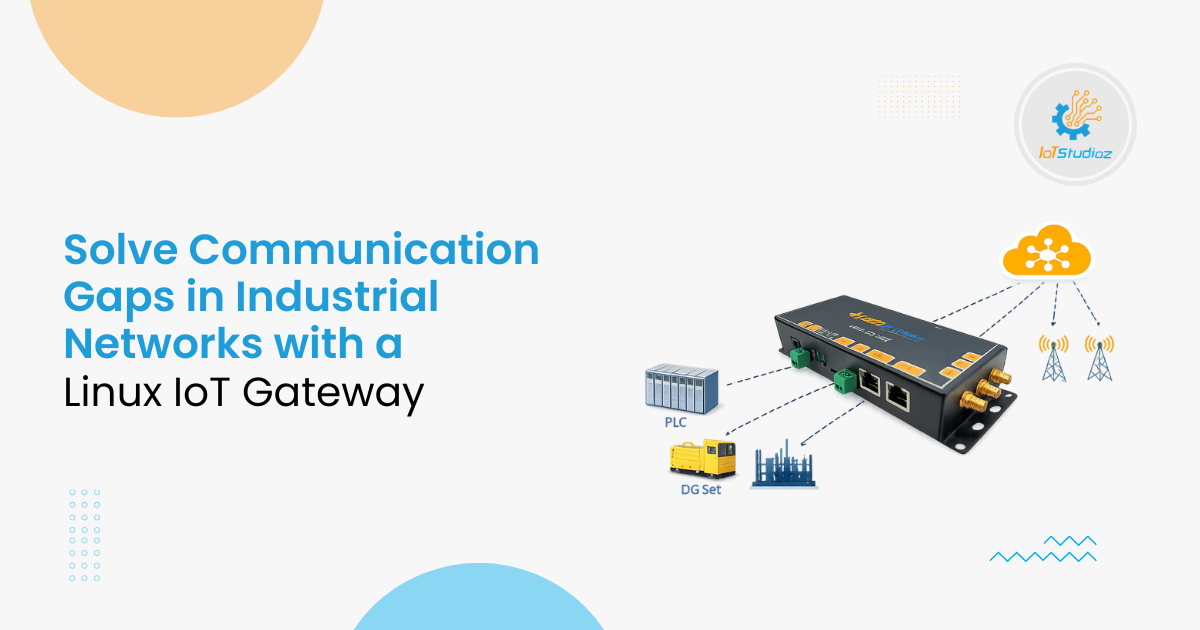
Solve Communication Gaps in Industrial Networks with a Linux IoT Gateway
Industrial environments today operate thousands of machines, sensors, and controllers. These devices need reliable communication to share data for monitoring and control. Yet many factories still use legacy systems and proprietary protocols. This creates communication gaps that slow operations, limit visibility, and reduce productivity. A Linux IoT Gateway can serve as a central hub that bridges these gaps and enables modern communication solutions. This technical article explains how these gateways work, why industrial networks face communication issues, and how a Linux-based edge solution improves performance.
Industrial IoT deployment continues to grow rapidly:
- The Industrial IoT Gateway market is expected to expand by over USD 3.36 billion between 2024 and 2028.
- Industrial gateway adoption has increased as more companies seek real-time analytics and cloud integration.
- Gateways now represent a large share of installed IoT devices due to their role in communication bridging and edge computing.
These figures show how critical gateways are becoming in industrial digital transformation.
What Are Industrial Communication Gaps?
In industrial settings, communication gaps refer to failures or inefficiencies when devices cannot exchange data effectively. These problems often occur when:
- Devices speak different protocols.
- Data flows between operational networks (OT) and enterprise IT systems.
- Remote sensors use wireless communication with weak signals.
- Legacy hardware does not support modern networking.
Industrial communication gaps can cause visible issues, including unplanned machine stoppages, data bottlenecks, latencies, and inconsistent control signals. Statistics show that legacy infrastructure and protocol fragmentation delay many IoT projects by months and create integration complexity that is costly to resolve.
Why Industrial Networks Struggle with Connectivity
Industrial networks have unique challenges compared to traditional IT networks.
1. Diverse Protocols and Standards
Industrial sites often mix protocols like Modbus, OPC UA, PROFIBUS, and custom formats. These protocols were designed decades apart, and many lack a common communication method. Without unified translation, systems cannot exchange data in real time.
2. Legacy and Modern Systems
Older machines may have proprietary communication chips, while newer systems use Ethernet/IP or MQTT. Connecting these systems requires specialized middleware or hardware. Many organizations struggle to integrate legacy devices with modern IoT platforms.
3. Security and Reliability
Industrial environments are critical infrastructure. They need secure communication to prevent unauthorized access or data tampering. Yet more than 30% of IIoT deployments still experience security concerns that deter full automation. Cyberattacks targeting manufacturing networks have risen sharply.
4. Workforce and Skill Gaps
Deploying and maintaining advanced IoT solutions requires network engineers with deep expertise in embedded systems, communication standards, and security. Many sites lack this talent, which adds delays and increases errors in implementation.
What Is a Linux IoT Gateway?
A Linux IoT Gateway is a device or software platform that connects edge devices to corporate networks or cloud services. It runs a Linux operating system, often customized for real-time operations, security, and networking. These gateways typically include:
- Support for multiple industrial protocols.
- Message brokers like MQTT.
- Data transformation engines.
- Edge computing capabilities to process data locally.
Linux is a common OS for IoT gateways. Around 43% of all IoT gateways and edge nodes run embedded Linux today.
Why Linux?
Linux provides several advantages:
- Open-source flexibility for customization.
- Robust networking stacks and protocol support.
- Real-time performance with appropriate kernels.
- Strong support from the developer community.
- Modularity and scalability for multiple applications.
How Linux IoT Gateways Bridge Communication Gaps
A Linux IoT Gateway solves communication gaps in several ways:
1. Protocol Translation
Linux IoT Gateways can speak multiple industrial protocols simultaneously. For example, a gateway can receive OPC UA data from one machine and publish it using MQTT to another system. Protocol adapters running on Linux convert message formats in real time without losing data fidelity.
By acting as a translator, the gateway enables devices with incompatible protocols to communicate seamlessly. This cuts integration time and reduces custom middleware development.
2. Edge Processing and Filtering
Industrial IoT systems produce vast volumes of real-time data. A Linux IoT Gateway can process this data at the edge, filtering out noise, performing signal conditioning, and prioritizing messages based on importance. This reduces network load and speeds up decision-making.
The ability to run analytics at the edge improves responsiveness, especially when cloud connectivity is limited or intermittent.
3. Secure Communication
Linux supports advanced security frameworks such as TLS/SSL, VPNs, and firewall modules. Integrating these into the gateway strengthens protection against unauthorized access and data breaches. As industrial attacks increase, secure gateways reduce threats that could otherwise disrupt operations.
4. Scalability and Modularity
A Linux IoT Gateway can scale to support hundreds of endpoints. Engineers can update or add modules without replacing hardware. This modularity allows networks to evolve gradually, reducing upfront costs and risk.
Typical Use Cases in Industry
1. Factory Floor Modernization
In manufacturing facilities, machines from different vendors coexist. Some devices use legacy communication chips, while others are network capable. A Linux IoT Gateway can interface with all of these using common protocols, enabling real-time monitoring for production throughput and quality control.
This consolidation improves visibility across the factory. For example, sensors can stream data to a dashboard through the gateway, allowing operators to identify bottlenecks before they disrupt production.
2. Predictive Maintenance
Many industries use vibration and temperature sensors to monitor machine health. Linux IoT Gateways can preprocess sensor data and send only relevant alerts or trends to predictive analytics platforms. This reduces unnecessary network traffic and speeds up maintenance choices.
Predictive maintenance systems have shown significant returns by reducing breakdowns and downtimes. Integrating gateway-filtered data improves these systems’ accuracy with less false reporting.
3. Remote Site Monitoring
Oil, gas, utilities, and remote industrial plants often deploy sensors in locations with unreliable connectivity. Linux IoT Gateways support offline queuing and batch synchronization, ensuring data integrity even when connections drop. This capability ensures long-term reliability, especially in harsh environments.
Challenges When Deploying Linux IoT Gateways
Even with benefits, Linux IoT Gateway deployment has challenges:
1. Initial Costs
Purchasing gateway hardware and dedicating resources to configure it can be costly, especially for small enterprises. Integration often requires updates to existing infrastructure.
2. Protocol Complexity
Supporting a wide variety of industrial protocols demands careful design. Not all gateways natively support every legacy standard, so engineers must maintain adapters.
3. Security Management
While Linux supports strong security, configuring it properly requires expertise. Misconfiguration can leave gateways open to penetration.
4. Workforce Needs
Specialized skills in embedded Linux, networking, and industrial protocols are essential. A lack of trained personnel can slow deployment and create operational risk.
Best Practices for Effective Implementation
To avoid common pitfalls when deploying a Linux IoT Gateway:
1. Assess Protocol Requirements Early
Survey field devices and list all required communication standards. Choose a gateway that supports these and plan for any needed adapters.
2. Harden Security
Configure strong authentication, encryption, and monitoring tools. Regularly update software to patch vulnerabilities.
3. Plan for Scalability
Deploy gateways that support add-ons and future expansion. Avoid custom hacks that limit growth.
4. Train Teams
Invest in training for network engineers and IoT specialists. Skilled staff will reduce errors and speed up deployment timelines.
Conclusion
Industrial networks face significant communication challenges due to protocol fragmentation, legacy systems, and security risks. A Linux IoT Gateway provides a flexible and powerful solution that bridges communication gaps. By supporting multiple protocols, enabling edge processing, fortifying security, and scaling with growth, Linux-based gateways help industrial networks operate reliably and efficiently.
The industrial IoT gateway market continues to grow as enterprises adopt real-time analytics and cloud integration. With careful planning, implementation of Linux IoT Gateways can reduce network inefficiencies and improve data visibility, enhancing productivity and operational resilience across industries.
FAQ’s
1. What is a Linux IoT Gateway in industrial networks?
A Linux IoT Gateway is a hardware or software platform that connects industrial devices to enterprise IT systems or cloud platforms. It runs on a Linux operating system and supports multiple industrial protocols such as Modbus, OPC UA, and MQTT.
The gateway acts as a bridge between legacy machines and modern digital systems. It translates data formats, manages communication, and secures data transfer.
2. Why is Linux preferred for industrial IoT gateways?
Linux offers strong networking capabilities, stability, and customization options. Engineers can modify the kernel and services to meet industrial needs.
Linux also supports:
- Real-time processing with real-time kernels
- Secure communication using TLS and VPN tools
- Broad driver support for industrial hardware
- Long-term support versions for stable deployments
Many embedded and edge devices use Linux because it provides reliability and community support.
3. How does a Linux IoT Gateway improve communication reliability?
A Linux IoT Gateway improves reliability by handling protocol conversion and local processing.
It can:
- Buffer data during network outages
- Filter unnecessary sensor noise
- Prioritize critical control messages
- Perform edge analytics to reduce latency
This local control ensures machines continue operating even when cloud connectivity fails.
4. Is a Linux IoT Gateway secure for industrial environments?
Yes, when configured properly, it offers strong security features.
Linux supports:
- Encrypted communication using TLS/SSL
- Firewall and access control rules
- Secure boot and device authentication
- Role-based access management
Security depends on correct configuration and regular updates. Organizations must monitor and patch vulnerabilities to reduce risk.
5. What industries benefit most from Linux IoT Gateways?
Several industries benefit from deploying a Linux IoT Gateway, including:
- Manufacturing and smart factories
- Oil and gas operations
- Energy and utilities
- Transportation systems
- Water treatment plants
These sectors often use mixed legacy and modern systems. A Linux IoT Gateway helps integrate them into a unified communication architecture.