
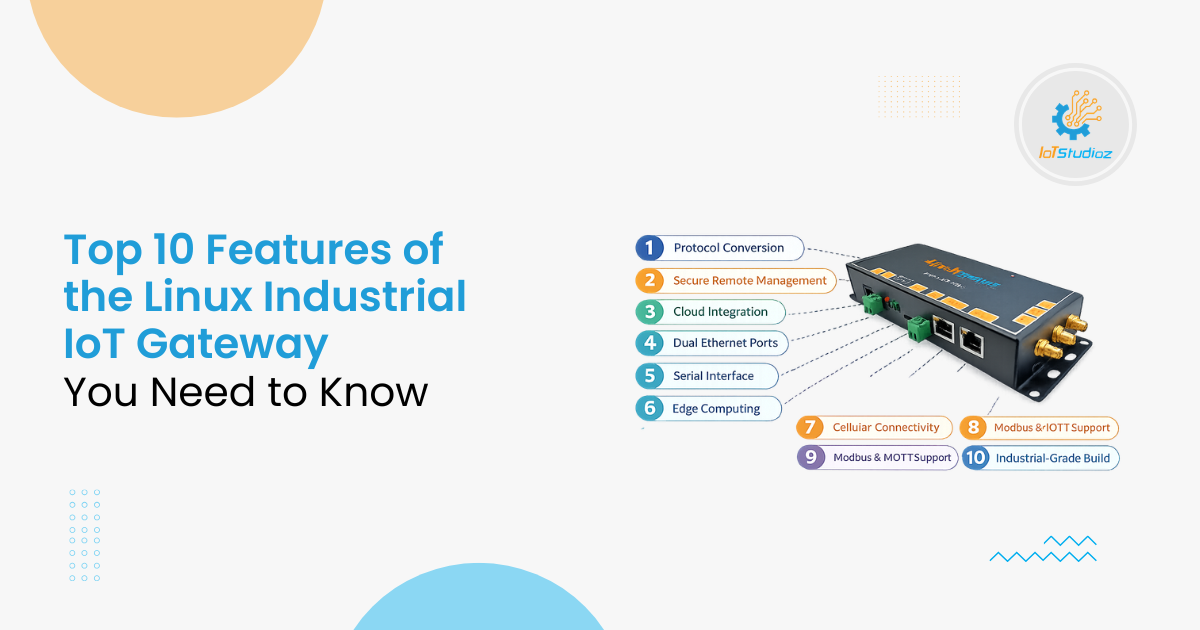
Top 10 Features of the Linux Industrial IoT Gateway You Need to Know
Industrial networks are becoming more complex as factories, plants, and utilities adopt digital systems. Machines that once operated in isolation now need to connect, communicate, and share data. However, legacy devices, different network standards, communication delays, and security limitations pose real challenges.
A Linux Industrial IoT Gateway plays a central role in solving these issues. It acts as a bridge between operational technology (OT) devices, industrial controllers, and higher‑level IT or cloud systems. This blog explains the top 10 features of Linux‑based IoT gateways that every engineer, architect, and industrial technologist should understand.
1. Multi‑Protocol Compatibility
Industrial environments run a mix of protocols, both modern and legacy. These include:
- OPC UA (Open Platform Communications Unified Architecture)
- Modbus RTU and TCP
- PROFINET, PROFIBUS
- EtherNet/IP
- BACnet
- MQTT (Message Queuing Telemetry Transport)
A Linux IoT Gateway with multi‑protocol support translates traffic between these systems without requiring separate protocol converters. The gateway essentially normalizes data so that every system can interpret it correctly.
Why This Matters
Many industrial devices do not speak a common language. For example:
A PLC (Programmable Logic Controller) might report machine status using Modbus, while a cloud dashboard expects OPC UA or MQTT. A Linux IoT Gateway translates between them in real time.
Technical Benefit
- Removes need for custom middleware
- Eliminates manual protocol conversion scripts
- Reduces integration development time
2. Edge Data Processing and Filtering
Edge data processing means that data is processed close to the source before it is sent to higher‑level systems.
An industrial facility can generate millions of data points per hour. Sending all this raw data to the cloud is inefficient, costly, and can introduce latency.
Linux Gateway Capability
A Linux IoT Gateway can:
- Filter out redundant data
- Preprocess and summarize sensor streams
- Run calculations locally
- Detect anomalies at the edge
Statistical Insight
Industry data indicates that over 70% of IoT data does not need to be stored centrally. Processing at the edge reduces bandwidth use and very often improves responsiveness of control systems.
Technical Advantage
- Reduces network congestion
- Speeds up response time for automation
- Optimizes data sent to cloud or analytics platforms
3. Security and Network Hardening
Industrial networks demand secure communication. Attackers targeting industrial control systems often exploit weak protocols or insecure endpoints.
A Linux IoT Gateway integrates several security layers:
- TLS/SSL encryption for communication
- Certificate‑based authentication
- Firewall rules
- Role‑based access
- Secure boot and kernel hardening
Linux provides a rich security framework and popular tools such as iptables, SELinux, and hardened kernel modules.
Why This Matters
Industrial networks are now frequent targets for cyberattacks. Security strategies are no longer optional.
Technical Protection
- Secure tunnels prevent man‑in‑the‑middle attacks
- Access control limits who can view or change data
- Logs provide audit trails for compliance
4. Scalability Through Modular Architecture
Industrial systems are rarely static. New sensors, machines, or data platforms are added over time.
Linux IoT Gateways often use a modular design, allowing:
- Protocol drivers to be added or removed
- Application logic to run as separate plugins
- Services to be decoupled from core functions
Modularity reduces technical debt and makes future expansion easier.
Technical Benefits
- Supports incremental deployment
- Limits system downtime during upgrades
- Encourages reuse of tested middleware components
5. Real‑Time Deterministic Performance
Certain industrial applications require deterministic timing. Control loops, safety interlocks, and synchronization tasks demand predictable performance.
Linux can be optimized with real‑time extensions such as PREEMPT_RT or specialized real‑time patches. These deliver precise timing behavior critical for:
- High‑speed machinery
- Fast feedback control
- Time‑sensitive automation sequences
Performance Outcome
A real‑time Linux IoT Gateway processes urgent messages within fixed time bounds, ensuring machines respond without delay.
6. Local Storage and Offline Synchronization
Industrial environments sometimes face network interruptions. In remote or harsh locations, connectivity may be intermittent.
Linux IoT Gateways support:
- On‑device storage
- Queuing of data when the network fails
- Resume and synchronization when the link returns
This store‑and‑forward approach prevents data loss and ensures industrial historians stay up to date.
Example Scenario
A mining site loses satellite connectivity for several hours. The gateway continues logging sensor and telemetry data locally, then uploads it when the network returns.
Technical Impact
- Guarantees data continuity
- Reduces synchronization errors
- Improves reliability of analytics and reporting
7. Standardized APIs for Easy Access
APIs define how software communicates with systems.
A well‑designed Linux IoT Gateway exposes standardized interfaces like:
- REST APIs
- WebSockets
- OPC UA structured information models
- MQTT topics with defined schemas
Standard APIs make it easier to integrate the gateway with dashboards, analytics engines, enterprise systems, and third‑party tools.
Technical Outcome
- API documentation simplifies development
- Reduces need for custom drivers
- Encourages consistent data models
8. Support for Containers and Microservices
Modern software architecture favors containers such as Docker, containerd, or Kubernetes at the edge.
Linux ecosystems excel at container support. Gateways can run:
- Protocol converters
- Analytics modules
- Edge AI engines
- Monitoring agents
All within isolated containers.
Why This Matters
Containers make deployments predictable, updates safe, and components easier to manage.
Technical Advantages
- Hot‑swappable services
- Better resource isolation
- Simplified version control
9. Cloud and Enterprise Integration
Today’s industrial systems are connected to cloud platforms for analytics, asset management, and big‑data processing.
Linux IoT Gateways typically support:
- Secure connectivity to AWS IoT
- Integration with Azure IoT Hub
- Connectivity to private enterprise servers
- Support for streaming platforms like Kafka
These integrations use secure protocols and standardized payload formats.
According to industry forecasts, the global Industrial IoT Gateway market is projected to grow by more than USD 3.3 billion by 2028, largely due to demand for cloud‑ready solutions.
Technical Value
- Enables predictive analytics
- Power real‑time dashboards
- Supports global connectivity
10. Monitoring, Logging, and Diagnostics
A gateway is more than a data pipe. It also generates operational data about itself.
Linux IoT Gateways include:
- Event logs
- Performance metrics
- Diagnostic dashboards
- Threshold alerts
Engineers can use this feedback to:
- Detect network delays
- Track communication errors
- Diagnose device failures
Statistics show that improved system visibility reduces mechanical downtime by up to 30% in industrial settings.
Technical Benefit
- Faster troubleshooting
- Predictive maintenance support
- Improved SLAs
Why Linux Is the Ideal Foundation
Linux provides several core advantages for industrial gateways:
| Capability | Linux Contribution |
| Protocol extensibility | Large open‑source libraries |
| Networking | Mature TCP/IP stack |
| Security | Hardening tools and strong encryption |
| Modularity | Flexible service architecture |
| Real‑time performance | Kernel tuning and real‑time patches |
Linux excels in both low‑level system functions and high‑level application hosting. This makes it a natural fit for complex industrial gateways.
Typical Industrial Use Cases
1. Factory Automation
A Linux IoT Gateway connects PLCs, CNC machines, and robotic controllers with an MES (Manufacturing Execution System). Filtering and protocol translation enable unified monitoring.
2. Remote Site Monitoring
Remote energy sites or pipelines use gateways to buffer sensor data and forward it when the network becomes available.
3. Predictive Maintenance Systems
Vibration sensors stream data. The gateway distills trends at the edge and forwards only meaningful alerts to cloud services for analysis.
Best Practices for Deployment
To implement a Linux Industrial IoT Gateway successfully:
- Document protocol requirements before choosing a gateway
- Use secure authentication and certificate management
- Deploy real‐time kernel configurations where timing matters
- Test offline and recovery scenarios
- Monitor gateway health continuously
Planning reduces integration risks and improves system reliability.
Conclusion
A Linux Industrial IoT Gateway solves many common industrial network problems. Its top features – including multi‑protocol support, edge data processing, security controls, local storage, API access, container support, and cloud integration — make it essential for modern industrial automation.
By using these features effectively, organizations can:
- Improve data visibility
- Reduce communication failures
- Strengthen network security
- Lower operational costs
Understanding these capabilities helps technical teams select, deploy, and manage gateways that support their industrial transformation goals.