
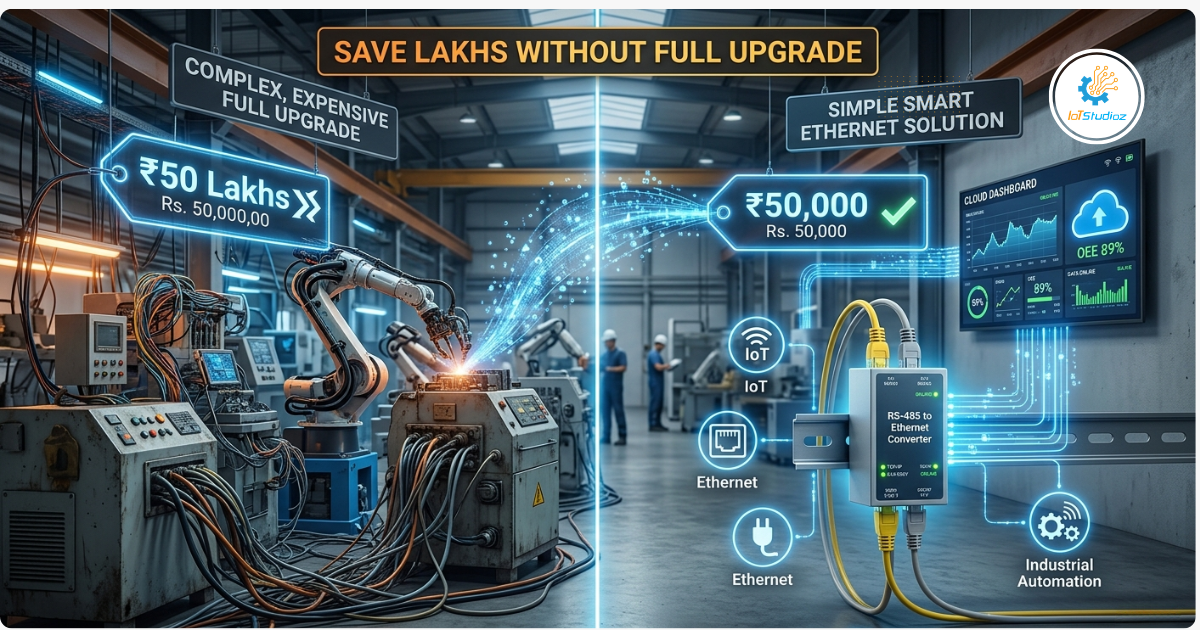
Before You Upgrade Your Factory, Read This: The ₹50,000 Fix That Saves ₹50 Lakhs Leave a comment
The term “Industry 4.0” makes them worry that their existing equipment is obsolete, often leading to plans to spend ₹50–₹100 Lakhs on new CNC machines, PLCs, or automation systems. But here’s the reality: over 80% of factory-floor equipment still functions perfectly well, and the real bottleneck is communication, not the hardware.
Your current machines, many running on the RS-485 protocol, have been delivering reliable performance for years. The challenge lies not in the machines, but in the missing insights from data. With a simple ₹50,000 connectivity upgrade, factories can capture real-time digital data, monitor production, and improve efficiency without replacing expensive machinery.
The Protocol Gap Explained
Legacy industrial equipment uses the RS-485 standard. It is rugged and handles long distances well. However, RS-485 is a “serial” language. It cannot talk to your office computer directly. It cannot send data to the cloud on its own.
Modern management needs real-time dashboards. You want to see production counts from your laptop. To do this, you must bridge the gap between serial wires and high-speed networks. This is where an RS-485 to Ethernet Converter becomes your most valuable tool.
Why the “Full Upgrade” Is a Financial Trap
Buying a new machine for ₹50 Lakhs brings several hidden costs:
- Training Time: Your staff must learn entirely new interfaces.
- Integration Issues: New machines might not fit your current workflow.
- Disposal Costs: Removing old, heavy machinery is expensive and slow.
- Fast Depreciation: New technology loses financial value quickly.
A high-quality RS-485 to Lan Converter costs between ₹5,000 and ₹10,000. Even with professional wiring and basic software, your total cost stays under ₹50,000. You save over ₹49 Lakhs by adding a “digital brain” to your existing hardware.
How the RS-485 to Ethernet Converter Works
An RS-485 to Ethernet converter functions as a real-time communication bridge between industrial devices and modern networks. It receives differential electrical signals from RS-485 lines, converts them into digital data, and encapsulates them into TCP/IP packets. These packets are then transmitted over Ethernet networks for further processing.
1. Remote Monitoring
Remote monitoring becomes significantly easier with an RS-485 to Ethernet converter because it eliminates the need for physical presence near equipment. Operators can securely access machine data such as temperature, pressure, and speed from distant locations, improving efficiency, response time, and overall operational convenience across facilities.
2. Precise Data Logging
The converter enables continuous and accurate data logging by transmitting real-time information to centralized servers or databases. This allows businesses to store detailed production records, analyze performance trends over time, detect inefficiencies, and make informed decisions to reduce downtime, optimize processes, and minimize operational costs.
3. Multiple User Access
Unlike traditional RS-485 systems that support only one master device at a time, an Ethernet-based setup allows multiple users to access data simultaneously. Engineers, managers, and technicians can monitor and analyze the same system in real time, improving collaboration, decision-making, and overall productivity within the organization.
4. Easy Integration with Modern Systems
An RS-485 to Ethernet converter simplifies integration between legacy industrial equipment and modern IT infrastructure. It allows older machines to communicate with software platforms like SCADA, ERP, or cloud services. This ensures businesses can upgrade digitally without replacing existing hardware, saving costs and extending equipment lifespan.
5. Improved Network Scalability
The converter enhances scalability by allowing multiple RS-485 devices to connect over standard Ethernet networks. As operations grow, additional devices can be added without complex rewiring. This flexibility supports expanding industrial setups, enabling seamless communication across larger systems while maintaining stable and efficient data transmission.
Industry Stats: The Power of Simple Connectivity
Recent studies on mid-sized Indian factories show impressive results. Companies that connected their legacy gear saw a 12% rise in uptime. They did not buy a single new machine. They only added connectivity tools.
| Equipment Type | Cost of Full Replacement | Cost of Connectivity Fix |
| CNC Machine | ₹35,00,000 | ₹8,500 |
| Power Meter | ₹1,50,000 | ₹4,000 |
| Industrial PLC | ₹12,00,000 | ₹12,000 |
| Estimated Total | ₹48,50,000 | ₹24,500 |
The ROI (Return on Investment) for an RS-485 to Lan Converter is often reached in less than 30 days.
Essential Features for Industrial Environments
Not every converter is suitable for a factory. Cheap, home-grade versions will fail quickly. Factories are hot, dusty, and electrically noisy. Your hardware must be durable.
1. Industrial Isolation
Industrial isolation is critical in factory environments where heavy machinery generates significant electrical noise. This interference can travel through communication lines and damage sensitive systems. A converter with at least 1.5kV galvanic isolation protects connected devices, ensuring stable data transmission and safeguarding your network from voltage spikes.
2. Protocol Conversion
Protocol conversion ensures seamless communication between legacy machines and modern systems. Most industrial equipment uses Modbus RTU, while newer applications rely on Modbus TCP. A compatible converter translates these protocols efficiently, allowing software platforms to access machine data easily without requiring additional programming or complex system modifications.
3. Rugged Design
A rugged design is essential for durability and long-term performance in industrial settings. Features like DIN-rail mounting allow secure installation inside control panels, while a metal enclosure helps dissipate heat effectively. Such construction protects internal components from physical damage, dust, and temperature fluctuations commonly found in factories.
4. Wide Operating Temperature Range
Industrial environments often experience extreme temperature variations, from very cold storage areas to high-heat production zones. A reliable converter should support a wide operating temperature range, ensuring consistent performance without overheating or failure. This feature helps maintain uninterrupted communication even in the harshest working conditions.
5. Reliable Power Supply Options
Flexible and stable power supply support is vital for industrial applications. Converters should accept a wide voltage input range to handle fluctuations in factory power systems. This ensures continuous operation even during voltage drops or surges, reducing downtime and maintaining consistent data communication across connected devices.
How to Implement This ₹50,000 Fix
You can modernize your floor by following these steps:
- Identify the Port: Locate the A(+) and B(-) terminals on your machine or meter.
- Wire the Device: Connect these serial wires to the RS-485 to Lan Converter.
- Link the Network: Plug a standard Cat6 Ethernet cable into your network switch.
- Set the IP: Assign the device a static IP address so your software can find it.
- Collect Data: Use a simple SCADA or dashboard software to pull the numbers.
The Logical Case for Keeping Old Gear
Mechanical engineers built older machines to last 30 to 40 years. Modern machines often use lighter, less durable parts. By keeping your heavy steel machines, you maintain mechanical reliability.
The only “old” part of your machine is how it talks. Modernizing the signal is more efficient than modernizing the metal. You get the data speed of a new factory with the stability of your proven equipment.
Avoiding Common Purchasing Mistakes
Many managers buy “commercial-grade” converters to save a few hundred rupees. This is a mistake. Commercial units often restart when a large motor nearby turns on.
- Temperature Range: Ensure it handles up to 70°C.
- Power Input: Most factories use 24V DC power.
- Watchdog Timer: This feature automatically restarts the device if the software freezes.
Conclusion
An RS-485 to LAN converter is a practical, cost-effective way to modernize your factory without heavy investment or operational disruption. It not only saves capital but also reduces downtime and eliminates the need for extensive staff retraining. By using an RS-485 to Ethernet converter, you can quickly transform legacy machines into connected, data-driven assets. Before committing to expensive upgrades, inspect your existing equipment, those overlooked serial ports can serve as powerful gateways to real-time insights, helping you build a smarter, more efficient factory in minimal time.
Frequently Asked Questions
1. Why is replacing old factory machines often unnecessary?
Most industrial machines (over 80%) are still mechanically sound. The real issue is lack of data visibility, not performance. Upgrading communication systems instead of hardware solves this problem at a fraction of the cost.
2. What problem does RS-485 technology create in modern factories?
RS-485 is a serial communication protocol that cannot directly connect to modern computers or cloud systems. This limits real-time monitoring and data analysis, creating a communication gap.
3. How does an RS-485 to Ethernet converter solve this issue?
It converts RS-485 signals into TCP/IP data packets that can travel over Ethernet networks. This allows machines to send data to computers, dashboards, or cloud platforms in real time.
4. Is this solution compatible with modern industrial software?
Yes, RS-485 to Ethernet converters support integration with systems like SCADA, ERP, and cloud platforms by converting protocols such as Modbus RTU to Modbus TCP.
5. What are common mistakes to avoid when choosing a converter?
Avoid using low-cost, commercial-grade converters. These may fail in harsh industrial environments due to heat, dust, and electrical noise. Always choose industrial-grade devices with reliability features like watchdog timers.