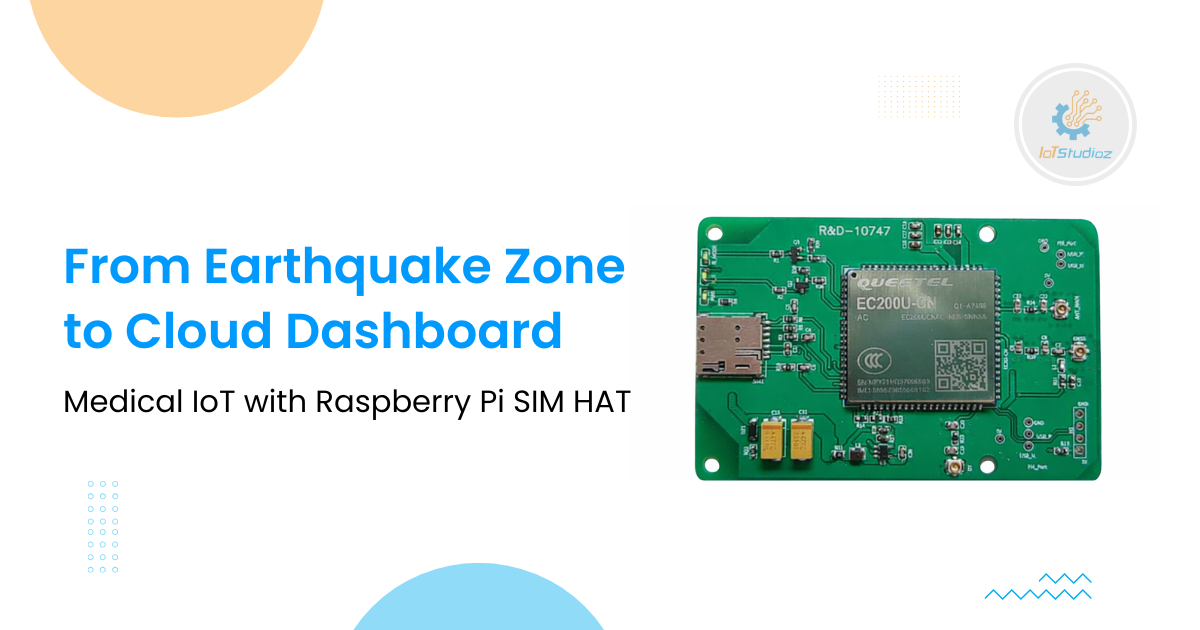
From Earthquake Zone to Cloud Dashboard: Medical IoT with Raspberry Pi SIM HAT Leave a comment
Earthquakes can disrupt healthcare systems within minutes, causing power loss, network failures, and damaged hospitals, with up to 40% of facilities becoming partially or fully non-operational in severe events while emergency demand rises sharply. Medical IoT helps address this challenge by enabling connected devices to collect and transmit vital patient data, where remote monitoring can reduce response and triage time by around 30–40% even when local infrastructure fails. By combining a Raspberry Pi with a cellular SIM HAT, a compact and low-power edge gateway is created that can reliably transmit medical data from earthquake-affected zones to cloud dashboards, supporting timely, data-driven medical decisions when they matter most.
Why Earthquakes Break Communication Networks
Earthquakes damage physical infrastructure first. Fiber cables snap. Cellular base stations lose power. Local internet routers stop working.
According to the International Telecommunication Union, more than 60% of disaster areas face network outages after major earthquakes. In many cases, services remain unavailable for over 24 hours.
Wi-Fi depends on local routers and wired backhaul. Once these fail, connected medical systems go offline. This creates blind spots for doctors and emergency teams.
Cellular networks recover faster than wired networks. Many towers switch to backup power. Mobile coverage often returns before fixed internet. This makes cellular IoT a better option for disaster healthcare.
Medical IoT in Disaster Healthcare
Medical IoT connects sensors, computing devices, and cloud platforms. These systems collect health data and share it in near real time.
In earthquake response, Medical IoT supports:
- Continuous patient monitoring
- Remote triage decisions
- Alert generation for critical cases
- Tracking of medical equipment
Wearable sensors measure heart rate, oxygen saturation, temperature, and motion. Gateways send this data to cloud systems. Doctors view dashboards from safe locations.
A study published by IEEE showed that connected monitoring systems reduced emergency response delays by almost 30%. Faster data access improves treatment outcomes during disasters.
Why Raspberry Pi Fits Medical IoT Use
Raspberry Pi offers reliable edge computing at low cost. Engineers use it widely in healthcare and industrial IoT.
Key advantages include:
- Compact size for portable kits
- Affordable hardware cost
- Linux operating system support
- Easy sensor integration
Raspberry Pi supports USB, GPIO, SPI, and I2C interfaces. This allows direct connection to medical sensors and devices.
However, Raspberry Pi does not include native cellular connectivity. In disaster zones, Wi-Fi fails often. A SIM HAT solves this limitation.
What a SIM HAT Adds to Raspberry Pi
A SIM HAT adds cellular connectivity to Raspberry Pi. It connects through USB or serial interfaces. It accepts a SIM card from a mobile operator.
Main benefits include:
- Wide-area coverage
- Mobility for field deployments
- Independence from local networks
- Reliable uplink to cloud platforms
In Medical IoT systems, the SIM HAT becomes the main communication channel between the field and the cloud.
LTE Categories for Medical IoT
Different medical applications need different data speeds. LTE categories define these capabilities. Two common options are CAT 1 and CAT 4.
1. LTE CAT 1 for Medical IoT
LTE CAT 1 supports moderate data rates with stable performance.
Key CAT 1 features include:
- Download speeds up to 10 Mbps
- Upload speeds up to 5 Mbps
- Lower power use
- Long-term network support
CAT 1 suits applications such as:
- Vital sign monitoring
- Alert-based reporting
- Battery-powered medical devices
The Raspberry Pi 4G LTE CAT 1 HAT fits these use cases well. It supports reliable telemetry without high power demand.
GSMA reports show that CAT 1 connections will exceed 500 million globally by 2026. This confirms strong long-term support.
2. LTE CAT 4 for High-Data Medical Use
LTE CAT 4 supports higher data rates and lower latency.
CAT 4 characteristics include:
- Download speeds up to 150 Mbps
- Upload speeds up to 50 Mbps
- Better support for real-time data
CAT 4 suits advanced use cases such as:
- Medical image uploads
- Video-based consultations
- Live dashboards with multimedia
The Raspberry Pi 4G LTE CAT 4 HAT supports these needs. It enables rich data transfer from the field to specialists.
Choosing Between CAT 1 and CAT 4
It serve different roles in disaster healthcare.
CAT 1 works best for:
- Long battery life
- Sensor-heavy systems
- Text and numeric data
CAT 4 works best for:
- High-resolution images
- Video communication
- Real-time data streams
Many deployments combine both technologies. CAT 1 handles routine monitoring. CAT 4 supports critical high-data tasks.
Smart Parking & Traffic Monitoring Solutions Using Raspberry Pi LTE HAT
Medical IoT System Architecture
Medical IoT system architecture connects sensors, devices, edge gateways, and cloud platforms to monitor, transmit, and analyze patient health data remotely.
A typical disaster-ready Medical IoT system includes:
- Medical sensors
- Raspberry Pi processing unit
- Raspberry Pi 4G LTE CAT 1 HAT or CAT 4 HAT
- Cellular network
- Cloud platform
- Web dashboard
Data flow follows these steps:
- Sensors capture patient data
- Raspberry Pi processes the data locally
- SIM HAT sends data over LTE
- Cloud servers store and analyze data
- Dashboards display insights to clinicians
This structure supports fast response and remote decision-making.
Edge Processing in Disaster Zones
Edge processing reduces network load and response time. Raspberry Pi performs local computation before sending data.
Common edge tasks include:
- Noise filtering
- Threshold checks
- Alert generation
- Temporary data storage
For example, the system sends oxygen data only when values cross danger levels. This saves bandwidth and power.
Power Management in Emergency Conditions
Power access remains limited after earthquakes. Medical IoT systems often rely on batteries or solar panels.
Power strategies include:
- High-capacity battery packs
- Solar charging units
- Reduced data transmission intervals
Field tests show that a Raspberry Pi with a CAT 1 HAT can operate for 15 to 20 hours on a 20,000 mAh battery. CAT 4 systems consume more power and require larger energy reserves.
Cloud Dashboards for Medical Teams
Cloud dashboards provide centralized access to patient data.
They show:
- Vital sign trends
- Alerts and notifications
- Device health status
- Location information
Doctors access dashboards securely from any location. This reduces the need for on-site specialists.
During the Nepal earthquake response, remote dashboards helped international teams support local doctors. Reports showed faster triage decisions and better coordination.
Data Security and Privacy
Medical data requires strong protection. Disaster conditions do not reduce privacy requirements.
Security practices include:
- Encrypted LTE communication
- Secure device authentication
- Encrypted cloud storage
- Controlled dashboard access
Raspberry Pi systems support standard Linux security tools. SIM HAT modules support secure network protocols.
Real-World Deployment Example
A field medical camp deployed portable monitoring kits after an earthquake.
Each kit included:
- Raspberry Pi
- Raspberry Pi 4G LTE CAT 1 HAT
- Vital sign sensors
- Battery power system
Data reached cloud dashboards within seconds. Remote doctors helped prioritize patients.
Another team used Raspberry Pi 4G LTE CAT 4 HAT units to transmit ultrasound images. Specialists reviewed images remotely and advised treatment.
Benefits and Limitations
Benefits
- Reliable connectivity without local networks
- Real-time medical visibility
- Lower hardware cost
- Flexible CAT 1 and CAT 4 support
Limitations
- Higher power use with CAT 4
- Dependence on cellular coverage
- Technical setup requirements
Achieve Reliable, Always-On Connectivity for Critical IoT Deployments with Raspberry Pi SIM HAT
At IoTStudioz, we understand that dependable connectivity is essential in mission-critical and remote environments. Our Raspberry Pi SIM HAT solutions enable stable, high-speed cellular communication to keep your IoT systems connected when traditional networks fail. Designed for demanding use cases such as medical IoT, disaster response, and industrial monitoring, our SIM HATs ensure continuous data flow from the field to the cloud. Robust, scalable, and easy to integrate, they empower teams to maintain real-time visibility and operational control.
Connect with IoTStudioz today and discover how our Raspberry Pi cellular solutions can keep your critical systems running without interruption.
Conclusion
Medical IoT improves healthcare delivery during earthquakes, where reliable connectivity determines system success and traditional networks often fail. Cellular SIM HATs provide resilient communication, while Raspberry Pi enables flexible edge computing in disaster environments. The Raspberry Pi 4G LTE CAT-1 HAT supports low-power medical telemetry for vital signs and continuous monitoring, whereas the Raspberry Pi 4G LTE CAT-4 HAT enables higher-bandwidth transmission for richer medical data. Together, these technologies securely move critical health information from earthquake zones to cloud dashboards, enabling faster decision-making, better coordination among medical teams, and improved patient outcomes.
Frequently Asked Questions (FAQ)
1. Why is Medical IoT important in earthquake-prone areas?
Medical IoT enables real-time patient monitoring when hospitals and networks fail. It helps doctors make faster decisions and improves survival rates during emergencies.
2. Why is Raspberry Pi commonly used in disaster Medical IoT systems?
Raspberry Pi offers low cost, small size, and strong software support. It integrates easily with medical sensors and cellular SIM HATs.
3. What role does a SIM HAT play in Medical IoT deployments?
A SIM HAT provides cellular connectivity. It allows Raspberry Pi systems to send data without relying on local Wi-Fi or wired networks.
4. When should I use a Raspberry Pi 4G LTE CAT 1 HAT?
Use a Raspberry Pi 4G LTE CAT 1 HAT for vital sign monitoring, alerts, and telemetry. It works well for low power and long-duration deployments.
5. When is a Raspberry Pi 4G LTE CAT 4 HAT a better choice?
A Raspberry Pi 4G LTE CAT 4 HAT suits high-data use cases such as medical imaging, video consultation, and real-time dashboards.
6. Can CAT 1 and CAT 4 be used together in one medical system?
Yes. Many systems use CAT 1 for routine monitoring and CAT 4 for data-heavy tasks. This balances power use and performance.
7. How reliable is cellular connectivity after an earthquake?
Cellular networks often recover faster than wired networks. Studies show mobile coverage returns within hours in many disaster zones.
8. How long can a Raspberry Pi Medical IoT system run on battery power?
A Raspberry Pi with a CAT 1 HAT can run 15–20 hours on a 20,000 mAh battery. CAT 4 systems require more power.
9. How is patient data protected in Medical IoT systems?
Systems use encrypted LTE communication, secure authentication, and encrypted cloud storage. Linux-based security tools add extra protection.
10. What types of medical data can these systems transmit?
They transmit vital signs, alerts, location data, device status, images, and video. CAT 1 suits numeric data, while it supports rich media.