
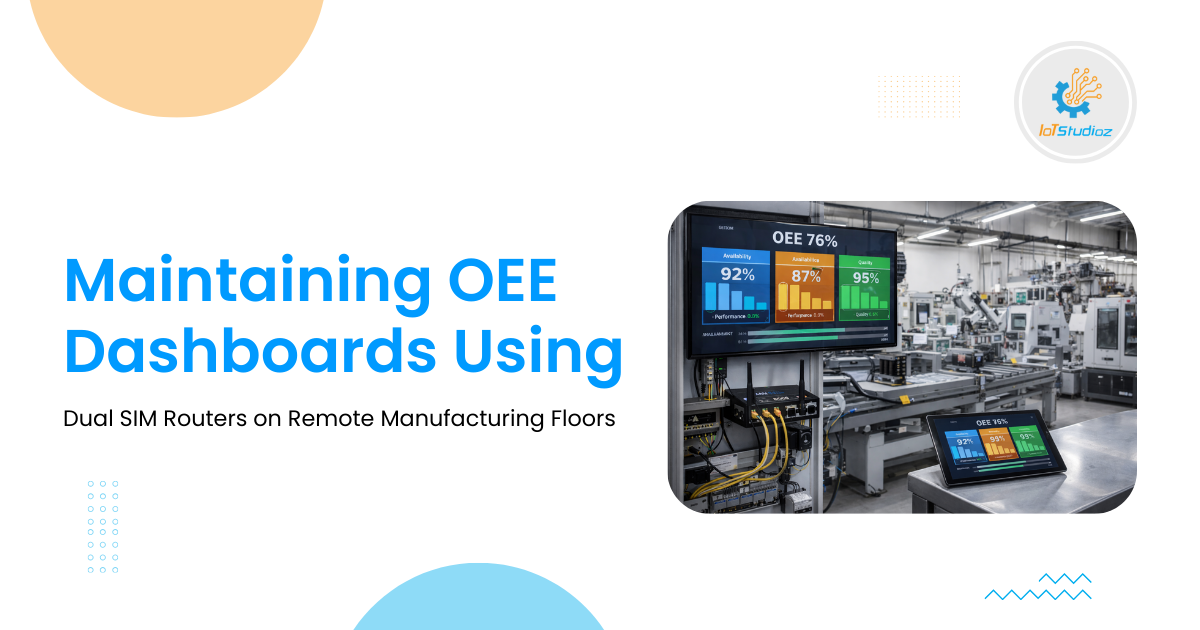
Maintaining OEE Dashboards Using Dual SIM Routers on Remote Manufacturing Floors
Manufacturing plants depend on accurate production data. Overall Equipment Effectiveness, or OEE, is one of the most important performance indicators. Industry reports show that manufacturers using real-time production data achieve productivity gains of up to 20%. OEE dashboards provide real-time insights into machine health and output. However, studies indicate that remote industrial sites face up to 40% more network disruptions than urban plants, creating serious connectivity challenges that can affect data accuracy and decision-making.
What Is OEE and Why It Matters
OEE (Overall Equipment Effectiveness) is a vital metric in manufacturing used to measure how efficiently production equipment is utilized. It considers three primary factors: Availability, Performance, and Quality. OEE is calculated by multiplying these three factors, with the ideal score being 100%, indicating perfect production with no downtime, maximum speed, and only quality products.
Why OEE Matters:
- Availability: Measures the amount of scheduled production time the machine is actually running.
- Performance: Evaluates if the machine is running at the ideal speed or slower.
- Quality: Tracks how many defect-free products are produced.
By monitoring OEE, manufacturers can identify inefficiencies, reduce waste, and improve overall profitability. Regular OEE tracking leads to continuous improvement and operational optimization.
Role of OEE Dashboards
OEE dashboards display live data from machines and production lines. Engineers and supervisors use dashboards to:
- Identify downtime causes
- Monitor production rates
- Detect quality losses
- Improve maintenance planning
Stat: According to Deloitte, manufacturers using real-time performance dashboards see efficiency improvements of 15 to 25 percent.
Challenges on Remote Manufacturing Floors
Remote manufacturing locations often operate outside major industrial zones. Network infrastructure is limited or inconsistent.
Common Connectivity Issues
- No fiber or wired broadband
- Weak cellular signal coverage
- Frequent network outages
- Harsh environmental conditions
Unstable connectivity causes data gaps. Missing data reduces OEE accuracy and decision quality.
Importance of Reliable Connectivity for OEE Systems
OEE systems depend on continuous data transmission. Machines generate thousands of data points each minute. Any network break interrupts data flow.
Effects of Network Failure
- Incomplete OEE calculations
- Delayed alerts
- Incorrect downtime reporting
- Loss of historical production data
Reliable networking is essential for correct OEE performance tracking.
Industrial Routers in Manufacturing Environments
Industrial routers connect machines and control systems to data platforms. They differ from commercial routers in design and durability.
Key Features of Industrial Routers
- Designed for 24/7 operation
- High resistance to heat and dust
- Strong vibration tolerance
- Long product lifecycle
A Dual SIM 4G LTE Industrial Router adds network redundancy, which is critical for remote sites.
Understanding Dual SIM Industrial Router Technology
A Dual SIM Industrial Router supports two SIM cards from different mobile operators. The router monitors both network connections.
How Dual SIM Operation Works
- One SIM acts as the primary connection
- The second SIM remains on standby
- The router checks signal strength and stability
- Automatic switching occurs during network failure
This process requires no manual intervention.
Why Dual SIM Routers Support Reliable OEE Dashboards
Dual SIM routers ensure reliable OEE dashboards by providing network redundancy, automatic failover, and stable connectivity, minimizing downtime and ensuring continuous data flow in remote locations.
1. Continuous Data Transmission
OEE dashboards need steady data streams, and Dual SIM routers ensure continuous connectivity by automatically switching to a backup network during outages, preventing disruptions and maintaining accurate data.
2. Network Redundancy for Remote Sites
Remote plants often rely on cellular networks, and single network dependency increases the risk of failure. According to GSMA, rural cellular networks experience outages 30 to 40 percent more often than urban networks. Dual SIM routers help mitigate this risk by automatically switching between networks, ensuring continuous connectivity and minimizing disruptions to operations.
Data Flow from Machines to OEE Dashboards
Data flows from machines through sensors and PLCs to edge gateways, then via industrial routers to servers or cloud platforms, enabling real-time OEE dashboards and performance monitoring.
Understanding the data path highlights the router’s role.
Typical OEE Data Flow
- Sensors capture machine signals
- PLCs process operational data
- Edge gateways format production data
- Industrial router transmits data
- Servers or cloud platforms store data
- OEE dashboards display metrics
The router acts as the central communication link.
Maintaining OEE Accuracy with Dual SIM Routers
Dual SIM routers maintain OEE accuracy by providing continuous, uninterrupted connectivity, preventing data loss, and ensuring real-time, reliable production monitoring.
1. Preventing Data Gaps
Dual SIM routers support buffering during brief outages. Stored data transmits once connectivity returns.
This protects historical production records.
2. Supporting Real-Time Visibility
Production teams rely on live dashboards for quick action. Stable connectivity ensures real-time alerts remain accurate.
Stat: Manufacturers using real-time alerts reduce downtime response times by 20 percent, according to McKinsey.
Use Cases from Remote Manufacturing
1. Remote Metal Fabrication Plant
A metal fabrication plant operates in a remote industrial zone. Wired internet access is unavailable.The plant uses a Dual SIM 4G LTE Industrial Router with two national carriers. OEE dashboards receive live machine data.The plant improved equipment availability by 17 percent within nine months.
2. Cement Production Facility
A cement facility operates in a mountainous area. Weather affects cellular signal stability.Dual SIM routers switch networks during signal loss. OEE dashboards remain operational throughout production shifts.Maintenance teams reduced unplanned stops due to faster issue detection.
Technical Capabilities That Support OEE Dashboards
1. High Reliability Hardware Design
Industrial routers withstand:
- Temperature extremes
- Electrical noise
- Mechanical vibration
These traits suit demanding factory conditions.
2. Secure Data Transmission
Production data must remain protected. Dual SIM routers support:
- Encrypted VPN tunnels
- Firewall filtering
- Secure authentication
These features protect operational data from unauthorized access.
Integration with Manufacturing Control Systems
1. PLC and SCADA Compatibility
Dual SIM routers support common industrial protocols, including:
- Modbus TCP
- OPC UA
- PROFINET
This ensures smooth integration with existing automation systems.
2. Cloud and Edge Analytics Support
Many OEE platforms use cloud analytics. Some use edge processing for faster response.
Dual SIM routers support both deployment models.
Bandwidth Management for OEE Data
1. Traffic Prioritization
OEE data requires consistent bandwidth. Dual SIM routers support traffic prioritization.Production metrics receive priority over non-critical traffic.
2. Latency Reduction
Lower latency improves dashboard refresh rates. Dual SIM routers select the fastest available network.This improves real-time decision making.
Power Stability in Remote Plants
It instability affects network equipment in remote locations.
Power Protection Features
Industrial routers support:
- Wide voltage input ranges
- Surge protection
- Battery backup compatibility
These features maintain connectivity during power fluctuations.
Remote Monitoring and Management
Centralized Router Control
Dual SIM routers support remote management tools. Engineers can:
- Monitor signal strength
- Check data usage
- Update firmware remotely
This reduces maintenance costs and site visits.
Cost Impact of Dual SIM Routers
1. Downtime Cost Reduction
Network-related downtime impacts production significantly.
Stat: Aberdeen Group reports average downtime costs of $260,000 per hour for manufacturers.Dual SIM routers reduce downtime caused by connectivity failure.
2. Controlled Connectivity Expenses
Manufacturers can select cost-effective carrier plans. Data usage can balance between two networks.This improves cost predictability.
Scaling OEE Dashboards Across Multiple Sites
Large manufacturers operate several remote facilities.Dual SIM routers support standardized network deployment across all locations.IT teams manage configurations centrally.
Compliance and Data Traceability
Production data is crucial for supporting quality audits and compliance reporting. To ensure accurate and complete data records, consistent connectivity is essential. Dual SIM routers provide a solution by offering seamless failover between networks, guaranteeing uninterrupted data logging. This ensures that companies maintain audit-ready data logs, even during network disruptions. With dual SIM routers, businesses can confidently meet industry standards and regulatory requirements, knowing their data is always available and reliable.
Single SIM vs Dual SIM Routers
Here’s a clear table comparing Single SIM and Dual SIM routers based on your points:
| Feature | Single SIM Routers | Dual SIM Routers |
| Network Dependency | Depends on one carrier | Supports two carriers for redundancy |
| Outage Risk | Higher risk of downtime | Reduced risk with automatic switching |
| Coverage | Limited coverage flexibility | Better coverage and network reach |
| Data Reliability for OEE | May cause interruptions | Ensures continuous, reliable data flow |
| Operational Advantage | Basic connectivity | Improved uptime and operational stability |
This highlights why Dual SIM routers are critical for reliable OEE dashboards in remote manufacturing environments.
Single SIM vs Dual SIM Routers: Why Redundancy Has Become a Must for Industrial IoT
Future Direction of OEE Systems
OEE systems are evolving toward smarter, more connected manufacturing. Advanced platforms now integrate AI and predictive analytics to anticipate equipment issues, reduce downtime, and optimize production efficiency. Cloud-enabled OEE solutions allow centralized monitoring of multiple plants, while IoT-connected machines provide faster, more accurate data for dashboards. In this context, Dual SIM routers play a crucial role by maintaining reliable and uninterrupted connectivity, even in remote or challenging industrial locations. This ensures continuous data flow, supports real-time decision-making, and enables manufacturers to adopt proactive strategies for improving overall equipment effectiveness.
Deployment Best Practices
1. Carrier Selection
Choose two carriers with different coverage strengths to ensure reliable connectivity. Using carriers with complementary networks reduces downtime and improves availability across locations. Avoid selecting SIM cards from the same provider, as this limits redundancy and failover effectiveness. A diversified carrier strategy strengthens network resilience.
2. Antenna Placement
Proper antenna placement is critical for optimal network performance. Install antennas away from electrical noise sources to reduce interference and signal degradation. Before final installation, test signal strength to identify the best location. This ensures stable connectivity, improved data transmission, and reliable network performance.
From Downtime to Real-Time OEE Monitoring in Hours with Dual SIM Routers
At IoTStudioz, we understand that remote manufacturing floors often face connectivity challenges that can disrupt critical OEE dashboards. Our Dual SIM Industrial Routers offer a seamless solution to ensure reliable, uninterrupted data flow. By automatically switching between networks, these routers maintain constant connectivity, even during carrier outages. Designed for industrial environments, they provide real-time data transmission from machines to dashboards, ensuring accurate OEE metrics for smarter decision-making. Quick to deploy and easy to integrate, they help keep your operations running smoothly with minimal downtime.
Connect with IoTStudioz today and discover how our Dual SIM Industrial Routers can ensure continuous, reliable OEE monitoring for your remote manufacturing floors.
Conclusion
Maintaining accurate OEE dashboards on remote manufacturing floors depends heavily on reliable and continuous connectivity. Network disruptions can compromise data accuracy and delay critical operational decisions. A Dual SIM Industrial Router addresses these challenges by providing network redundancy and stability, while a Dual SIM 4G LTE Industrial Router ensures uninterrupted data transmission even in demanding environments. With consistent connectivity, manufacturers benefit from improved uptime, faster response times, and more accurate performance insights. For remote manufacturing operations, dual SIM connectivity plays a vital technical role in sustaining effective and reliable OEE monitoring.
Frequently Asked Questions
1. What is an OEE dashboard and why is it important?
An OEE dashboard tracks Overall Equipment Effectiveness by measuring availability, performance, and quality, helping manufacturers identify inefficiencies and improve productivity.
2. Why is reliable network connectivity critical for OEE monitoring?
OEE dashboards rely on real-time production data. Network disruptions can cause data gaps, inaccurate metrics, and delayed decision-making.
3. How do dual SIM routers prevent data loss?
Dual SIM routers automatically switch to a secondary network if the primary connection fails, ensuring continuous data transmission.
4. What challenges do remote manufacturing sites face?
Remote sites often experience weak signals, network outages, and limited infrastructure, making stable connectivity difficult.
5. How does a dual SIM industrial router improve uptime?
By providing network redundancy and failover, it minimizes downtime and keeps monitoring systems online.