
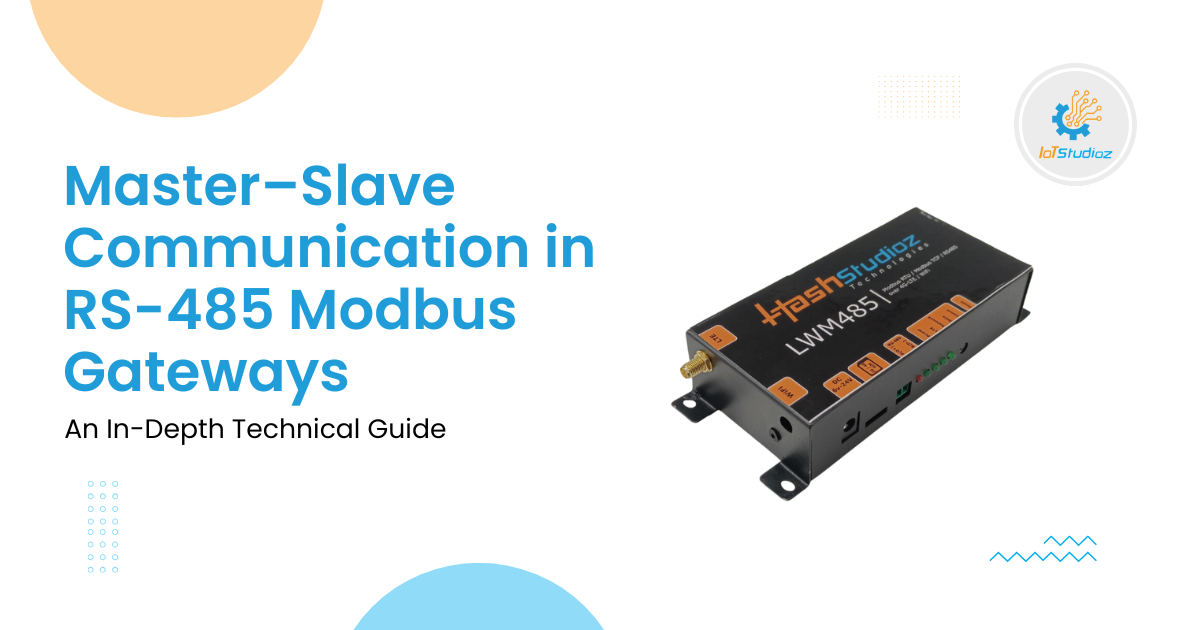
Master–Slave Communication in RS-485 Modbus Gateways: An In-Depth Technical Guide Leave a comment
We explore master–slave communication in RS-485 Modbus gateways as one of the most trusted and widely implemented communication models in industrial automation. This architecture is designed to deliver deterministic data exchange, predictable timing, electrical robustness, and long-distance communication, making it ideal for mission-critical environments.
RS-485 Modbus networks continue to dominate applications where reliability, simplicity, and interoperability are non-negotiable. In this guide, we explain every point and sub-point in depth, covering electrical principles, protocol mechanics, gateway intelligence, addressing logic, error handling, optimization strategies, and deployment best practices.
RS-485 Physical Layer Fundamentals
Differential Signaling Mechanism
RS-485 uses balanced differential signaling, where data is transmitted as the voltage difference between two signal lines—commonly labeled A and B. Instead of relying on a voltage level referenced to ground, the receiver interprets data based on the polarity between these two wires.
This mechanism delivers several critical advantages:
- High noise immunity: Electromagnetic interference (EMI) generated by motors, variable frequency drives (VFDs), contactors, and relays typically couples equally into both signal lines. Since the receiver only measures the voltage difference, common-mode noise is effectively canceled.
- Stable communication in harsh industrial environments: Differential signaling enables reliable communication in factories, substations, and outdoor installations where electrical noise, vibration, and temperature variations are unavoidable.
- Reduced impact of ground potential differences: Over long cable runs, devices may operate at different ground potentials. Differential signaling minimizes communication errors caused by these voltage offsets.
A logic “1” or “0” is defined purely by the polarity between the A and B lines, ensuring accurate signal interpretation even under adverse electrical conditions.
Cable Type, Impedance, and Distance
RS-485 communication relies on twisted-pair cables with a characteristic impedance of approximately 120 ohms. Proper cable selection is essential for maintaining signal integrity over long distances.
This design enables the following benefits:
- Long-distance communication: At lower baud rates, RS-485 networks can reliably transmit data over distances of up to 1200 meters, making them suitable for large industrial facilities.
- Reduced signal reflection and distortion: Matching cable impedance with termination resistors prevents reflections that can corrupt data and cause CRC errors.
- Consistent electrical characteristics across the bus: Twisted-pair construction maintains uniform impedance and minimizes susceptibility to external noise.
Cable length, baud rate, and environmental noise must be carefully balanced to achieve optimal performance.
RS-485 Network Topology and Bus Architecture
RS-485 Network Topology and Bus Architecture refers to the physical and logical structure used to connect multiple RS-485 devices on a shared communication medium. It defines how devices are wired, how signals travel, and how communication is controlled to ensure reliability and scalability.
1. Multi-Drop Bus Configuration
Multi-Drop Bus Configuration means multiple RS-485 devices share a single pair of communication wires under centralized control.
Key points include:
- Parallel device connection – All devices are electrically connected in parallel on the same bus, reducing wiring complexity.
- Single active transmitter – Only one device transmits at a time, preventing electrical contention and data collisions.
- Centralized communication control – A master device governs all data exchanges, ensuring orderly communication.
- Scalable industrial deployment – Additional devices can be added without redesigning the network.
2. Device Count and Unit Load Concept
Device Count and Unit Load Concept defines how many devices can be connected to an RS-485 bus based on electrical loading limits.
Key points include:
- Standard unit load limit – Traditional RS-485 supports up to 32 unit loads per segment.
- Modern low-load transceivers – Newer devices use fractional unit loads, allowing significantly more devices.
- Voltage stability assurance – Proper planning maintains sufficient differential voltage across the bus.
- Signal integrity protection – Prevents degradation caused by excessive electrical loading.
Modbus Protocol Overview for RS-485 Networks
Modbus Protocol Overview for RS-485 Networks explains the communication protocol used to structure data exchange over RS-485 serial links.
1. Why Modbus RTU Is Preferred
Modbus RTU is a compact binary protocol optimized for efficient and reliable serial communication.
Key points include:
- Low protocol overhead – Binary encoding minimizes message size and maximizes bandwidth usage.
- Strict request–response model – Only the master initiates communication, eliminating collisions.
- Deterministic timing – Predictable response behavior supports real-time industrial control.
- Half-duplex compatibility – Ideal for RS-485 networks where transmit and receive share the same bus.
Master–Slave Communication Model Explained
Master–Slave Communication Model defines a controlled communication structure where one device manages all data exchanges.
1. Master Device: Central Control Authority
Master Device refers to the single controller responsible for initiating and managing all communication.
Key points include:
- Request initiation – Sends all read and write commands to slave devices.
- Polling management – Controls polling order, frequency, and priority.
- Failure detection – Identifies timeouts and missing responses.
- Error recovery handling – Executes retries and fallback logic.
- Collision prevention – Ensures only one device transmits at a time.
2. Slave Devices: Passive Responders
Slave Devices are field devices that respond only when addressed by the master.
Key points include:
- Unique Modbus addressing – Each slave has a distinct address for identification.
- Continuous bus monitoring – Slaves listen but do not transmit unless requested.
- Response-only transmission – Data is sent only after a valid master request.
- No unsolicited messages – Ensures predictable and deterministic communication.
Modbus RTU Frame Structure and Message Processing
Modbus RTU Frame Structure defines how data is formatted and transmitted over the RS-485 bus.
1. Frame Composition
Modbus RTU Frame Composition specifies the structure of each communication message.
Key points include:
- Slave address – Identifies the intended destination device.
- Function code – Indicates the requested operation (read/write).
- Data field – Contains register addresses, values, or data length.
- CRC-16 checksum – Ensures message integrity and detects errors.
2. Timing Rules and Frame Delimitation
Timing Rules and Frame Delimitation define how Modbus RTU identifies message boundaries.
Key points include:
- 3.5 character-time silence – Marks the beginning and end of a frame.
- 1.5 character-time inter-byte limit – Prevents message fragmentation.
- Timing accuracy requirement – Ensures correct frame interpretation and reliability.
RS-485 Modbus Gateway Architecture
RS-485 Modbus Gateway Architecture describes how gateways manage communication between serial Modbus devices and modern networks.
1. Gateway as an Intelligent Master Device
Gateway as an Intelligent Master Device means the gateway controls the RS-485 bus and manages data flow.
Key points include:
- Multi-slave polling – Collects data from multiple Modbus devices.
- Data aggregation – Buffers and organizes collected data.
- Protocol translation – Converts Modbus RTU to Ethernet, cloud, or industrial protocols.
- Legacy-modern integration – Bridges field devices with digital systems.
2. Protocol Conversion and Data Normalization
Protocol Conversion and Data Normalization ensures Modbus data is usable across higher-level systems.
Key points include:
- Register mapping – Aligns raw registers with application parameters.
- Scaling and unit conversion – Converts values into engineering units.
- Timestamping – Adds time context for monitoring and analytics.
- Data validation – Ensures accuracy before forwarding data.
Addressing Strategy and Network Planning
Addressing Strategy and Network Planning defines how devices are logically identified and organized.
1. Importance of Unique Slave Addresses
Unique Slave Addressing ensures correct device identification on the network.
Key points include:
- Collision prevention – Only the intended slave responds.
- Simplified diagnostics – Faulty devices are easier to locate.
- Logical grouping – Addresses can reflect location or function.
2. Broadcast Address Usage
Broadcast Address Usage allows commands to be sent to all slaves simultaneously.
Key points include:
- Address 0 usage – Reserved for broadcast messages.
- No slave responses – Prevents bus congestion.
- Synchronized configuration – Useful for mass updates.
- Cautious application – Prevents unintended system-wide changes.
Electrical Design Best Practices
Electrical Design Best Practices ensure stable and noise-resistant RS-485 communication.
1. Termination Resistors and Signal Integrity
Termination Resistors match cable impedance to prevent reflections.
Key points include:
- 120-ohm termination – Installed at both ends of the bus.
- Reflection prevention – Eliminates signal distortion.
- Improved CRC reliability – Reduces communication errors.
2. Biasing, Grounding, and Shielding
Biasing, Grounding, and Shielding stabilize idle bus conditions and reduce interference.
Key points include:
- Bias resistors – Define a known idle state.
- Single-point grounding – Prevents ground loops.
- Shielded cabling – Minimizes EMI impact.
Error Handling and Exception Management
Error Handling and Exception Management defines how communication faults are detected and resolved.
1. Modbus Exception Responses
Modbus Exception Responses provide standardized error reporting.
Key points include:
- Illegal function codes – Unsupported operations.
- Invalid register addresses – Nonexistent data requests.
- Internal device failures – Hardware or firmware errors.
2. Timeouts, Retries, and Recovery Logic
Timeouts, Retries, and Recovery Logic maintain communication reliability.
Key points include:
- Response timeout configuration – Detects missing replies.
- Limited retry attempts – Prevents bus congestion.
- Adaptive recovery strategies – Maintains system stability.
Performance Optimization Techniques
Performance Optimization Techniques improve efficiency and responsiveness.
1. Polling Optimization
Polling Optimization reduces unnecessary bus traffic.
Key points include:
- Contiguous register reads – Minimizes message overhead.
- Reduced polling frequency – Avoids redundant requests.
- Critical data prioritization – Ensures fast updates where needed.
2. Baud Rate Selection
Baud Rate Selection balances speed, distance, and noise immunity.
Key points include:
- Higher baud rates – Improve responsiveness.
- Lower baud rates – Increase distance and noise tolerance.
- Environment-based selection – Ensures reliable operation.
Security Considerations in RS-485 Modbus Systems
Security Considerations address protection of legacy Modbus systems.
Key points include:
- Network segmentation – Isolates control networks.
- IP-side authentication – Restricts access to gateways.
- Encrypted cloud communication – Protects transmitted data.
Industrial Applications of RS-485 Modbus Master–Slave Systems
Industrial Applications of RS-485 Modbus Systems highlight their proven reliability.
Key points include:
- Energy metering and substations – Long-distance, noise-resistant communication.
- Water and wastewater plants – Reliable control of distributed assets.
- Manufacturing automation – Deterministic machine communication.
- HVAC and BMS systems – Centralized monitoring and control.
- Renewable energy installations – Stable operation in remote locations.
Future-Proofing with RS-485 Modbus Gateways
Future-Proofing with RS-485 Modbus Gateways means upgrading legacy RS-485 Modbus systems so they remain relevant, scalable, and compatible with modern digital technologies—without replacing existing field devices.
Key points include:
- Legacy system extension – Enables continued use of existing RS-485 devices while adding modern communication capabilities.
- Cloud and IIoT connectivity – Connects Modbus RTU networks to cloud platforms, dashboards, and Industrial IoT systems.
- Remote monitoring and diagnostics – Allows real-time status monitoring and fault detection from any location.
- Predictive maintenance support – Uses collected data to anticipate failures and schedule maintenance proactively.
- Data normalization and integration – Converts raw Modbus data into standardized formats for SCADA, MES, and ERP systems.
- Industry 4.0 readiness – Bridges operational technology (OT) with information technology (IT) for smart automation.
- Cost efficiency – Eliminates the need for full system replacement, reducing upgrade and maintenance costs.

Conclusion
Master–slave communication in RS-485 Modbus gateways delivers a robust, deterministic, and scalable foundation for industrial communication. Through disciplined protocol implementation, sound electrical design, and intelligent gateway integration, organizations achieve reliable data exchange and long-term operational efficiency.
FAQ
1. What is master–slave communication in RS-485 Modbus?
It is a communication model where a single master controls all data exchange, and slave devices respond only when requested.
2. Why is RS-485 preferred for industrial communication?
RS-485 offers long-distance communication, high noise immunity, and reliable multi-drop networking.
3. How many devices can connect to an RS-485 Modbus network?
Traditionally 32 devices per segment, but modern designs can support many more using low-load transceivers.
4. What is the role of an RS-485 Modbus gateway?
A gateway acts as a master, collects data from slaves, and converts it to Ethernet or cloud protocols.
5. Is Modbus RTU secure?
Modbus RTU itself is not secure, but gateways add security layers such as authentication and encryption.
6. What causes common RS-485 communication issues?
Poor termination, incorrect grounding, duplicate addresses, and timing misconfiguration are the most common causes.