
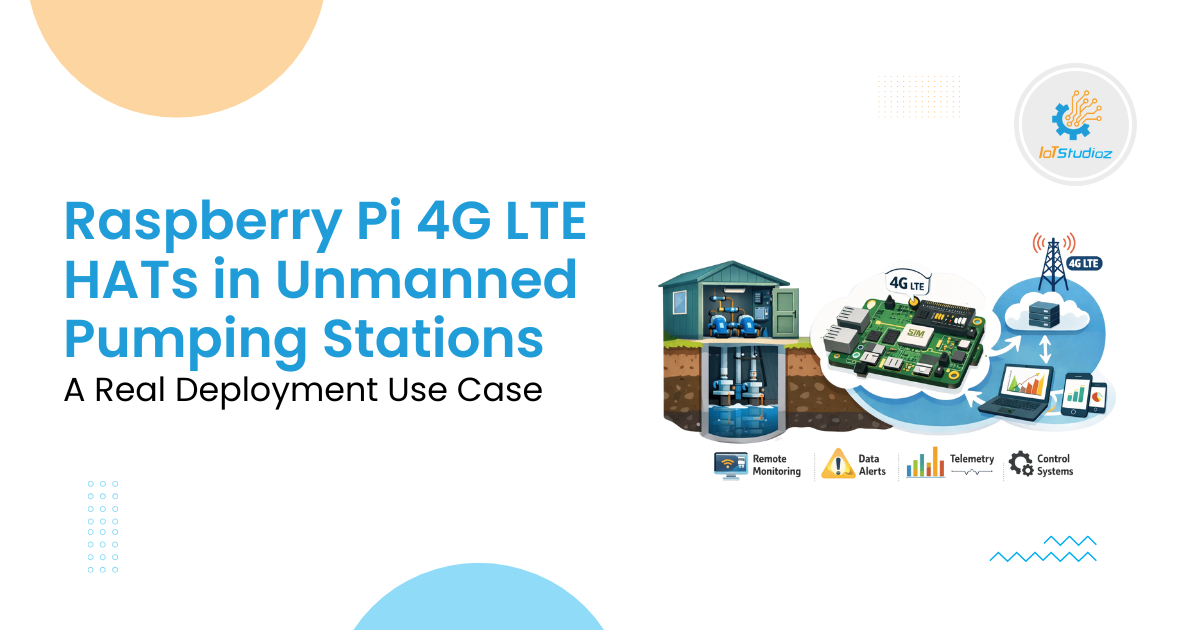
Raspberry Pi 4G LTE HATs in Unmanned Pumping Stations: A Real Deployment Use Case
Unmanned pumping stations lie at the heart of modern infrastructure. They support water supply, wastewater, industrial fluid transfer, and irrigation systems that operate across wide geographic areas. Traditionally, such stations required manual monitoring or expensive wired communication networks. These approaches often lacked flexibility, especially in remote zones without reliable connectivity.
Today’s industrial systems leverage Internet of Things (IoT) technology to reduce operational costs and improve uptime. One key enabler of remote connectivity in these systems is the Raspberry Pi 4G LTE HATs. These HATs (Hardware Attached on Top modules) let Raspberry Pi compute units communicate directly over cellular networks. The topic of this article focuses on how Raspberry Pi 4G LTE HATs play a transformative role in remotely monitoring and controlling unmanned pumping stations.
This article provides a technical perspective on design, implementation, and real-world benefits. It includes concrete statistics, engineering challenges, and system-level insights.
IoT in Industrial Monitoring: Market Context
Before diving into deployment specifics, it helps to understand the broader IoT landscape.
- Global IoT connections are projected to grow to over 21 billion by the end of 2025. This represents a 14% year-over-year increase, driven by industrial, utility, and infrastructure applications.
- Cellular IoT connectivity (including 4G LTE) is expected to reach around 4.5 billion devices by the end of 2025. These connections span smart meters, industrial sensors, and remote monitoring units.
- IoT-based pump monitoring solutions could represent a multi-billion-dollar market by 2025, enabling energy efficiency and cost savings of up to 30% in energy and 25% in maintenance costs.
These figures show that IoT integration has shifted from early experimentation toward large-scale industrial deployments. Remote connectivity solutions like Raspberry Pi 4G LTE HATs underpin many of these systems.
Why Use Raspberry Pi with 4G LTE Connectivity?
Raspberry Pi has grown popular in industrial and edge computing systems due to its balance of processing power, low cost, and open-source ecosystem.
Key Advantages of Raspberry Pi in IoT
- Affordable computation platform: Raspberry Pi boards provide quad-core ARM processors and memory suitable for edge analytics and data preprocessing.
- GPIO and peripheral support: Built-in GPIO interfaces allow direct sensor and actuator integration.
- Linux ecosystem: Full support for Linux distributions enables robust communication stacks, scripting languages, and open source connectivity tools.
However, these technical strengths are incomplete without a reliable communication interface in remote deployments.
Understanding Raspberry Pi 4G LTE HATs
A Raspberry Pi 4G LTE HAT is a cellular modem board that plugs into the Raspberry Pi hardware. It attaches to the onboard GPIO and adds cellular communication, SIM card slots, antenna ports, and power regulation circuits.
What Makes 4G LTE HATs Suitable for Remote Systems?
- Cellular Coverage: LTE networks provide much wider coverage than Wi-Fi or Ethernet in rural or industrial areas.
- Plug-and-Play: Most HATs install without complex wiring.
- Power Efficiency: LTE Category-1 modules consume less power than higher LTE categories, making them appropriate for systems with limited energy budgets.
- Embedded GPS: Some modules include GNSS location data for site coordinate tagging.
- Industrial Temperature Range: Many HATs support extended operating temperatures from -40°C to +80°C.
Performance Metrics
A typical Raspberry Pi 4G LTE HAT with Quectel EC200A module delivers:
| Metric | Value |
| Downlink | Up to 150 Mbps |
| Uplink | Up to 50 Mbps |
| Latency | ~60–150 ms |
| SIM Type | Nano SIM |
| Network | 4G LTE (Fallback to 3G/2G) |
These parameters are adequate for telemetric data transmission, remote control signals, and even periodic video snapshots from field cameras.
System Architecture: Monitoring Unmanned Pump Stations
Here’s a high-level architecture for an unmanned pumping station using Raspberry Pi 4G LTE HATs:
On-Site Hardware
- Raspberry Pi 4 or similar compute unit: Runs the local monitoring software and interfaces with sensors.
- 4G LTE HAT Module: Provides cellular connectivity to send data to the cloud or operational dashboards.
- Sensor Array: Interfaces with flow meters, pressure sensors, vibration sensors, and electrical meters.
- Actuators (Control Outputs): Used to remotely start/stop pumps or control valves.
- Power Supply: Includes redundancy such as solar panels, batteries, or UPS for continuous operation.
Communication Stack
- Cellular Data: The Raspberry Pi connects to carrier networks via the HAT.
- Protocols: MQTT or HTTPS transmit telemetry to a central server.
- Security: SIM-based authentication and encrypted tunnels ensure data protection.
Cloud Dashboard
Remote operators view dashboards that:
- Display real-time metrics.
- Trigger alerts on abnormal conditions.
- Provide historical data trends.
- Enable remote actuation.
This architecture eliminates the need for local network infrastructure and reduces the frequency of physical maintenance visits.
Software Components
Implementing this system requires several software layers:
1. Operating System
Raspberry Pi OS (Linux) provides a stable environment for networking and sensor control.
2. Connectivity Management
- NetworkManager or ModemManager handles LTE connections.
- PPP or USB networking interfaces provide the communication bridge.
3. Telemetry Protocols
- MQTT: Lightweight, ideal for frequent small messages.
- HTTPS/REST: Used for server APIs and configuration tasks.
3. Monitoring Agents
Custom Python or C agents read sensors, aggregate data, and send it at defined intervals. These agents also manage reconnection attempts if LTE drops.
Real Deployment Use Case
1. Scenario
A municipality deployed Raspberry Pi units with 4G LTE HATs on multiple unmanned water pumping stations scattered across rural zones. These stations had no fixed broadband, and power was supplied via solar arrays.
2. Deployment Highlights
- Each station reported telemetry every 5 minutes.
- Operators received SMS and email alerts for critical thresholds.
- Monthly data usage was under 1 GB per station due to efficient protocol choice.
- Remote firmware updates eliminated in-field visits.
3. Business Outcomes
- Operational Cost Reduction: Reduced technician site visits by over 40%.
- Maintenance Efficiency: Predictive analytics flagged pump degradation early, reducing downtime.
- Energy Management: Remote control enabled operational scheduling based on peak demand.
These results mirror broader industry findings, where remote monitoring reduces maintenance cost and improves uptime effectively.
Engineering Considerations
Here are some technical factors engineers must address:
1. Power Budget
LTE modems draw power spikes up to 2 A during transmission bursts. Ensure your power supply can handle this with margin.
2. Antenna Placement
External antennas improve signal strength in remote areas. Place antennas outside metal enclosures.
3. Edge Cases
- Signal Loss: Implement auto-reconnect logic.
- CGNAT Cellular Limits: Some carriers use CGNAT, complicating inbound access; consider VPN tunnels.
Security and Reliability
Security is essential in industrial IoT:
- SIM Authentication: Adds a layer before network access.
- Encrypted Communication: Use TLS for data payloads.
- Private APNs: Isolate device traffic from public internet.
Reliability comes from error handling, watchdog timers, and system health checks.
Future Trends
4G LTE will remain a strong choice for unmanned pumping stations due to wide coverage and long-term carrier support. Many operators plan to maintain 4G networks for the next decade, which suits long-life infrastructure.
New options such as 5G RedCap and LTE-M are gaining attention. 5G RedCap offers lower power use and reduced hardware cost compared to full 5G. LTE-M supports low power devices and extended coverage, making it suitable for sensors and backup links.
Despite these developments, 4G LTE remains preferred because of lower costs, proven stability, and existing infrastructure. Hybrid systems may appear in the future, but 4G LTE will continue to serve as the primary connectivity solution in many deployments.
Conclusion
The integration of Raspberry Pi 4G LTE HATs in unmanned pumping stations bridges the gap between edge hardware and global connectivity. By using cellular networks, engineers eliminate dependency on local broadband. These systems deliver real-time data, reduce maintenance costs, and improve visibility into field operations.
With the IoT market expanding rapidly and cellular connections forming a significant share of industrial deployments, Raspberry Pi combined with LTE HATs presents a practical, cost effective, and scalable solution for utilities, agriculture, and infrastructure sectors.
FAQs
1. Why are Raspberry Pi 4G LTE HATs suitable for unmanned pumping stations?
Raspberry Pi 4G LTE HATs provide wide-area cellular connectivity where wired internet is unavailable. They support remote monitoring, control, and alerts. This makes them ideal for pumping stations in rural or isolated locations.
2. What type of data is usually sent from pumping stations using 4G LTE?
Common data includes pump status, flow rate, pressure, vibration levels, energy usage, and fault codes. Most systems send small data packets every few minutes. This keeps monthly data usage low, often below 1 GB per site.
3. How reliable is 4G LTE connectivity for industrial pump monitoring?
4G LTE networks typically offer over 99% network availability in covered areas. With proper antenna placement and retry logic, uptime improves further. Many deployments report stable operation even in remote regions.
4. What are the power requirements when using Raspberry Pi 4G LTE HATs?
LTE modules can draw current spikes up to 2 amps during data transmission. A stable power supply with enough headroom is required. Solar-powered sites often include batteries and charge controllers to manage this load.
5. Can Raspberry Pi 4G LTE HATs support secure industrial communication?
Yes, they support encrypted protocols such as TLS over MQTT or HTTPS. SIM authentication and private APNs add extra security layers. These measures help protect pump control systems from unauthorized access.