
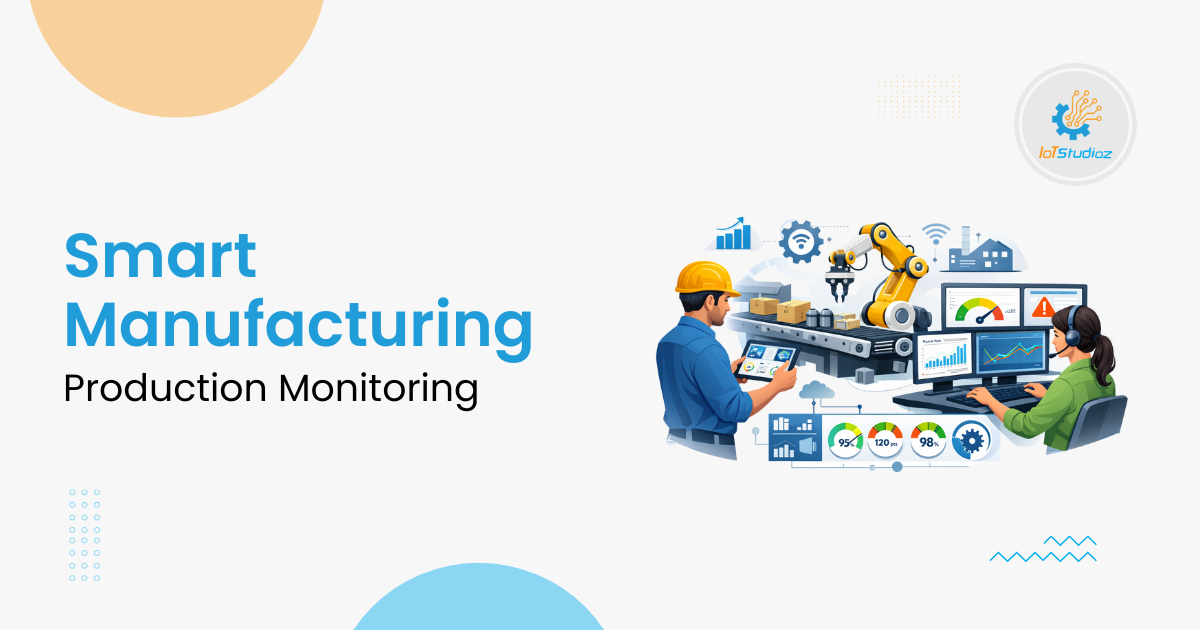
Smart Manufacturing Production Monitoring
Smart manufacturing fundamentally changes how factories operate. It uses digital technologies to make production more efficient, visible, and data-driven. One key component in this evolution is production monitoring. This article explains what smart manufacturing production monitoring is, why it matters, and how IoT Gateway Solutions support real-time insights, control, and higher productivity.
The content below draws on current industry data and technical best practices. You will find facts, examples, and clear arguments that help you understand this key topic from a technical perspective.
What Is Smart Manufacturing?
Smart manufacturing refers to the application of digital systems to traditional factory processes. These systems connect machines, sensors, and software. They collect large amounts of data and turn it into useful insights for operations. Smart manufacturing is key to Industry 4.0, the current phase of industrial evolution that combines networking, sensors, analytics, and automation to improve production systems.
In smart manufacturing, production monitoring means continuously collecting and analyzing data from machines and systems during manufacturing. Real-time production monitoring tracks variables such as speed, temperature, cycle time, and output. These insights give engineers and operators visibility into what is happening in the factory at any moment.
Why Production Monitoring Matters
Production monitoring brings measurable benefits. Management teams, engineers, and technicians use these benefits to reduce waste, boost throughput, and respond faster to problems.
1. Reduce Downtime
Traditional factories often operate with fixed maintenance schedules or reactive repairs. In contrast, production monitoring detects early signs of equipment wear or failure. For example, vibration and temperature data from machines can signal a pending breakdown. Factories that adopt IoT-based monitoring can reduce unplanned downtime by up to 50%.
2. Improve Product Quality
Quality issues often start with small variations in machine settings or material properties. Continuous monitoring captures this data early. As a result, manufacturers can stop defective batches before they go too far in the process. Many manufacturers report consistent improvements in product quality once smart monitoring is in place.
3. Better Decision-Making
Real-time data lets floor managers and executives make informed choices quickly. Without live data, decisions rely on delayed reports or manual counts. Production monitoring eliminates this gap. It supports operational adjustments on the fly, helping factories improve resource usage and meet delivery targets more consistently.
Core Technologies Behind Production Monitoring
Smart manufacturing production monitoring uses several technologies working together:
1. Sensors and Edge Devices
Sensors on machines measure physical conditions such as speed, vibration, and temperature. These devices often operate at the network edge to collect data directly from production equipment.
2. Networking
Data from sensors moves through local networks to centralized systems. Reliable communication is vital. Factories use Ethernet, wireless networks, and industrial protocols to ensure real-time data reaches monitoring systems without delay.
3. IoT Gateway Solutions
This article emphasizes IoT Gateway Solutions as a critical technology. These solutions act as the bridge between factory equipment and higher-level analytics. Below we explain how they work.
4. Analytics Platforms
Central systems (often in the cloud or local servers) store and analyze data. These platforms use algorithms and dashboards to present insights. They help teams identify trends, anomalies, and machine health in real time.
What Are IoT Gateway Solutions?
IoT Gateway Solutions serve as intermediaries between on-site devices and enterprise applications. They collect raw sensor data, pre-process it if needed, and transmit it to analytics platforms or cloud systems.
Key Functions of IoT Gateways
- Protocol Translation: Industrial machines often use specialized communication protocols. IoT gateways convert these signals into standard network formats (e.g., MQTT, HTTP) for analysis.
- Data Filtering: Gateways can reduce data volume by filtering out noise or irrelevant data before transmission. This saves bandwidth and storage.
- Security: Gateways can encrypt data and enforce authentication to protect factory data.
- Edge Processing: Some gateways run lightweight analytics at the edge. This enables quick responses (such as alerts) without waiting for cloud processing.
How IoT Gateway Solutions Support Production Monitoring
IoT Gateway Solutions play a central role in smart manufacturing. Below are technical benefits in the context of production monitoring.
1. Real-Time Data Flow
Production monitoring depends on continuous sensor data. Gateways ensure data flows smoothly from machines to central systems. They buffer data during network disruptions and ensure accurate transmission.
2. Interoperability Between Devices
Factories often have heterogeneous equipment from different vendors. Gateways translate diverse machine signals into a standard format. This interoperability enables comprehensive monitoring rather than isolated pockets of data.
3. Reduced Latency
IoT gateways closer to equipment enable fast local processing. For example, a gateway might trigger an alert when vibration thresholds are crossed. This rapid local action prevents delays that could cause production loss.
4. Lower Network Load
Sending raw sensor data for every signal can overwhelm manufacturing networks. Gateways pre-process data, sending only meaningful events and summaries. This reduces bandwidth use and supports faster analytics.
Key Metrics Monitored Through Production Systems
Smart production monitoring systems track various metrics:
- Machine Utilization: Measures how effectively machines are used compared to their capacity.
- Cycle Time: Time taken to produce one unit.
- Throughput: Rate at which the production line produces units.
- Downtime Causes: Classification of stoppages due to specific reasons.
- Defect Rates: Frequency of defective products.
- Energy Usage: Power consumed by machines for sustainability analysis.
These metrics feed dashboards and reports that help engineers fine-tune production processes.
Real-World Use Cases
1. Predictive Maintenance
Instead of fixed schedules, maintenance is triggered by equipment condition. For instance, a manufacturing plant monitors motor vibration through IoT sensors and gateways. When patterns indicate increasing wear, the system schedules maintenance. This avoids breakdowns and saves maintenance costs.
2. Quality Assurance
An electronics manufacturer uses IoT sensors to monitor soldering temperatures during assembly. Deviations trigger automatic alerts. Data is logged and analyzed to improve future process parameters, reducing defects.
3. Energy Monitoring
High energy use machines are monitored for power spikes. The system identifies inefficient usage patterns. Engineers then reconfigure production or upgrade equipment to reduce energy waste.
Adoption Trends and Statistics
Smart manufacturing is growing rapidly worldwide. The global smart manufacturing market may reach $573.8 billion by 2027.
Most manufacturers agree that digital transformation improves outcomes:
- 87% of manufacturers believe smart manufacturing increases productivity and efficiency.
- Predictive maintenance enabled by IoT can reduce downtime by up to 50%.
- 40% of manufacturers have adopted IoT solutions in at least one area.
- Around 58% of manufacturers worldwide use Industry 4.0 technologies.
- Digital tools help 49% of manufacturers improve supply chain visibility.
These numbers show adoption is significant and growing, with clear benefits for firms that implement the right technologies.
Steps to Deploy Smart Production Monitoring
1. Assess Current Infrastructure
Review existing equipment, controls, and networks. Identify what can be connected and where sensors are needed.
2. Select Sensors and Hardware
Choose sensors that match the parameters you need to monitor, such as vibration, temperature, or flow rates. Ensure compatibility with gateways.
3. Choose IoT Gateway Solutions
Pick gateways that support necessary industrial protocols and security standards. Consider features like edge analytics and remote management.
4. Connect to Analytics Platform
Data from gateways should feed into a central system with dashboards and alerts. This platform should support integration with ERP or MES tools.
5. Define KPIs and Goals
Set measurable production goals. For example, reduce machine downtime by a specific percentage or improve throughput by a defined target.
6. Train Teams
Operators and engineers should understand how to interpret dashboards and respond to alerts. Training ensures the new system delivers value.
7. Monitor and Improve
Use collected data continuously to refine production parameters. Improvement should be incremental and iterative.
Challenges and Considerations
Adopting smart production monitoring is not without challenges:
- Data Security: Protecting sensitive manufacturing data is critical. Gateways and analytics must use strong security measures.
- Integration Complexity: Older machines may lack digital interfaces. Retrofits and adapters may be necessary.
- Skill Gaps: Staff need training to manage and interpret new systems.
- Cost: Investment in sensors, gateways, and analytics must justify expected returns.
Despite these challenges, the long-term benefits of improved operation and lower costs often outweigh initial investment.
Conclusion
Smart manufacturing production monitoring transforms how factories operate. IoT Gateway Solutions play a central role by collecting, converting, and forwarding data from machines to analytics systems. With real-time visibility, predictive maintenance, efficient resource use, and better quality control, manufacturers can achieve measurable gains.
Current data shows that smart manufacturing adoption is widespread and growing. Manufacturers that invest in modern monitoring solutions position themselves to compete in an environment that increasingly values data-driven decision-making.
Embracing production monitoring and IoT gateways is a strategic technical step for any industry moving toward next-generation manufacturing.
FAQ
1: What is production monitoring in smart manufacturing?
Production monitoring is the continuous tracking of machine and process data during manufacturing. It collects real-time information such as machine status, cycle time, output count, and faults. This data helps manufacturers detect issues early, improve efficiency, and maintain consistent product quality.
2: How do IoT Gateway Solutions support production monitoring?
IoT Gateway Solutions collect data from sensors and machines on the shop floor. They convert industrial protocols into standard data formats and send the data to monitoring systems. Gateways also filter data, reduce network load, and improve response time by supporting edge processing.
3: What types of data are monitored in smart manufacturing?
Common data types include:
- Machine run and idle time
- Production count and cycle time
- Temperature, vibration, and pressure
- Fault and alarm logs
- Energy consumption
This data helps teams track performance, detect failures, and improve production planning.
4: Can production monitoring work with old manufacturing equipment?
Yes. Many older machines can be connected using external sensors and IoT Gateway Solutions. Gateways help integrate legacy equipment by translating signals into digital data. This approach avoids full machine replacement and reduces upgrade costs.
5: What are the main benefits of using IoT-based production monitoring?
Key benefits include:
- Reduced unplanned downtime
- Better machine utilization
- Improved product quality
- Faster issue detection
- Data-driven maintenance decisions
Studies show IoT-enabled monitoring can reduce downtime by up to 50% and improve overall productivity.