
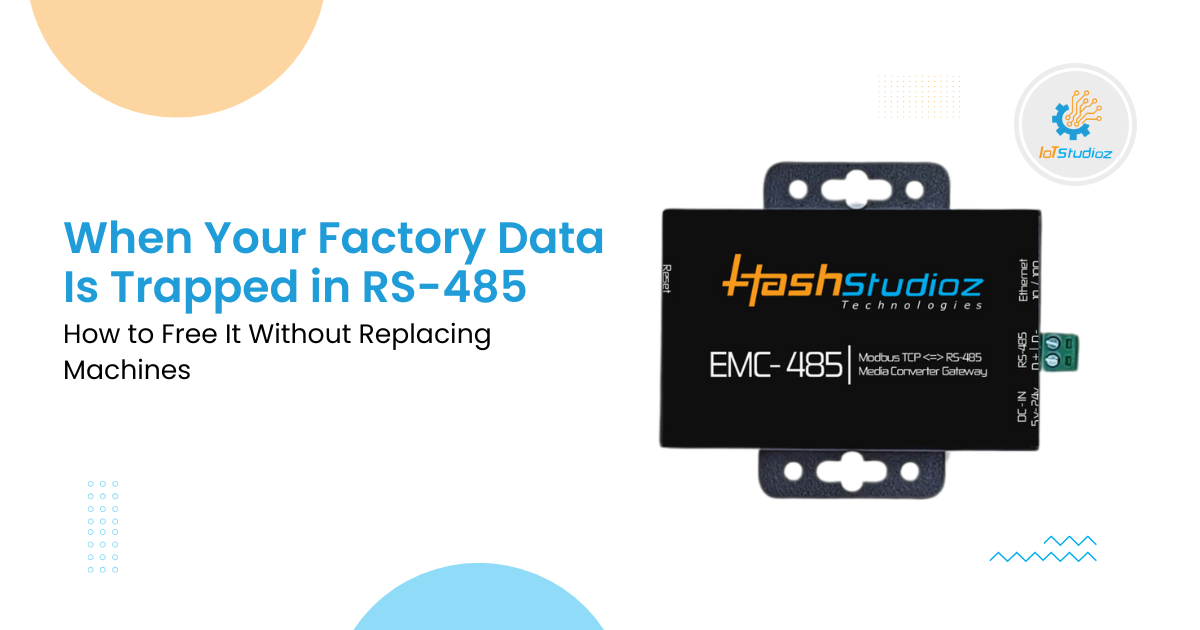
When Your Factory Data Is Trapped in RS-485: How to Free It Without Replacing Machines
Modern manufacturing is driven by data. From real-time monitoring to predictive maintenance, factories rely on instant, actionable information to optimize operations. Yet, many industrial facilities are still using legacy machines that communicate over RS-485, a robust serial communication standard developed decades ago. While RS-485 excels at reliable, long-distance communication, it often leaves valuable factory data isolated from modern systems.
The good news? You don’t need to replace your machines to access this data. With the right strategy and technology, you can unlock trapped RS-485 data and integrate it into today’s Industrial Internet of Things (IIoT) ecosystems.
Understanding the RS-485 Challenge
1. Legacy Communication Limitation
- RS-485 Basics: RS-485 supports multi-drop serial communication, typically connecting multiple devices in a master-slave configuration.
- Data Isolation: Many older PLCs and machines communicate only over RS-485, which is incompatible with Ethernet or modern SCADA systems.
- Operational Gap: Without real-time data access, factory management cannot perform timely analysis, predictive maintenance, or process optimization.
2. Incompatibility with Modern Networks
- Modern monitoring systems expect Ethernet or IP-based connectivity.
- RS-485 devices cannot directly connect to cloud platforms, dashboards, or analytics tools.
- Replacing legacy machines just for connectivity is costly and disruptive.
Solutions to Free RS-485 Data
1. RS-485 to Ethernet Converters
Devices that bridge the gap between RS-485 serial networks and Ethernet networks.
Key Benefits:
- Converts serial data into Ethernet-compatible packets.
- Enables legacy machines to communicate with SCADA, MES, and IIoT platforms.
- Supports multiple RS-485 devices simultaneously through a single Ethernet interface.
Implementation Steps:
- Identify RS-485 devices and map the network topology.
- Choose an RS-485 to Ethernet converter that matches your protocol (Modbus RTU, ASCII, etc.).
- Connect the RS-485 bus to the converter.
- Configure the converter’s IP settings to integrate into your existing Ethernet network.
- Test communication with your SCADA or IIoT software to ensure real-time data flow.
Example: A factory with 10 PLCs on RS-485 can use a single converter to provide all machine data over Ethernet to a centralized dashboard, enabling live production monitoring without hardware replacement.
2. Using Industrial Gateways
Gateways are advanced devices that can handle protocol conversion, data buffering, and secure transmission.
Advantages Over Simple Converters:
- Protocol translation (Modbus RTU → Modbus TCP, or custom protocols)
- Data aggregation and preprocessing
- Secure transmission to cloud or edge systems
- Reduces network traffic by sending only relevant data
Implementation:
- Connect RS-485 devices to the gateway.
- Configure the gateway to translate and forward data to Ethernet or cloud endpoints.
- Use gateway software for monitoring, logging, and device management.
3. Leveraging IoT Edge Devices
Edge devices are small industrial computers that sit at the interface between machines and the cloud.
Benefits:
- Collect RS-485 data locally and process it before sending it over Ethernet.
- Enable analytics at the edge, reducing cloud dependency and latency.
- Provide additional functions such as data logging, alerting, and visualization.
Implementation:
- Install Raspberry Pi or industrial-grade edge device with RS-485 HAT or module.
- Write or configure software to poll RS-485 devices and convert data to MQTT, HTTP, or other IoT-friendly protocols.
- Connect the device to the Ethernet network or cellular network for remote monitoring.
4. Implementing Wireless RS-485 Bridges
Wireless RS-485 bridges enable serial devices to communicate over Wi-Fi, LoRa, or cellular networks without running long Ethernet cables.
Benefits:
- Eliminates the need for extensive cabling across large factories.
- Provides flexibility for temporary setups or hard-to-reach machines.
- Ideal for retrofitting older machines into modern IIoT ecosystems.
Implementation:
- Connect the RS-485 device to a wireless bridge.
- Configure the bridge to communicate with an Ethernet gateway or Wi-Fi access point.
- Validate that the data reaches SCADA, MES, or cloud platforms.
Example: A factory floor with machines spread across different rooms used LoRa-based RS-485 bridges to send production data to a central server without rewiring the plant.
5. Using Software-Based Protocol Converters
Software converters run on industrial PCs, edge devices, or even servers to translate RS-485 data into modern network protocols.
Benefits:
- No additional hardware needed if you have compatible edge devices or industrial PCs.
- Flexible: can support multiple protocols and custom mappings.
- Easy to update and maintain remotely.
Implementation:
- Connect RS-485 devices to a serial port on the industrial PC.
- Install software to convert Modbus RTU (or other protocols) to TCP/IP or MQTT.
- Configure software to push data to SCADA, analytics dashboards, or cloud systems.
Example: A facility used a small industrial PC to convert RS-485 data from 12 machines to MQTT for an IoT platform, enabling real-time monitoring across multiple sites.
6. Edge Analytics and Data Preprocessing
Instead of just forwarding raw RS-485 data, edge devices can process and filter data locally before sending it over Ethernet.
Benefits:
- Reduces network bandwidth requirements.
- Sends only meaningful, actionable data to central systems.
- Enables predictive analytics and alerts at the source.
Implementation:
- Install edge devices with RS-485 interfaces near machines.
- Configure software to preprocess data (e.g., calculate averages, detect anomalies).
- Send filtered or summarized data to SCADA or cloud platforms.
Example: A bottling plant used edge preprocessing to detect machine vibration patterns. Only alerts were sent to the central dashboard, reducing unnecessary data transfer while improving predictive maintenance.
7. Integrating with Cloud Platforms
Once RS-485 data is converted to Ethernet, it can be forwarded to cloud-based platforms for monitoring, analytics, and reporting.
Benefits:
- Remote monitoring of production lines from anywhere.
- Centralized storage for historical data and trend analysis.
- Supports AI-driven insights for production optimization.
Implementation:
- Use RS-485 to Ethernet converters or gateways that support cloud protocols (MQTT, HTTP, OPC UA).
- Connect devices to the cloud platform and configure dashboards and alerts.
- Ensure secure connections using encryption and authentication.
Example: A textile factory integrated RS-485 converters with a cloud platform to monitor machine speed, temperature, and downtime. Management accessed the dashboard from mobile devices, improving decision-making speed.
8. Implementing Redundant RS-485 Networks
Redundant RS-485 setups ensure that critical machine data is always accessible even if one communication path fails.
Benefits:
- Increases reliability of data acquisition.
- Minimizes downtime due to network failures.
- Protects important production data from being lost.
Implementation:
- Set up dual RS-485 lines connected to converters or gateways.
- Configure automatic failover between primary and backup lines.
- Test failover periodically to ensure continuous operation.
Example: A packaging plant implemented a redundant RS-485 network for its critical bottling machines, ensuring that production monitoring continued uninterrupted during maintenance or cable failures.
9. Utilizing Smart Sensors with RS-485 Output
Some modern sensors and measurement devices come with RS-485 output, enabling them to integrate seamlessly with legacy PLCs or converters.
Benefits:
- Adds new monitoring capabilities without overhauling legacy systems.
- Provides real-time insights for quality control, energy monitoring, or environmental conditions.
- Easily integrates with existing RS-485 to Ethernet setups.
Implementation:
- Identify areas in the factory that can benefit from additional monitoring.
- Replace or augment older sensors with RS-485-compatible smart sensors.
- Connect these sensors to the existing RS-485 network and converters.
Example: A chemical processing plant added RS-485 temperature and humidity sensors to their older PLC network. The data was routed via converters to a cloud analytics platform, improving quality control and reducing material wastage.
10. Gradual Digital Transformation with Hybrid Networks
A hybrid approach combines RS-485 devices with modern Ethernet/IoT devices, allowing incremental digital transformation.
Benefits:
- Avoids the high cost of replacing all machines at once.
- Ensures legacy machines remain operational while modern systems are integrated.
- Supports a phased adoption of Industry 4.0 technologies.
Implementation:
- Map out legacy RS-485 machines and identify new IoT-enabled devices to be added.
- Connect RS-485 devices via converters or gateways to Ethernet networks.
- Gradually integrate new IoT devices alongside legacy machines for unified monitoring and control.
Example: A factory maintained its RS-485 CNC machines while adding IoT-enabled motors and energy meters. Using converters and gateways, all devices fed data into a single SCADA system, allowing a phased, cost-effective upgrade to a smart factory.
Best Practices for RS-485 Data Liberation
- Network Assessment: Map all RS-485 devices and understand communication patterns.
- Protocol Matching: Ensure converters or gateways support your existing protocols (e.g., Modbus RTU).
- Redundancy & Reliability: For critical systems, use converters or gateways with failover options.
- Security Measures: Protect your network with firewalls, VLANs, and encrypted connections.
- Testing & Validation: Test data accuracy and latency before full-scale deployment.
Real-World Example
A mid-sized manufacturing plant was struggling to integrate 15 legacy machines into its SCADA system. Replacing machines was cost-prohibitive. By deploying RS-485 to Ethernet converters on each machine and a central industrial gateway, they achieved:
- Real-time production monitoring
- Predictive maintenance alerts
- Centralized data logging and analytics
Outcome: Operational efficiency improved by 20%, and downtime reduced significantly—all without replacing any machines.
Conclusion
Legacy RS-485 networks no longer need to be a barrier to modern factory automation. With a combination of RS-485 to Ethernet converters, industrial gateways, edge devices, wireless bridges, smart sensors, and hybrid network strategies, manufacturers can unlock trapped machine data without replacing functional equipment.
By adopting these solutions, factories can:
- Achieve real-time monitoring of production lines.
- Implement predictive maintenance and reduce downtime.
- Ensure data reliability and security with redundant and preprocessed data streams.
- Gradually embrace digital transformation at a controlled cost.
- Integrate seamlessly with cloud analytics platforms for actionable insights.
Freeing RS-485 data is not just about connectivity – it’s about turning isolated machine signals into actionable intelligence that drives efficiency, quality, and competitiveness. The right combination of technology allows factories to retain their legacy investments while stepping confidently into the era of Industry 4.0.
FAQs
1. Can RS-485 machines be connected to modern Ethernet networks without replacing them?
Yes. Legacy machines using RS-485 can be connected to modern Ethernet networks using RS-485 to Ethernet converters, industrial gateways, or edge devices. These solutions translate serial data into IP-based communication, allowing seamless integration with SCADA, MES, and cloud platforms without changing existing machines.
2. What industrial protocols are commonly supported when freeing RS-485 data?
Most RS-485 devices use Modbus RTU or Modbus ASCII. Modern converters and gateways can translate these protocols into Modbus TCP, MQTT, OPC UA, or HTTP, making them compatible with modern industrial and IoT systems.
3. Is RS-485 still reliable for industrial communication?
Absolutely. RS-485 remains widely used in industrial environments due to its noise immunity, long-distance support, and multi-drop capability. When combined with Ethernet or IoT connectivity, it continues to be a dependable foundation for industrial communication.
4. How secure is RS-485 to Ethernet data conversion?
Security depends on the deployment. While RS-485 itself is not encrypted, security can be enforced at the Ethernet or gateway level using firewalls, VLANs, authentication, TLS encryption, and secure cloud connections. Industrial gateways often include built-in security features for safe data transmission.
5. What is the most cost-effective way to modernize an RS-485-based factory?
The most cost-effective approach is a hybrid digital transformation strategy. By using RS-485 to Ethernet converters and gateways, factories can gradually integrate legacy machines into modern monitoring systems while adding new IoT-enabled equipment over time—avoiding large upfront replacement costs.