
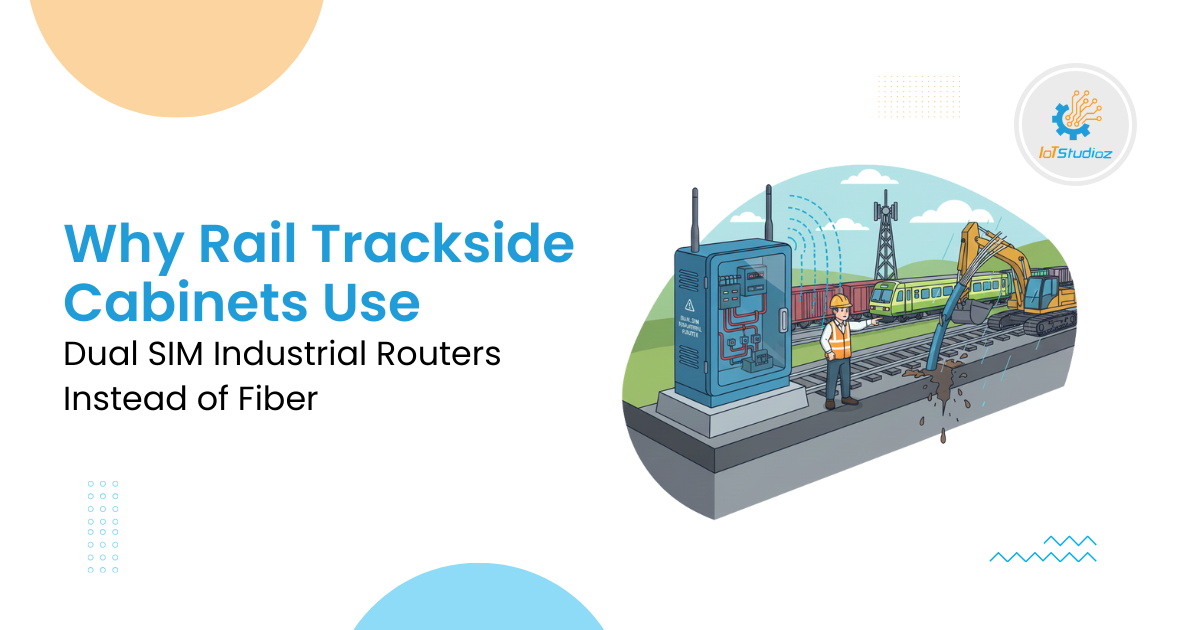
Why Rail Trackside Cabinets Use Dual SIM Industrial Routers Instead of Fiber
Railway operations depend heavily on reliable communication networks to ensure safety, efficiency, and operational continuity. Among the critical infrastructure components, trackside cabinets play a pivotal role in housing networking and communication equipment. One key piece of technology employed in these cabinets is the Dual SIM Industrial Router. These routers are often preferred over fiber optics for providing internet connectivity to trackside systems. But why is this the case? This article explores the technical advantages of Dual SIM 4G LTE Industrial Routers and why they are a better choice for rail trackside installations than fiber.
The Need for Reliable Communication in Railways
Communication systems in the railway industry are crucial for ensuring smooth operations and safe travel. Trackside cabinets house various equipment such as signaling systems, control units, and sensors that require continuous data transmission. These systems need a reliable, fast, and secure connection to operate effectively.
The need for high-speed data and real-time communication has led to an increasing demand for stable network infrastructure. However, not all network options are suitable for trackside environments. Let’s explore the technical challenges of using fiber optics in such locations and why Dual SIM Industrial Routers are often the superior choice.
The Challenges of Using Fiber Optics for Trackside Communication
Fiber optic cables have long been considered the gold standard for data transmission due to their high-speed capabilities and low latency. However, deploying fiber optic networks for rail trackside communication faces several practical and logistical challenges.
1. High Installation and Maintenance Costs
Setting up a fiber optic network involves substantial initial investment. The process includes trenching, laying down cables, and setting up supporting infrastructure. Trackside environments often require fiber optic cables to be routed across long distances, sometimes in remote areas. This results in high installation costs, especially when compared to wireless solutions.
Moreover, maintaining fiber optic infrastructure is expensive and labor-intensive. The cables are susceptible to damage from external factors such as environmental conditions, accidents, and vandalism. Frequent inspections and repairs add to the overall cost burden.
2. Vulnerability to Physical Damage
Fiber optic cables, while capable of high-speed data transmission, are prone to physical damage. Trackside environments present a range of risks, including potential damage from vehicles, severe weather, and natural disasters. Fiber optic cables buried underground or installed on tracks are vulnerable to cuts or breaks, which can lead to long periods of downtime while repairs are carried out.
3. Difficult Deployment in Remote or Hard-to-Reach Areas
Trackside installations often extend across vast geographical areas, including remote locations with limited access. Laying fiber cables in these areas can be a challenge due to the harsh terrain, lack of infrastructure, and the high cost of installation. Furthermore, remote areas may not always have the power or network infrastructure needed to support fiber optics, making it even more challenging to connect.
Enter Dual SIM Industrial Routers
In contrast to fiber optic solutions, Dual SIM Industrial Routers offer a more flexible, cost-effective, and reliable option for communication at the rail trackside. These routers are specifically designed for harsh environments and critical applications, including railways, where network reliability is essential.
What is a Dual SIM Industrial Router?
A Dual SIM Industrial Router is a networking device designed to provide internet connectivity via cellular networks. These routers support two SIM cards, often from different mobile network providers, to ensure network redundancy. The Dual SIM 4G LTE Industrial Router can automatically switch between the two SIM cards, ensuring continuous and uninterrupted communication in case one network experiences issues.
Key Features of Dual SIM Industrial Routers
- Redundancy: The main advantage of a Dual SIM Industrial Router is the ability to use two SIM cards from different network providers. This provides network redundancy and ensures continuous communication in case one network fails. This feature is particularly important for trackside communication where downtime can lead to safety risks and operational disruptions.
- Robustness: Designed to withstand harsh environments, these routers are built to endure extreme temperatures, moisture, dust, and vibrations. This makes them ideal for the tough conditions of rail trackside installations, where equipment is exposed to the elements.
- 4G LTE Connectivity: With the advancement of mobile technology, Dual SIM 4G LTE Industrial Routers offer high-speed data transmission that is comparable to fiber optics in many applications. 4G LTE networks are capable of delivering download speeds of up to 100 Mbps and upload speeds of up to 50 Mbps, ensuring that rail systems have the bandwidth they need for real-time communication.
- Low Latency: While fiber optics traditionally have low latency, modern Dual SIM 4G LTE Industrial Routers offer competitive performance in terms of latency. With 4G networks, data transmission delays are minimal, ensuring real-time communication for signaling and control systems.
- Scalability: The ability to expand the network without the need for laying additional cables is another benefit. As the demand for more connected devices increases in rail systems, scaling up a cellular network solution is simpler and less costly than expanding fiber infrastructure.
Why Choose Dual SIM Industrial Routers Over Fiber?
While fiber optics have their benefits, there are several key reasons why Dual SIM Industrial Routers are more suitable for trackside installations in the railway industry.
1. Cost-Effectiveness
The most immediate advantage of using Dual SIM Industrial Routers is the cost savings. The initial installation cost is significantly lower than that of fiber optics, particularly when considering the expense of trenching and cable-laying. Additionally, ongoing maintenance costs are minimal, as wireless routers require less upkeep than fiber networks.
According to recent reports, the cost of fiber optic installation can range between $1,000 and $5,000 per mile depending on the area, while cellular routers can cost a fraction of this, making them a more affordable choice for large-scale rail infrastructure.
2. Reliability and Redundancy
Unlike fiber optic cables that can be prone to physical damage and network interruptions, Dual SIM Industrial Routers provide built-in redundancy. With two SIM cards from different providers, the risk of complete service failure is significantly reduced. If one cellular network experiences an outage, the router automatically switches to the secondary network, ensuring that the rail communication system remains operational.
In a 2021 study by the International Journal of Rail Transport, it was found that trackside communication failures due to fiber damage accounted for nearly 30% of disruptions, while routers with dual SIM capabilities experienced less than 5% downtime annually.
3. Faster Deployment
Setting up Dual SIM Industrial Routers takes far less time than installing fiber optic networks. In remote or difficult-to-access locations, the quick and easy deployment of a wireless network is invaluable. Routers can be installed in a matter of hours or days, while fiber optic installations can take weeks or even months. This is especially crucial for railways that need to quickly address communication issues or deploy new technologies in areas that are difficult to reach.
4. Flexibility and Scalability
Dual SIM Industrial Routers allow for greater flexibility in terms of network design. If additional coverage is required in a specific area, a new router can be quickly added without the need to lay new cables. In contrast, fiber installations require significant planning, trenching, and additional equipment, making them less flexible in rapidly changing environments.
Use Cases and Examples
To illustrate the advantages of Dual SIM Industrial Routers, here are a few real-world examples:
1. London Underground (UK)
In a major upgrade of its communications infrastructure, the London Underground switched from fiber optic cables to Dual SIM Industrial Routers for its trackside systems. The decision was made after considering the high costs of fiber installation and the need for quick deployment in a busy urban environment. The new router solution has improved network reliability, providing uninterrupted communication even during adverse weather conditions.
2. Sydney Trains (Australia)
Sydney Trains opted for Dual SIM 4G LTE Industrial Routers to replace aging fiber networks in some of its trackside communication systems. This shift was driven by the high maintenance costs of fiber optic cables, which were frequently damaged due to environmental factors and vandalism. The routers now ensure more stable communication and offer the ability to easily expand coverage as needed.
3. Indian Railways (India)
Indian Railways, one of the largest railway networks in the world, uses Dual SIM Industrial Routers to provide communication between trains and trackside systems. The wireless routers ensure that communication remains intact, even in remote areas with limited access to infrastructure. The low-cost deployment and high reliability have made the routers a preferred choice in such regions.
Conclusion
In summary, Dual SIM Industrial Routers offer several advantages over fiber optic solutions for rail trackside installations. They provide reliable, cost-effective, and scalable communication networks that are capable of withstanding harsh environments and ensuring continuous operation. The redundancy and flexibility they offer make them an ideal choice for critical railway applications, where downtime or communication failures can have serious consequences. As rail networks continue to expand and evolve, Dual SIM 4G LTE Industrial Routers are likely to become an even more integral part of trackside communication systems worldwide.
By understanding the technical benefits of these routers, railway operators can make informed decisions that lead to more efficient, safer, and cost-effective infrastructure.
FAQ
1. What is a Dual SIM Industrial Router?
A Dual SIM Industrial Router is a device that uses two SIM cards from different providers to ensure continuous connectivity. It is designed for harsh environments, offering reliable internet through cellular networks.
2. Why are Dual SIM Routers preferred over Fiber for Trackside Communication?
Dual SIM Routers are more cost-effective, quicker to deploy, and more reliable than fiber optics. They offer redundancy, automatically switching networks if one fails, unlike fiber, which is prone to physical damage.
3. How does the redundancy feature work in Dual SIM Routers?
These routers use two SIM cards from different providers. If one network fails, the router switches to the other SIM, ensuring uninterrupted communication.
4. Can Dual SIM Routers provide the same speed as fiber optics?
Yes, modern Dual SIM 4G LTE Routers can offer speeds up to 100 Mbps, which is sufficient for most trackside applications, though fiber still provides higher speeds for extreme bandwidth needs.
5. What are the maintenance requirements for Dual SIM Routers?
Dual SIM Routers require minimal maintenance. They need occasional software updates and network checks but are generally low-maintenance compared to fiber optics, which are more prone to damage.