
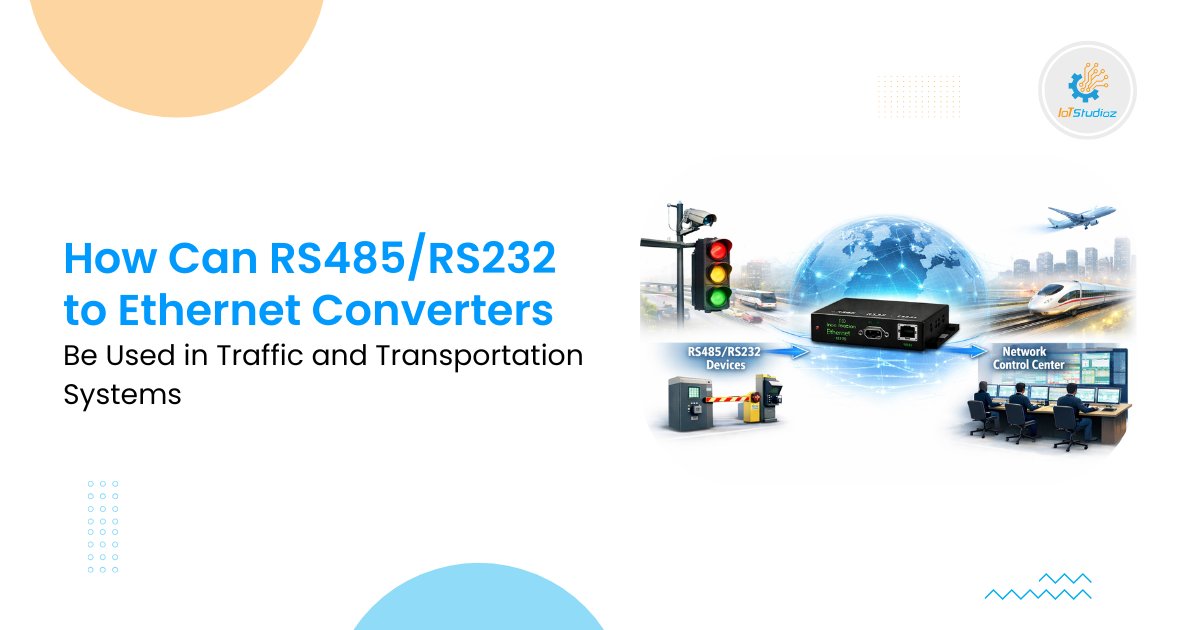
How Can RS-485/RS-232 to Ethernet Converters Be Used in Traffic and Transportation Systems
Modern traffic and transportation systems rely on robust data communication. These networks must connect a wide range of devices, sensors, and controllers. Legacy communication standards like RS-485 and RS-232 remain in use because of their simplicity and reliability. At the same time, Ethernet has become the dominant communication medium for networking. RS-485/RS-232 to Ethernet Converters bridge this gap. They allow older devices to communicate over modern IP networks.
What Are RS485 and RS232 Communications?
1. RS-232
RS-232 is a serial communication standard. It has been used since the 1960s. This standard typically connects a single device to a computer or controller. It supports low-speed data transmission over short distances. RS-232 was once common in traffic signal controllers, vehicle diagnostic systems, and roadside sensors.
2. RS-485
RS-485 is a serial standard designed for multi-drop networks over longer distances. RS485 supports up to 32 nodes on a shared bus. It can work over distances up to 1200 meters. That makes it suitable for connecting multiple sensors or controllers in a transportation network. It uses differential signaling, which resists noise in industrial environments.
3. The Need to Connect Legacy Serial Devices
Traffic systems often include devices installed decades ago. Replacing all legacy hardware with new Ethernet-enabled devices costs millions. RS-485 Ethernet Converters help preserve existing equipment. They allow serial devices to communicate through modern IP networks.
What Are RS-485/RS-232 to Ethernet Converters?
RS-485/RS-232 to Ethernet Converters are devices that translate serial protocols into Ethernet/IP. They receive data from RS-232 or RS-485 ports. Then they package it into TCP/IP or UDP packets. The converter sends these packets over Ethernet networks.
These converters often have the following features:
- Multiple serial ports (RS232, RS485)
- One or more Ethernet ports
- Support for TCP Server, TCP Client, UDP
- Configurable baud rate and protocol settings
- Industrial-grade hardware for harsh environments
They work as protocol bridges. Legacy equipment continues operation while communicating with modern networked systems.
Why Use Converters in Traffic and Transportation?
Traffic and transportation systems must exchange data between devices spread over large areas. Serial connections alone cannot meet this need. Ethernet-based systems overcome distance, scalability, and integration challenges.
Here are key reasons to use converters:
1. Extending Communication Distance
Ethernet can carry data over kilometers using fiber optic links. In contrast, RS-232 supports ~15 meters and RS-485 supports ~1200 meters. Converters let legacy devices connect to a distant central server without rewiring each device.
2. Centralized Monitoring
Traffic operators need real-time data. Ethernet networks allow central servers to poll or receive data from remote devices. Converters forward serial data onto these networks. Traffic management systems can collect, analyze, and display data efficiently.
3. System Integration
Modern traffic control software expects IP communication. Converters allow older controllers to interface with new software. This integration avoids costly device replacement.
4. High Device Density
Roadside cabinets may contain many devices. Ethernet switches can connect many devices to a network. Converters help connect each serial device onto the same network.
Where Converters Are Used in Traffic Systems?
1. Traffic Signal Controllers
Signal controllers manage traffic lights at intersections. Many older controllers use RS485 to communicate with field sensors. Converters connect these controllers to a central traffic management system. The system receives status and fault data over Ethernet.
2. Vehicle Detection Systems
Inductive loop detectors and radar sensors often use serial communication. A converter can send detection counts to a traffic server. This data supports adaptive signal control.
3. Variable Message Signs (VMS)
Signs on highways display real-time information. Older VMS controllers use serial protocols. RS-485/RS-232 to Ethernet Converters link these controllers to remote operation centers.
4. Toll Collection Systems
Bar code scanners, RFID readers, and weigh-in-motion sensors use RS232/RS485 interfaces. Converters feed data into toll processing systems. Ethernet networks then carry transaction data securely.
5. Public Transport Communication
Buses and trains may use serial devices for passenger counting, GPS, and diagnostics. Converters allow these devices to send data over cellular or Wi‑Fi networks.
Technical Operation of RS-485/RS-232 to Ethernet Converters
1. Serial to IP Conversion
Serial to IP converters read serial data, buffer it, and send it as Ethernet packets using TCP or UDP. TCP Server waits for a host connection, TCP Client connects to a server, and UDP sends data without a connection. The mode chosen depends on application requirements and reliability needs.
2. Baud Rate and Protocol Settings
Baud rate and protocol settings must be correctly matched between the converter and the serial device to ensure reliable communication. Key parameters include baud rate (such as 9600 or 19200), data bits (7 or 8), stop bits (1 or 2), and parity options (None, Even, or Odd). Any mismatch in these settings can lead to data loss or corruption, making accurate configuration essential.
3. Network Configuration
Converters require IP addresses to communicate over a network and can be configured using either static or DHCP methods. A static IP provides a fixed address, making it ideal for stable, fixed network environments where consistent access is required. DHCP assigns IP addresses automatically, simplifying setup and deployment, especially in large or dynamic systems.
4. Reliability Features
Industrial converters often include advanced reliability features designed for demanding environments. These may include watchdog timers that automatically restart the system during faults, redundant power inputs to prevent downtime, and wide operating temperature ranges from –40°C to +75°C. Such capabilities are essential for traffic and other critical systems where high uptime and consistent performance are mandatory.
Benefits of Using RS-485/RS-232 to Ethernet Converters
1. Cost Savings
Replacing all serial devices with IP-ready devices is expensive. Converters extend the life of existing equipment. Municipalities save on hardware and labor costs.
2. Scalability
Ethernet networks support thousands of nodes. Converters let technicians add devices without redesigning networks. IP-based systems scale naturally.
3. Improved Data Access
Ethernet delivers data to central systems rapidly. Traffic engineers can view performance metrics, trends, and alerts remotely. Faster data access improves decision-making.
4. Enhanced Diagnostics
Converters may support diagnostic tools. These tools monitor communication quality and packet loss. Operators can detect failing devices early.
Challenges and Considerations
1. Network Security
Network security is critical when serial devices are converted to Ethernet and exposed to larger networks. Traffic systems are especially sensitive, requiring protection through firewalls, access control lists, and encryption such as VPN or SSL/TLS. Since many legacy devices lack built-in security, network segmentation is essential to reduce risk and limit exposure.
2. Latency and Throughput
Serial devices operate at low baud rates. Ethernet can be orders of magnitude faster. If converters are misconfigured, latency may increase. Engineers must test timing-sensitive connections.
3. Protocol Translation
Converters translate at the transport layer. They do not inherently translate application protocols. If a serial application expects custom framing or checksums, the converter must preserve the byte stream exactly.
4. Environmental Conditions
Roadside cabinets reach high temperatures and vibration. Converters must withstand such conditions. Choosing industrial-grade models with appropriate ratings is essential.
Key Design Considerations for Traffic Systems
1. Choosing the Right Converter
Choosing the right converter is essential for reliable operation. The device should support multiple serial port options such as RS-232 and RS-485, offer the required network modes including TCP and UDP, and operate within an industrial temperature range. A hardened enclosure is also important to withstand vibration, dust, and harsh environmental conditions.
2. Placement of Converters
Placement of converters affects performance and reliability. They can be installed inside roadside cabinets, central control hubs, or near aggregating devices. Positioning converters close to serial devices helps minimize cable lengths, reducing signal loss, interference, and potential communication issues.
3. Power Supply
Power supply is critical for converter reliability. Options include local power with surge protection, Power over Ethernet (PoE) if supported, or redundant power for critical locations. Ensuring a stable and protected power source helps maintain continuous operation and improves overall system uptime.
Case Studies and Examples
1. City Traffic Management
A mid-sized city had 150 intersections. Each used RS-485-based controllers. The city built a central traffic control center. Engineers installed RS-485 Ethernet Converters at each cabinet. The converters sent controller data over fiber optic Ethernet. Traffic operators now monitor all intersections in real time.
Key outcomes:
- 24/7 monitoring with no manual visits
- Faster detection of controller failures
- Data-driven signal timing adjustments
2. Highway Variable Message Signs
A state transportation agency had 50 VMS units. Each used an RS-232 interface. They upgraded to a central signage control system. Converters forwarded sign commands over a secure IP network. Operators could update messages within seconds.
Benefits included:
- Reduced driver confusion
- Faster alert dissemination during incidents
- Reduced travel delays
3. Toll Plaza System
A toll operator used weigh-in-motion sensors with RS-485 communication. These sensors fed data into local toll processors. The operator converted data to Ethernet and integrated it with the central billing system. Online analytics improved revenue tracking.
Results:
- Reduced manual reconciliation
- Faster dispute resolution
- Better reporting accuracy
Statistics Supporting Ethernet Integration
Data shows wide adoption of Ethernet in industrial and transportation networks:
- Over 70% of industrial networks use Ethernet by 2024. This trend includes transportation controllers and SCADA systems. (Source: Industry surveys)
- Ethernet infrastructure can support gigabit speeds, which future-proofs communication links.
- Transport agencies report up to 40% reduction in maintenance costs after migrating to networked systems with remote monitoring.
Best Practices for Deployment
1. Perform a Site Survey
Performing a site survey is essential before installation. Technicians should map serial device locations, measure cable distances, check power availability, and assess the existing network infrastructure. Conducting this survey helps identify potential challenges in advance, ensuring a smoother deployment and minimizing unexpected issues during installation.
2. Test Communication Before Wide Rollout
Testing communication before a full rollout is essential. Pilot installations allow validation of converter configurations, network routing, and application compatibility. This step ensures the system works as intended and helps prevent widespread network issues, reducing downtime and costly troubleshooting during large-scale deployment.
3. Document All Configurations
Documenting all configurations is vital for efficient maintenance. Record IP addresses, serial settings, rack and cabinet locations, and firmware versions. Clear and detailed documentation simplifies future troubleshooting, ensures consistency during updates, and helps technicians quickly resolve issues without confusion or guesswork.
4. Provide Training for Staff
Providing training for staff ensures smooth operation and rapid issue resolution. Field and network engineers should understand converter operation, basic network security principles, and the use of troubleshooting tools. Proper training enables faster response to outages, reduces downtime, and enhances overall system reliability.
Future Trends in Traffic Communications
1. Migration to IP-Based Devices
New traffic devices increasingly support Ethernet natively. Over time, legacy equipment will phase out. In the interim, converters provide a cost-effective bridge.
2. Integration with Smart City Platforms
Traffic data feeds into broader smart city systems. Integrating converters allows serial devices to contribute to predictive analytics and machine learning.
3. Use of Cellular and 5G Networks
Converters with embedded cellular modems enable remote sites without wired networks. 5G may offer lower latency and higher reliability for mobile units.
Conclusion
RS-485/RS-232 to Ethernet Converters play a crucial role in modern traffic and transportation systems. They connect legacy devices to Ethernet networks. This connection enables centralized control, remote monitoring, and data integration. Converters extend device life, lower costs, and support scalable networks.
Deploying converters requires careful planning, security, and robust hardware. When implemented well, they help agencies improve traffic flow, safety, and system reliability. As transportation systems evolve, these converters will remain valuable tools for integrating older equipment into modern network architectures.
Frequently Asked Questions
1. What is the purpose of RS-485/RS-232 to Ethernet converters in traffic systems?
These converters bridge legacy serial devices, like traffic signal controllers or vehicle detection sensors, to modern Ethernet/IP networks. They allow real-time data transmission to central control centers, enabling monitoring, remote control, and system integration without replacing expensive existing hardware.
2. Which traffic devices commonly use RS-485 or RS-232 communication?
Devices such as traffic signal controllers, variable message signs (VMS), inductive loop detectors, radar sensors, toll collection sensors, and public transport counting systems often use RS-485 or RS-232. Converters allow these devices to communicate over modern IP-based networks.
3. How do RS-485/RS-232 to Ethernet converters work technically?
Converters read serial data from devices, buffer it, and encapsulate it into TCP or UDP packets. Depending on configuration, they can operate in TCP Server mode, TCP Client mode, or UDP mode, transmitting data reliably over Ethernet networks to a central server or application.
4. What are the key benefits of using these converters in transportation networks?
Benefits include extending communication distance, centralized monitoring, integration with modern software, scalability to connect many devices, cost savings by preserving legacy equipment, and improved diagnostics for early fault detection.
5. Can these converters operate in harsh environmental conditions?
Yes, industrial-grade converters are designed for wide temperature ranges (–40°C to +75°C), vibration resistance, and dust protection. They often include features like redundant power inputs and watchdog timers to ensure high reliability in roadside cabinets and control hubs.