What Is an LVDS to HDMI Converter Board and How Does It Work?
Modern electronic devices rely on different display interfaces to transfer video signals from one component to another. While LVDS is widely used in LCD panels and embedded systems, HDMI is a common interface for monitors, televisions, and other display devices. Connecting these two interfaces requires a compatible conversion solution.
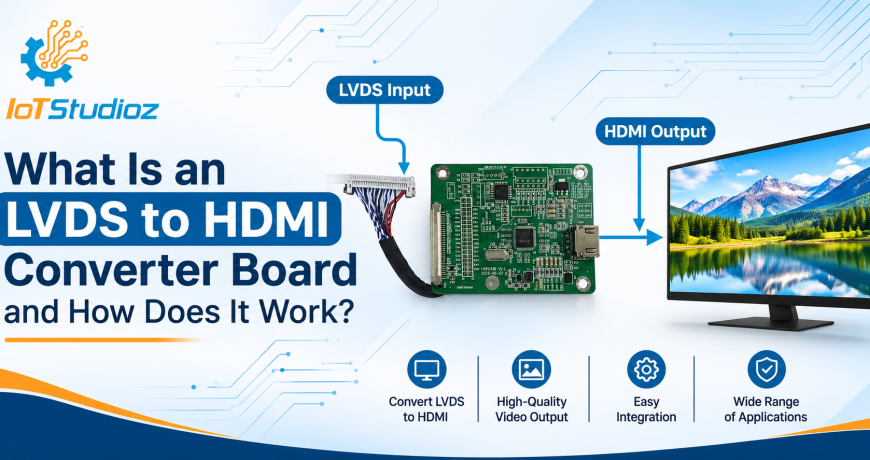
An LVDS to HDMI Converter Board helps bridge this gap by converting LVDS video signals into an HDMI-compatible format. It makes it easier to connect LVDS-based display systems with HDMI-supported monitors and screens.
In this blog, we will explore what an LVDS to HDMI converter board is, how it works, its key features, applications, and the factors to consider when choosing one.
What Is an LVDS to HDMI Converter Board?
An LVDS to HDMI Converter Board is an electronic circuit board designed to convert video signals from Low-Voltage Differential Signaling (LVDS) into a format supported by HDMI displays.
LVDS is commonly used for internal display connections in industrial equipment, embedded computers, laptops, and LCD panels. It offers high-speed data transmission with low electromagnetic interference and reduced power consumption.
However, many modern monitors and external display devices use HDMI as their primary video input. An LVDS to HDMI converter board enables communication between these different display interfaces.
In simple terms, it takes video data from an LVDS source, processes the signal, and converts it into an HDMI-compatible output that can be displayed on an external monitor.
What Is LVDS and How Does It Work?
LVDS stands for Low-Voltage Differential Signaling. It is a high-speed electrical signaling technology used to transmit digital data between electronic components.
Unlike conventional single-ended signaling, LVDS transmits data through two complementary signal lines. The receiver detects the voltage difference between these lines to identify the transmitted information.
This differential signaling approach offers several advantages:
- Low Power Consumption: Operates with relatively low voltage swings, helping reduce power usage.
- High-Speed Data Transmission: Supports fast data transfer for display applications.
- Low Electromagnetic Interference: Differential signaling helps reduce electromagnetic emissions.
- Reliable Communication: Provides stable signal transmission in suitable high-speed electronic designs.
- Compact Integration: Works well with embedded systems and internal display connections.
These characteristics make LVDS a popular choice for industrial displays, LCD panels, and embedded computing applications.
What Is HDMI and Why Is It Used?
HDMI stands for High-Definition Multimedia Interface. It is a widely used digital interface that transmits uncompressed video and digital audio through a single cable.
HDMI is commonly found in:
- Desktop monitors and televisions
- Embedded computing systems
- Digital signage displays
- Industrial monitoring equipment
- Multimedia devices
- Gaming and entertainment systems
HDMI supports different video resolutions and refresh rates depending on the interface version and connected hardware.
Its widespread compatibility makes it a convenient option for connecting display devices across different applications.
How Does an LVDS to HDMI Converter Board Work?
An LVDS to HDMI Converter Board works by receiving digital video data from an LVDS source and converting it into an HDMI-compatible signal.
The conversion process generally involves several stages.
1. Receiving the LVDS Input Signal
The converter board receives digital video signals from an LVDS-compatible source, such as an LCD controller, embedded motherboard, or industrial computing device.
The input connector carries the differential data signals and clock information required for video transmission.
2. Processing the Input Data
The board uses a suitable receiver or conversion controller to interpret the incoming LVDS signals.
This stage handles the input data format, timing information, and other signal characteristics required for conversion.
3. Converting LVDS Signals into HDMI Format
The conversion controller processes the received video data and generates an HDMI-compatible output signal.
Depending on the board design, this may involve video timing adjustments, data formatting, and HDMI signaling protocols.
4. Transmitting the HDMI Output
Once conversion is complete, the board sends the HDMI signal through its HDMI output connector.
The connected HDMI monitor or display receives the signal and displays the corresponding video content.
5. Displaying the Video
The HDMI-compatible display processes the incoming signal and presents the video output.
The overall result is a connection between an LVDS-based video source and an HDMI-supported display.
Key Features of an LVDS to HDMI Converter Board
The features of an LVDS to HDMI Converter Board depend on its controller, circuit design, and supported display configurations. Some important features include:
1. LVDS Input Compatibility
The board is designed to receive video signals from compatible LVDS interfaces. Input configurations may vary depending on the number of channels, signal mapping, and connector type.
2. HDMI Output Support
It provides an HDMI output interface for connecting compatible external displays, monitors, and other HDMI-supported devices.
3. Video Resolution Support
Different converter boards support different resolutions and refresh rates. Some designs support HD or Full HD output, while others may support higher resolutions.
4. Stable Signal Conversion
A suitable conversion controller helps maintain signal integrity and accurate video timing during the conversion process.
5. Compact PCB Design
Most converter boards feature compact circuit layouts, making them suitable for embedded applications and space-constrained electronic systems.
6. Easy Display Integration
These boards simplify the integration of LVDS-based video sources with HDMI display equipment, provided the electrical and timing requirements are compatible.
Common Applications of LVDS to HDMI Converter Boards
LVDS to HDMI converter boards are useful in applications where an LVDS video source needs to connect to an HDMI-compatible display.
Some common applications include:
1. Industrial Automation
Industrial machines and control systems often use LVDS-based displays. Converter boards can help connect these systems to external HDMI monitors for monitoring and visualization.
2. Embedded Computing
Embedded computers and development platforms may use LVDS interfaces for display connectivity. An appropriate converter board allows compatible systems to connect with HDMI monitors.
3. Digital Signage
Digital signage systems require reliable video connections for displaying advertisements, announcements, and information. LVDS to HDMI conversion can support display integration in compatible setups.
4. Medical Equipment
Medical monitoring and diagnostic equipment may use specialized display interfaces. Converter boards can help connect compatible LVDS video sources to HDMI-supported external displays.
5. Testing and Development
Engineers and developers working with embedded hardware can use LVDS to HDMI converter boards to test video output on standard HDMI monitors.
LVDS to HDMI Converter Board vs. HDMI to LVDS Converter Board
Although these two converter boards may appear similar, they perform opposite functions.
| Parameter | LVDS to HDMI | HDMI to LVDS |
| Input | LVDS | HDMI |
| Output | HDMI | LVDS |
| Main Function | Converts LVDS signals into HDMI | Converts HDMI signals into LVDS |
| Typical Use | Connecting LVDS sources to HDMI displays | Connecting HDMI sources to LVDS panels |
| Common Application | External monitor connectivity | LCD panel integration |
Choosing the correct conversion direction is important because these boards are not generally interchangeable.
Factors to Consider When Choosing an LVDS to HDMI Converter Board
Selecting the right converter board is important for achieving reliable display performance. Before purchasing one, consider the following factors.
1. Input Signal Compatibility
Check whether the converter supports your LVDS source. Pay attention to single-channel or dual-channel LVDS configurations, signal mapping, and connector pinout.
2. Supported Resolution
Verify that the converter supports the resolution and refresh rate required by your display application.
3. Display Timing Compatibility
Check horizontal and vertical timing parameters, pixel clock requirements, and synchronization specifications.
4. HDMI Output Compatibility
Ensure the HDMI output supports the requirements of your target monitor or display.
5. Power Supply Requirements
Check the operating voltage and current requirements of the converter board. Make sure the power supply matches the manufacturer’s specifications.
6. Connector and Pin Configuration
Verify the LVDS connector type, pin arrangement, and HDMI output interface before connecting the hardware.
7. Operating Environment
For industrial applications, consider operating temperature, electrical protection, and the board’s overall reliability.
Common Problems in LVDS to HDMI Conversion and Their Solutions
Even with a suitable converter board, users may encounter display-related problems during integration.
Here are some common issues and possible solutions.
| Common Problem | Possible Solution |
| No display output | Check power supply, connections, and input signal compatibility. |
| Flickering screen | Verify timing parameters and signal integrity. |
| Incorrect resolution | Confirm the supported resolution of the source, converter, and display. |
| Unstable video output | Check cable quality, grounding, and connector connections. |
| No HDMI signal detected | Verify HDMI compatibility and conversion board configuration. |
| Incorrect screen orientation or image | Check display timing and source configuration. |
Proper configuration and hardware compatibility checks can help prevent many of these issues.
Why Is an LVDS to HDMI Converter Board Important for Modern Display Systems?
As electronic devices continue to evolve, connecting different display interfaces has become an important part of hardware integration.
LVDS remains useful in embedded and industrial display systems because of its low-power differential signaling and reliable data transmission. HDMI, on the other hand, provides a widely supported interface for external display connectivity.
An LVDS to HDMI Converter Board helps connect these technologies without requiring a complete redesign of the existing hardware.
It offers several practical benefits:
- Simplifies integration between different display interfaces.
- Supports the use of compatible HDMI monitors with LVDS sources.
- Helps engineers test and troubleshoot display systems.
- Reduces the need for interface redesign.
- Supports flexible display configurations in embedded applications.
However, successful conversion depends on selecting a board that supports the source’s LVDS electrical specifications, data format, timing, and display requirements.
Conclusion
An LVDS to HDMI Converter Board provides a practical solution for connecting LVDS-based video sources with HDMI-compatible displays. By receiving LVDS signals, processing the video data, and generating an HDMI-compatible output, it helps bridge the gap between two commonly used display interfaces.
From industrial automation and embedded computing to digital signage and hardware development, these converter boards support flexible display integration across various applications.
When selecting a converter board, always check signal compatibility, supported resolution, timing requirements, connector configuration, and power specifications to ensure reliable operation.
If you are developing an embedded display solution or upgrading an existing system, choosing the right LVDS to HDMI converter board can make display integration simpler and more efficient.
FAQs
1. What is an LVDS to HDMI Converter Board used for?
An LVDS to HDMI Converter Board converts LVDS video signals into HDMI-compatible signals, allowing compatible LVDS sources to connect to HDMI displays.
2. Can I connect an LVDS LCD directly to an HDMI port?
No. LVDS and HDMI use different signaling methods and protocols. A compatible converter board is generally required to connect an LVDS source to an HDMI display.
3. Does an LVDS to HDMI converter support Full HD resolution?
Some converter boards support Full HD (1920 × 1080) resolution, but the actual capability depends on the converter controller, input configuration, and display compatibility.
4. Is an LVDS to HDMI converter board bidirectional?
No. Most converter boards are designed for a specific conversion direction. An LVDS to HDMI converter cannot generally be used as an HDMI to LVDS converter.
5. Where are LVDS to HDMI converter boards commonly used?
They are commonly used in industrial automation, embedded computing, digital signage, medical equipment, and display testing applications.
6. What should I check before buying an LVDS to HDMI converter board?
Check LVDS input compatibility, resolution support, display timing, connector pinout, HDMI output specifications, and power requirements.