
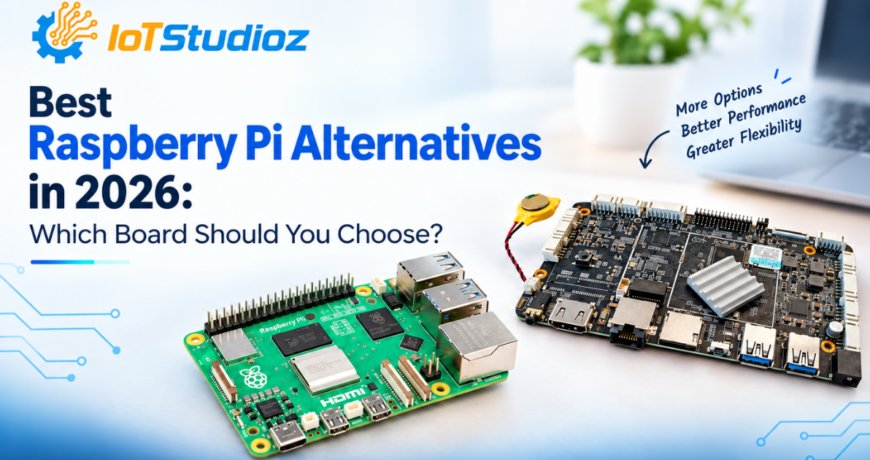
Best Raspberry Pi Alternatives in 2026: Which Board Should You Choose?
The Raspberry Pi has become one of the most popular single-board computers (SBCs) for developers, students, makers, and businesses. From DIY projects and home automation to robotics and industrial monitoring, Raspberry Pi boards offer a flexible platform for building a wide range of applications.
However, Raspberry Pi is not always the best fit for every project. Some applications require Android support, specialized industrial interfaces, better integration with existing hardware, or a platform designed for a specific embedded product. In other cases, developers may need a different balance of processing power, connectivity, power consumption, and cost.
This is where the best Raspberry Pi alternatives in 2026 become worth exploring.
Several alternative SBC boards offer different advantages, including AI processing, industrial connectivity, Android-based interfaces, Linux development, and compact embedded computing. Choosing the right board depends on your application’s requirements rather than specifications alone.
What Is a Single-Board Computer (SBC)?
A single-board computer is a complete computing system built on one circuit board. It typically integrates a processor, memory, storage interfaces, networking, USB connectivity, and input/output interfaces.
SBCs are widely used for:
- IoT gateways and edge computing
- Industrial automation and monitoring
- Smart displays and digital signage
- Robotics and computer vision
- Android-based embedded devices
- Home automation and media applications
- Prototyping and product development
Although Raspberry Pi is a leading option, alternative SBC boards can offer different processor architectures, operating systems, hardware interfaces, and deployment options.
Why Look for Raspberry Pi Alternatives in 2026?
Raspberry Pi remains a strong choice for many projects, but developers may need alternatives for several reasons.
1. Different operating system requirements
Some embedded products need Android rather than a conventional Linux desktop or command-line environment. A board with suitable Android support can simplify the development of touchscreen interfaces, kiosks, and dedicated smart devices.
2. Industrial connectivity
Industrial systems may require RS485, CAN, isolated serial interfaces, Ethernet, or other specialized connections. Depending on the board, these interfaces may require additional HATs, USB adapters, or custom hardware.
3. AI and edge computing
Computer vision, image processing, and on-device inference may benefit from boards with dedicated neural processing units (NPUs), compatible accelerators, or suitable GPU capabilities.
4. Product-specific hardware integration
Commercial products often need a stable hardware design, predictable software support, suitable connectors, and long-term component availability. A board designed for embedded integration may be more appropriate than a general-purpose maker board.
5. Performance and cost considerations
A board with more memory or a faster processor is not automatically the better choice. Developers should evaluate the complete system cost, including storage, power supplies, displays, accessories, software development, and production requirements.
Best Raspberry Pi Alternatives in 2026: Top Boards to Consider
The following boards represent different categories of alternative SBC boards. They are not direct equivalents: some prioritize AI, others focus on compact Linux computing, and some are better suited to Android or industrial applications.
1. Orange Pi 5 Series – A Strong General-Purpose Alternative
The Orange Pi 5 family is worth considering for projects that need substantial processing performance in a compact form factor.
Depending on the specific model, the family uses Rockchip processors such as the RK3588S and offers combinations of high-speed connectivity, memory, storage interfaces, and multimedia capabilities.
Best for:
- Linux-based development
- Multimedia applications
- Edge computing prototypes
- Computer vision projects
- Advanced DIY and maker applications
Advantages:
- Powerful processor options
- Suitable for demanding embedded workloads
- Multiple memory and connectivity configurations across the product family
- Useful for developers exploring ARM-based computing
Limitations:
- Specifications vary significantly between models.
- Operating system images and peripheral support may differ from Raspberry Pi’s well-established ecosystem.
- Hardware acceleration and AI performance depend on software compatibility, not just the processor.
Verdict: Orange Pi 5-series boards are worth comparing when processing performance is a priority. Verify the exact model, operating system support, and peripheral requirements before purchasing.
2. Radxa ROCK 5 Series – For High-Performance Embedded Computing
Radxa’s ROCK 5 family targets developers who need higher-performance ARM-based computing for demanding applications. Selected models use Rockchip RK3588-series processors.
These boards can be attractive for multimedia processing, edge computing, computer vision, and embedded Linux development.
Best for:
- Advanced edge computing
- Multimedia and video processing
- Computer vision prototypes
- High-performance ARM development
- Custom embedded systems
Advantages:
- Powerful processor options on selected models
- Useful interfaces for embedded development
- Potential for demanding workloads when supported by suitable software
- Flexibility for custom hardware and software projects
Limitations:
- Board dimensions, connectors, memory, and expansion options vary by model.
- Some projects may require additional configuration for drivers and hardware acceleration.
- Higher processing capability can increase power and cooling requirements.
Verdict: Consider a ROCK 5 board if your project needs substantial processing capability and your team can manage the associated software integration.
3. NVIDIA Jetson Orin Nano – For AI and Computer Vision
NVIDIA Jetson Orin Nano is designed for edge AI applications that benefit from GPU acceleration and NVIDIA’s software ecosystem.
It is particularly relevant to projects involving neural networks, image analysis, robotics, and intelligent camera systems.
Best for:
- AI-powered computer vision
- Robotics and autonomous systems
- Object detection and image analysis
- Edge inference
- Intelligent industrial inspection
Advantages:
- GPU-oriented AI computing capabilities
- Access to NVIDIA’s AI development ecosystem
- Suitable for supported machine learning and computer vision workloads
- Designed for edge AI applications
Limitations:
- The overall development cost can be higher than that of entry-level SBCs.
- AI performance depends on the model, software, memory, and power configuration.
- It is not the most economical choice for simple sensor monitoring or basic control applications.
- Its software environment differs from a conventional Raspberry Pi setup.
Verdict: Choose Jetson Orin Nano when AI acceleration is central to the application. For ordinary automation, basic IoT gateways, or Android-based user interfaces, a different SBC may offer a more appropriate balance.
4. BeagleBone Black – For Hardware Control and Industrial Prototyping
BeagleBone Black is a well-established single-board computer with a strong focus on hardware interfacing and embedded Linux development.
Its programmable real-time units (PRUs) are particularly useful in applications where certain hardware operations need more deterministic timing than a typical Linux application can provide.
Best for:
- Hardware interfacing
- Industrial control prototypes
- Sensor acquisition
- Embedded Linux applications
- Projects requiring real-time I/O support
Advantages:
- Useful low-level hardware capabilities
- PRUs for supported real-time tasks
- Established embedded development community
- Well suited to control-oriented prototypes
Limitations:
- Its processing capabilities are more modest than those of newer high-performance SBCs.
- It is not designed to compete with dedicated AI platforms.
- Developers must check current software support and peripheral compatibility.
Verdict: BeagleBone Black remains worth considering when hardware control and timing are more important than raw processing power.
5. Libre Computer Boards – For Budget-Friendly Linux Projects
Libre Computer offers several SBC models aimed at Linux-based computing and embedded development.
The available processor, memory, multimedia support, and expansion interfaces depend on the particular model, so developers should compare individual boards rather than treating the range as a single specification.
Best for:
- Lightweight Linux applications
- Basic IoT projects
- Home automation
- Educational projects
- Cost-conscious embedded prototypes
Advantages:
- Options for relatively simple Linux workloads
- Useful for experimentation and compact computing
- Different models suit different performance requirements
Limitations:
- Peripheral support and software maturity vary by model.
- Some boards offer fewer expansion options than other SBC families.
- Availability and total cost should be checked in the target market.
Verdict: Libre Computer boards are worth evaluating for cost-conscious projects that do not need advanced AI, high-end graphics, or specialized Android support.
6. ASUS Tinker Board – For Multimedia and Embedded Development
ASUS Tinker Board models are another category to evaluate when exploring alternatives to Raspberry Pi.
Depending on the model, these boards target multimedia, embedded Linux, and general-purpose computing. Developers should confirm the exact model’s processor, memory, interfaces, and software support.
Best for:
- Embedded multimedia prototypes
- General-purpose ARM computing
- Custom embedded interfaces
- Development and experimentation
Advantages:
- Options designed for embedded computing
- Useful for projects with model-specific multimedia requirements
- Potential fit for applications with established hardware and software compatibility
Limitations:
- Specifications and ecosystem support vary by generation.
- Community resources and compatible software should be evaluated for the chosen model.
- Availability and pricing may differ by region.
Verdict: Consider a Tinker Board when its exact hardware configuration and software ecosystem fit your project. Compare it with current alternatives before making a purchase decision.
7. RK3568-Based SBC – For Android-Based Embedded Applications
An RK3568-based single-board computer is a strong category to consider when developing embedded products that need an Android-based user interface, supported Linux workloads, or integration with external devices.
The Rockchip RK3568 is a quad-core ARM Cortex-A55 processor with an integrated Mali-G52-class GPU and hardware capabilities aimed at embedded computing. Exact features, interfaces, and supported software depend on the board design and its firmware.
Unlike choosing a board purely for maker projects, selecting an RK3568 board can be part of a broader embedded product strategy, especially when Android compatibility and hardware integration are important.
Best for:
- Android-based embedded devices
- Touchscreen control panels
- Smart terminals and kiosks
- Digital signage
- Custom human-machine interfaces (HMIs)
- Selected IoT and industrial interface applications
Advantages:
- Suitable processor architecture for supported Android and Linux builds
- Integrated graphics for compatible display applications
- Useful foundation for dedicated embedded products
- Potential for integration with displays, storage, networking, and external peripherals, depending on the board
- Can support custom software and application development when the board’s BSP and drivers are available
Limitations:
- Android compatibility depends on the specific board support package (BSP), firmware, drivers, and Android version.
- Industrial interfaces such as RS485, CAN, or isolated I/O may require onboard support or additional hardware.
- Developers should verify display interfaces, storage, networking, boot options, and long-term software maintenance before deployment.
- Performance and power consumption depend on the complete hardware design and workload.
Verdict: An RK3568 board is worth considering when Android-based embedded applications are a core requirement. It can be a better fit than a general-purpose Raspberry Pi setup for a product that needs a dedicated Android interface, provided the required BSP, drivers, and peripherals are supported.
If you are evaluating an RK3568 board for a commercial product, compare the actual board configuration, Android image, display support, connectivity, and documentation rather than relying on the processor name alone.
Comparison Table: Which Alternative SBC Board Fits Your Project?
The table below compares the main strengths of each category. It is a qualitative guide, not a benchmark ranking, because exact configurations and software support vary.
| Board / Category | Primary Strength | OS and Software Considerations | Best Use Case |
| Orange Pi 5 series | General-purpose performance | Linux support varies by model | Embedded computing and multimedia |
| Radxa ROCK 5 series | High-performance ARM computing | Check image and driver support | Advanced edge computing |
| NVIDIA Jetson Orin Nano | AI and GPU acceleration | NVIDIA-oriented AI ecosystem | Computer vision and robotics |
| BeagleBone Black | Hardware control and PRUs | Embedded Linux | Control and sensor interfacing |
| Libre Computer | Cost-conscious Linux computing | Model-specific compatibility | Basic IoT and lightweight workloads |
| ASUS Tinker Board | Embedded multimedia options | Depends on board generation | Multimedia and embedded prototypes |
| RK3568-based SBC | Android-oriented embedded development | Requires compatible Android BSP and drivers | Kiosks, HMIs, and smart terminals |
Important: No single board wins in every category. A platform with strong AI capabilities may be unnecessary for a simple gateway, while an affordable Linux board may not be appropriate for an Android touchscreen product.
How to Choose the Best Raspberry Pi Alternative
Before selecting a board, evaluate the following factors.
1. Operating System Compatibility
Start by identifying the software your product needs.
- Choose a Linux-focused SBC if your application depends on Linux services, containers, Python applications, or embedded Linux tools.
- Consider an AI-oriented board if your application depends on a supported machine learning stack.
- Consider an RK3568-based SBC if you need Android and the required Android version, BSP, and device drivers are available.
Do not assume that every board supports every operating system version or that all features work equally well across different software images.
2. Processing Power and Memory
Match the processor and RAM to your actual workload. A basic monitoring gateway may not need a high-end processor, while computer vision, video processing, and complex graphical interfaces may need more computing resources.
Review real application benchmarks, memory requirements, thermal behavior, and sustained performance before finalizing the board.
3. Connectivity and Hardware Interfaces
For embedded and industrial projects, check the interfaces that are available on the board itself.
These may include:
- Ethernet and Wi-Fi
- USB and serial ports
- RS232 and RS485
- CAN bus
- GPIO and I2C
- SPI and UART
- HDMI, MIPI, or other supported display interfaces
- M.2 or other expansion options, where available
An interface being supported by the processor does not necessarily mean it is exposed on the board. Confirm the schematics, connectors, voltage levels, and any isolation requirements.
4. Power Consumption and Thermal Design
Power requirements matter in battery-powered devices, industrial enclosures, and fanless systems.
Check idle and workload power consumption, input voltage requirements, cooling needs, and operating temperature ratings. Do not assume that two boards with similar processors will have identical power or thermal characteristics.
5. Software Support and Documentation
A board’s value depends on more than hardware specifications. Look for reliable operating system images, device drivers, technical documentation, sample applications, firmware updates, and a clear maintenance path.
For a commercial product, confirm how long the supplier expects to support the board and whether software updates will remain available throughout the product’s intended lifecycle.
6. Total Cost of Ownership
Compare the complete cost of development and deployment, not just the initial board price.
Include the cost of power supplies, storage, cooling, display components, interface adapters, enclosures, software integration, testing, and ongoing maintenance.
A board with a lower purchase price may require more engineering effort, while a board with stronger out-of-the-box support may reduce development time.
Which Board Should You Choose?
The best Raspberry Pi alternative depends on what you are building.
- For general-purpose Linux development: Evaluate Orange Pi or Libre Computer models based on performance and software support.
- For high-performance ARM computing: Compare suitable Radxa ROCK 5 and Orange Pi 5 models.
- For AI and computer vision: Consider NVIDIA Jetson Orin Nano when its AI ecosystem matches your workload.
- For control-oriented projects: Evaluate BeagleBone Black for its hardware interfacing and PRU capabilities.
- For multimedia and embedded experimentation: Compare compatible ASUS Tinker Board models.
- For Android-based embedded applications: Consider an RK3568-based SBC with a suitable Android BSP, display support, and required connectivity.
If your project requires a dedicated Android interface, the most important question is not whether a board is faster than Raspberry Pi. It is whether the platform supports the operating system, display, peripherals, and product requirements you need.
Final Thoughts
Raspberry Pi remains a capable and versatile platform, but it is not the only option for embedded development in 2026.
Alternative SBC boards serve different needs, from AI acceleration and high-performance ARM computing to real-time hardware control and budget-friendly Linux projects. The right choice depends on the workload, operating system, interfaces, software ecosystem, and deployment requirements.
For developers building Android-based embedded products, an RK3568-based board deserves consideration because it combines ARM computing capabilities with a potential path to Android-powered interfaces and custom embedded integration.
Before choosing any SBC, verify the exact model’s hardware specifications, operating system support, documentation, and long-term availability. This approach will help you select a platform that meets both your immediate development needs and your product’s future requirements.