
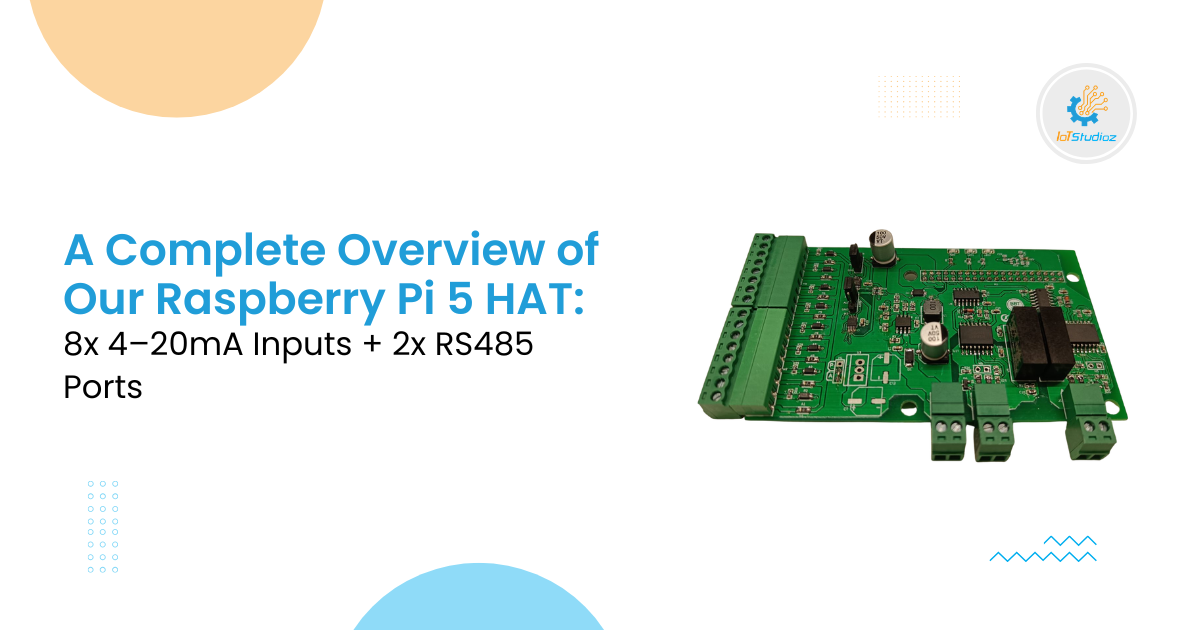
A Complete Overview of Our Raspberry Pi 5 HAT: 8x 4–20mA Inputs + 2x RS485 Ports Leave a comment
Industrial systems now demand compact, reliable, and accurate hardware. Traditional controllers still exist, but modern solutions are replacing them. The Raspberry Pi 5 HAT with 8x 4–20mA inputs and 2x RS485 ports offers a strong alternative.
This HAT combines analog input capability with industrial communication. It helps engineers collect data and control systems in real time. It also reduces cost and improves flexibility.
According to industry reports, the Industrial IoT market may cross $1 trillion by 2030. This growth increases demand for devices that support both sensing and communication.
Understanding the Role of a Raspberry Pi 5 HAT
A HAT is an expansion board designed for Raspberry Pi. It connects directly to the GPIO header. This connection allows the Pi to interact with external hardware.
The Raspberry Pi 5 HAT adds industrial-grade features that the base board lacks.
Key Functions
- Converts analog signals into digital data
- Enables communication with industrial devices
- Expands system capability without external modules
Why This Matters
The Raspberry Pi alone cannot read 4–20mA signals directly. It also lacks native RS485 ports. This HAT fills both gaps in one compact solution.
Practical Impact
Without a HAT, engineers use separate modules:
- External ADC boards
- USB-to-RS485 converters
This increases wiring complexity and system size. The HAT removes these issues.
Why Industrial Systems Use 4–20mA Signals
1. Basics of 4–20mA Current Loop
The 4–20mA standard represents sensor values using current. A sensor sends current through a loop.
- 4 mA represents the minimum value
- 20 mA represents the maximum value
For example, a temperature sensor may map:
- 4 mA → 0°C
- 20 mA → 100°C
2. Why Current Signals Work Better
Voltage signals drop over long cables. Current signals remain stable.
Noise affects voltage easily. Current signals resist noise better.
3. Advantages
- Long-distance transmission: Signals can travel up to 1000 meters with minimal loss.
- Noise resistance: Industrial environments include motors and drives. These generate electromagnetic noise. Current loops reduce its effect.
- Fault detection: If current drops below 4 mA, the system detects a fault.
4. Industry Statistics
- Around 75% of industrial sensors use 4–20mA
- Signal accuracy remains above 98% in most setups
- Maintenance cost reduces by 20–30% due to reliability
Overview of 8x 4–20mA Input Channels
The HAT includes eight independent input channels. Each channel reads one sensor.
1. Channel Design
Each channel includes:
- Signal conditioning circuit
- Analog-to-digital converter
- Protection components
2. Why Eight Channels Matter
Many industrial systems use multiple sensors. A single device must handle all inputs.
3. Benefits
- Reduces need for multiple boards
- Simplifies wiring
- Saves installation space
4. Accuracy and Stability
The HAT uses high-resolution ADCs. These provide accurate readings.
- Small current changes are detected
- Data remains stable over time
5. Example Use Case
In a water treatment plant:
- 2 sensors measure flow
- 2 sensors monitor pressure
- 2 sensors track tank levels
- 2 sensors measure temperature
All eight channels are used at once. Engineers monitor all parameters from a single system.
Importance of Electrical Isolation
Isolation is a critical feature in industrial electronics.
1. What is Isolation?
Isolation separates electrical circuits. It prevents direct current flow between them.
2. Why It Is Needed
Industrial systems often have:
- High voltage equipment
- Ground potential differences
- Sudden voltage spikes
These can damage sensitive electronics.
3. Benefits
- Protection
Isolation protects the Raspberry Pi from high voltage. - Noise reduction
It prevents noise from entering measurement circuits. - Improved accuracy
Clean signals result in better data quality.
4. Real Scenario
A motor starts in a factory. It generates electrical noise. Without isolation, sensor readings may fluctuate. With isolation, readings remain stable.
RS485 Communication
1. What is RS485?
RS485 is a serial communication standard. It uses differential signaling.
Two wires carry opposite signals. This method cancels noise.
2. Key Features
- Supports long-distance communication
- Allows multiple devices on one bus
- Works in noisy environments
3. Performance
- Distance up to 1200 meters
- Supports up to 32 devices
- Data rate up to 10 Mbps at short range
4. Industry Statistics
- Over 60% of industrial systems use RS485
- Common in Modbus RTU networks
- Widely used in SCADA systems
Benefits of Dual RS485 Ports
The HAT includes two RS485 ports. This adds flexibility.
1. Why Two Ports Are Useful
- Separate communication channels
- Independent device networks
- Improved system design
2. Benefits
- Parallel communication: Two networks operate at the same time.
- Reduced traffic load: Devices split across two buses improve performance.
- System redundancy: If one network fails, the other continues.
3. Example
In a factory:
- Port 1 connects to sensors
- Port 2 connects to actuators
This setup improves reliability and response time.
Integration with Industrial Protocols
The HAT supports common industrial protocols.
1. Protocols Supported
- Modbus RTU
- Custom UART protocols
- SCADA integration
2. How Integration Works
- Sensors send 4–20mA signals
- HAT converts signals into digital values
- Raspberry Pi processes the data
- RS485 sends data to external systems
3. Example
A SCADA system monitors plant data. The Raspberry Pi collects sensor data and sends it using Modbus RTU.
Performance with Raspberry Pi 5
The Raspberry Pi 5 provides strong processing capability.
1. Hardware Improvements
- Faster CPU
- Better memory performance
- Improved I/O bandwidth
2. Impact on System
- Faster data processing
- Reduced communication delay
- Better multitasking
3. Performance Stats
- CPU performance increases by up to 3x
- Data handling improves by 40–50%
This improves real-time monitoring systems.
Applications of the Raspberry Pi 5 HAT
1. Industrial Automation
Factories use sensors to monitor machines.
- Collect real-time data
- Control production processes
- Reduce downtime
2. Energy Monitoring
Power systems need constant monitoring.
- Measure energy consumption
- Detect faults early
- Improve efficiency
3. Smart Agriculture
Farmers use sensors for better crop management.
- Monitor soil moisture
- Control irrigation systems
- Increase yield
4. Building Automation
Buildings use automation for efficiency.
- Control HVAC systems
- Manage lighting
- Monitor security systems
RS485 connects devices across large buildings.
Role in Edge Computing
1. What is Edge Computing?
Edge computing processes data near the source.
2. Benefits
- Faster response: Data is processed instantly.
- Reduced bandwidth usage: Less data is sent to the cloud.
- Improved reliability: System works even without internet.
3. Example
A machine overheats:
- Sensor sends signal
- HAT reads data
- Raspberry Pi triggers alert
The response happens instantly.
Reliability in Industrial Environments
Industrial environments are harsh.
1. Common Challenges
- High temperature
- Electrical noise
- Dust and vibration
2. Design Strengths
- Strong PCB design
- Industrial-grade components
- Stable power handling
3. Result
The system works reliably under tough conditions. Data remains accurate.
Comparison with Traditional Systems
| Feature / Parameter | PLC Systems | Raspberry Pi + HAT |
| Cost | Very high initial cost | Cost-effective solution |
| Flexibility | Limited hardware and software changes | Highly flexible and customizable |
| Programming | Complex and requires special tools | Easy programming using Python, C/C++ |
| Scalability | Expansion is expensive | Easy to scale with add-ons and software |
| Hardware Integration | Requires separate modules | Integrated solution with single HAT |
| Communication Support | Depends on PLC model | Built-in RS485 support |
| Maintenance | Higher maintenance cost | Lower maintenance cost |
| Development Time | Longer development cycle | Faster development and deployment |
| Community Support | Limited vendor-specific support | Large open-source community |
| Cost Comparison | 5–10 times more expensive | Reduces cost by up to 60% |
Software and Development Support
1. Supported Tools
- Python
- C/C++
- Linux OS
2. Benefits for Developers
- Easy coding
- Large community support
- Quick deployment
3. Example Tasks
- Read sensor data
- Send data via RS485
- Store data locally or on cloud
Installation and Setup Guide
1. Step-by-Step Process
- Mount the HAT on Raspberry Pi
- Connect sensors to input channels
- Connect RS485 devices
- Install required drivers
- Run test scripts
2. Time Required
- Basic setup: 30–60 minutes
- Full integration: few hours
Safety Guidelines
1. Important Points
- Use proper grounding
- Check wiring before power
- Avoid over-voltage
2. Why It Matters
Improper setup can damage hardware and affect performance.
Future Market Trends
1. Key Trends
- Industrial IoT growing rapidly
- Edge computing adoption increasing
- Smart factories expanding
2. Growth Stats
- IoT market expected to reach $1 trillion by 2030
- Edge computing growing at 20% CAGR
3. Impact:
Demand for compact industrial solutions will increase. The Raspberry Pi 5 HAT fits this demand.
Conclusion
The Raspberry Pi 5 HAT with 8x 4–20mA inputs and 2x RS485 ports provides a complete solution for industrial systems.
It offers:
- Accurate data acquisition
- Reliable communication
- Cost-effective deployment
Engineers can build scalable and efficient systems using this HAT. It supports modern applications in automation, monitoring, and control.
FAQs
1. What is the main purpose of this Raspberry Pi 5 HAT?
The Raspberry Pi 5 HAT is designed for industrial data acquisition and communication. It reads analog signals from sensors using 4–20mA inputs and communicates with devices using RS485.
It helps engineers build monitoring and control systems without using separate modules. This reduces system complexity and cost.
2. How accurate are the 4–20mA input channels?
The HAT uses high-resolution ADCs for precise measurements. It can detect small current changes across the 4–20mA range.
In most applications, accuracy remains above 98%. Proper calibration and wiring improve accuracy further.
Stable readings are achieved even in noisy industrial environments.
3. Can this HAT communicate with Modbus devices?
Yes, the HAT supports RS485 communication, which works with Modbus RTU protocol.
You can connect multiple Modbus devices such as:
- Energy meters
- PLCs
- Sensors
The Raspberry Pi processes the data and exchanges it with these devices easily.
4. Why are two RS485 ports included instead of one?
Two RS485 ports allow connection to two separate networks. This improves flexibility and system design.
You can:
- Connect sensors on one port
- Connect controllers or actuators on another
This setup reduces communication load and improves performance.
5. Is this Raspberry Pi 5 HAT suitable for harsh industrial environments?
Yes, the HAT is built for industrial use. It includes protection features like electrical isolation and stable circuit design.
It performs well in environments with:
- Electrical noise
- Voltage fluctuations
- Temperature variations
Proper installation and enclosure further improve durability and reliability.