
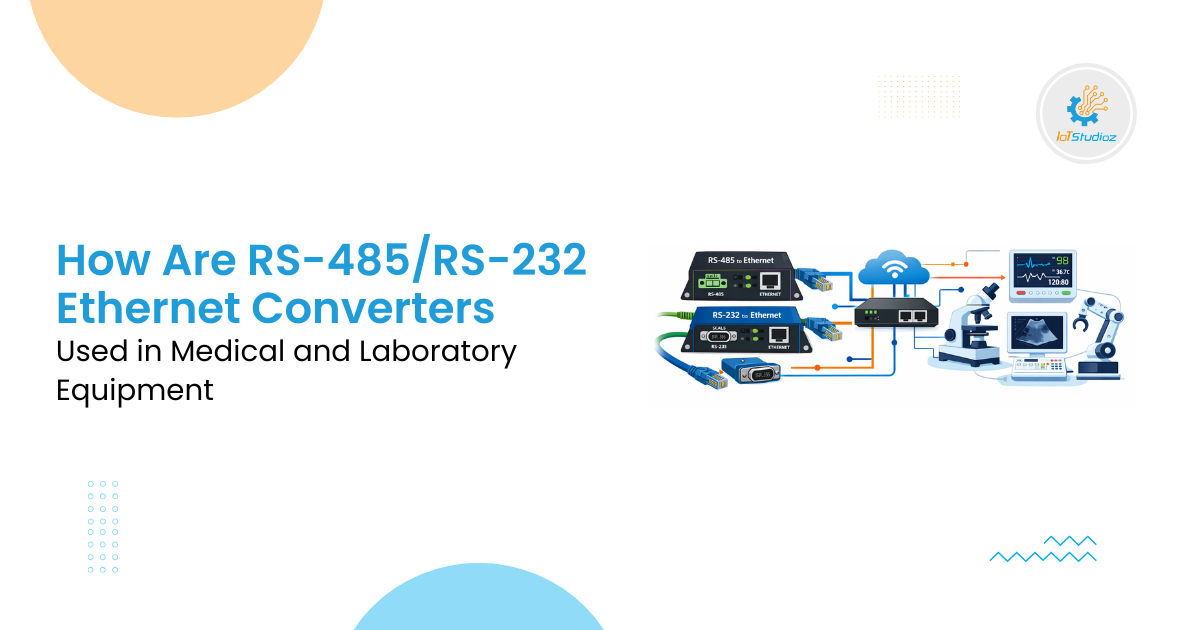
How Are RS-485/RS-232 Ethernet Converters Used in Medical and Laboratory Equipment
Medical and laboratory environments rely heavily on accurate data collection and seamless communication between devices. Instruments such as patient monitors, infusion pumps, laboratory analyzers, and imaging systems often need to communicate with computers, servers, or centralized control systems. Many of these devices use legacy serial communication protocols like RS-232 or RS-485. However, modern network infrastructures prefer Ethernet for speed, reliability, and remote access. This is where RS-485 / RS-232 to Ethernet converters play a crucial role.
- The global medical device integration market is projected to grow at a CAGR of 7.5% from 2024 to 2030. Converters play a key role in integrating legacy devices.
- Hospitals and labs increasingly demand converters with higher reliability, EMI protection, and long operational life.
- Telemedicine and remote patient monitoring drive the need for networked medical devices.
What Are RS-485 and RS-232 Protocols?
RS-232
RS-232 is one of the oldest serial communication standards. It typically supports point-to-point connections between devices, using voltage-based signaling over a single-ended line. It allows data transfer at rates up to 115.2 kbps and distances up to 15 meters. RS-232 ports are widely used in older medical devices like ventilators, infusion pumps, and patient monitors.
RS-485
RS-485, also known as EIA-485, is designed for multi-point communication over long distances. It uses differential signaling, allowing reliable data transmission over distances up to 1,200 meters at speeds up to 10 Mbps. RS-485 supports up to 32 devices on a single bus, making it ideal for laboratory automation systems, environmental monitoring devices, and industrial medical equipment.
Key Differences
| Feature | RS-232 | RS-485 |
| Max Distance | 15 meters | 1200 meters |
| Data Rate | 115.2 kbps | 10 Mbps |
| Topology | Point-to-point | Multi-drop |
| Noise Immunity | Low | High |
| Devices Supported | 2 | Up to 32 |
These legacy protocols are reliable but limited in integration with modern Ethernet-based networks. This is why converters are essential.
What Is an RS-485 / RS-232 to Ethernet Converter?
An RS-485 / RS-232 to Ethernet converter is a device that translates serial communication signals into Ethernet signals. This allows traditional serial devices to communicate over a TCP/IP network without modifying their internal hardware or firmware.
Technical Features
- Converts RS-232 or RS-485 signals to TCP/IP packets
- Supports multiple serial devices on a single network
- Provides configurable baud rates, parity, and stop bits
- Allows remote monitoring and control over LAN or WAN
- Often supports both TCP client/server and UDP communication
In simple terms, the converter acts as a bridge between old serial devices and modern Ethernet networks.
Why RS-485 / RS-232 to Ethernet Converters Are Used in Medical Equipment
Medical devices need real-time monitoring, accurate data transmission, and integration into hospital information systems (HIS) and electronic medical records (EMR). Here are some reasons why converters are widely used:
1. Remote Monitoring
Modern hospitals often use centralized monitoring systems. Devices like patient monitors or ventilators use serial ports for communication. By converting RS-232/RS-485 to Ethernet, staff can monitor multiple devices from a single workstation.
Example: A hospital ICU may have 50 patient monitors. Each monitor uses RS-232 for data. With a converter, all data can be sent over Ethernet to a central monitoring server. Staff can detect abnormalities in real time.
2. Integration with Hospital Networks
Many older medical devices were not designed to connect directly to Ethernet networks. RS-485 / RS-232 to Ethernet converters allow legacy devices to interface with hospital servers, EMRs, or laboratory management systems without replacing existing equipment.
Stat: A survey by HIMSS Analytics reported that 62% of U.S. hospitals still use legacy medical devices that require serial-to-network conversion.
3. Real-Time Data Logging
Converters enable automatic logging of medical data over Ethernet. This reduces human error in recording measurements manually. Devices like infusion pumps or anesthesia machines can continuously send operational data to a central database for auditing and regulatory compliance.
4. Compliance and Safety
Medical devices must comply with regulations like FDA 21 CFR Part 11 and ISO 13485. Converters help ensure accurate digital communication and traceability of patient data. Ethernet-based transmission reduces interference issues that might occur with long RS-232 or RS-485 cables.
How RS-485 / RS-232 to Ethernet Converters Are Used in Laboratory Equipment
Laboratory equipment often requires precise timing and data synchronization. Examples include centrifuges, PCR machines, spectrophotometers, and chemical analyzers.
1. Centralized Control
Many laboratories use Laboratory Information Management Systems (LIMS) to control instruments and store results. RS-485 / RS-232 to Ethernet converters allow multiple devices to be monitored and controlled through LIMS software, even if the devices were not designed for network integration.
2. Long-Distance Communication
Lab instruments may be spread across different rooms or floors. RS-485’s long-distance capability combined with Ethernet conversion allows reliable communication without physically relocating instruments.
Example: A research lab may have a chemical analyzer in one room and a centrifuge in another. Using RS-485 to Ethernet converters, both devices can transmit data over the same Ethernet network to a central LIMS server located 50 meters away.
3. Automation
Converters enable automation of repetitive laboratory tasks. By connecting instruments to Ethernet, scripts or software can automatically trigger tests, collect results, and store them in databases. This increases efficiency and reduces the risk of errors.
4. Data Security
Laboratories handling sensitive or regulated data benefit from Ethernet communication with encryption and authentication. RS-485 / RS-232 to Ethernet converters support protocols like TCP/IP and UDP, which can be integrated with firewall and VPN solutions for secure data transmission.
Technical Considerations When Choosing a Converter
Choosing the right converter requires attention to the device environment, data rates, and protocols.
1. Communication Speed
Converters must support the baud rate and protocol used by the device. Typical RS-232 baud rates range from 9600 to 115.2 kbps. RS-485 devices may require higher speeds up to 10 Mbps.
2. Number of Ports
Some converters offer a single RS-232/RS-485 port, while others provide multiple ports. Multi-port converters allow a single Ethernet connection to manage several devices.
3. Protocol Support
Devices may use standard ASCII communication or specific protocols like Modbus RTU or proprietary protocols. The converter must be compatible with the protocol for proper data translation.
4. Environmental Requirements
Medical and laboratory environments demand converters that can operate under high humidity, temperature variations, or electromagnetic interference (EMI). Industrial-grade converters are often preferred.
5. Network Features
Look for features such as:
- TCP/UDP support
- DHCP/static IP configuration
- Web-based management interfaces
- Firmware upgrade capability
Real-World Examples
1: Hospital Device Integration
A cardiology unit uses older ECG machines that output RS-232 data. Staff must review results on a central workstation. Installing RS-232 to Ethernet converters allowed all ECG data to be transmitted over the hospital network, reducing manual data entry and improving response times during emergencies.
2: Laboratory Automation
A genetics lab has ten DNA sequencers using RS-485 interfaces. Using RS-485 to Ethernet converters, the lab integrated all sequencers with LIMS. Results are automatically logged, errors are reduced, and researchers can monitor sequences remotely.
3: Environmental Monitoring in Labs
Some laboratories use RS-485-based temperature and humidity sensors. Connecting these sensors to an Ethernet network allows continuous monitoring and alerts when environmental conditions exceed safe thresholds. This helps maintain equipment integrity and experiment reliability.
Advantages of Using RS-485 / RS-232 to Ethernet Converters
- Legacy Device Integration: Extend the life of older equipment.
- Remote Access: Monitor and control devices from anywhere on the network.
- Centralized Data Management: Collect and analyze data in a single system.
- Improved Reliability: Ethernet networks are less susceptible to noise than long serial cables.
- Cost-Effective: Avoid replacing expensive medical or laboratory equipment.
Challenges and Limitations
- Latency: Converting serial to Ethernet may introduce minor delays. Critical applications must account for this.
- Complex Configuration: Some converters require detailed setup, including IP addresses, ports, and protocols.
- Device Compatibility: Not all legacy devices work seamlessly over Ethernet without firmware or protocol adjustment.
- Security Risks: Connecting devices to Ethernet increases vulnerability to network attacks if not properly secured.
Conclusion
RS-485 / RS-232 to Ethernet converters serve as a vital bridge between legacy medical and laboratory devices and modern network infrastructures. They enable remote monitoring, data centralization, automation, and secure communication. By converting serial signals to Ethernet, hospitals and laboratories can improve operational efficiency while avoiding the high cost of replacing existing devices.
These converters are not merely adapters; they are critical components in the digital transformation of healthcare and laboratory operations. Selecting the right converter requires careful consideration of communication speed, protocol compatibility, environmental conditions, and network features.
In medical and laboratory environments, where accuracy, safety, and efficiency are paramount, RS-485 / RS-232 to Ethernet converters provide a practical and technically sound solution to integrate older devices into modern networks.
FAQ
1: What is an RS-485 / RS-232 to Ethernet converter?
An RS-485 / RS-232 to Ethernet converter is a device that translates serial communication signals into Ethernet signals. It allows legacy medical or laboratory devices that use RS-232 or RS-485 ports to communicate over TCP/IP networks without modifying the original hardware.
2: Why are these converters important in medical equipment?
Medical devices like patient monitors, ventilators, and infusion pumps often use serial ports. Converters allow these devices to send real-time data to central monitoring systems, integrate with hospital servers, and support remote monitoring and data logging. This ensures accurate, timely, and compliant information flow.
3: Can RS-485 / RS-232 converters handle multiple devices?
Yes. RS-485 supports multi-drop communication, allowing up to 32 devices on a single bus. Many converters offer multiple serial ports, so several devices can connect to a single Ethernet network. This is particularly useful in laboratories and hospital units where many devices must be monitored centrally.
4: Are these converters secure for medical and laboratory data?
Converters themselves transmit data over Ethernet. When combined with secure network protocols, firewalls, or VPNs, they provide a safe communication channel. Using Ethernet instead of long serial cables also reduces interference and data corruption risks, improving reliability and compliance with standards like FDA 21 CFR Part 11.
5: What factors should I consider when choosing a converter?
Key considerations include:
- Supported baud rates and communication speed
- Number of serial ports required
- Compatibility with the device protocol (ASCII, Modbus, proprietary)
- Environmental durability (temperature, humidity, EMI protection)
- Network features like TCP/UDP support, DHCP/static IP, and web management