
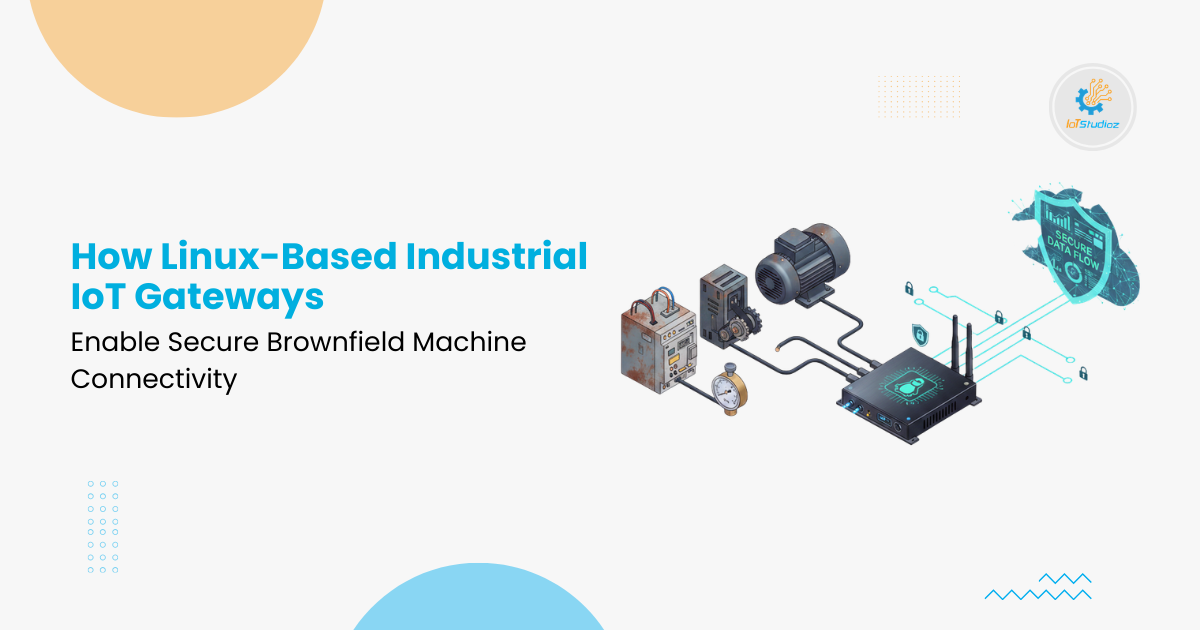
How Linux-Based Industrial IoT Gateways Enable Secure Brownfield Machine Connectivity
Manufacturing is changing fast, but many factories still rely on legacy machines never designed for connectivity. An IIoT Gateway helps bridge this gap as businesses increasingly demand real-time data and analytics. ARC Advisory Group estimates that over 98 million automation products installed globally since 1996 remain operational, representing the majority of factory equipment as brownfield or legacy systems.
Replacing these systems is expensive and risky. McKinsey reports that Industry 4.0 retrofits using an IIoT Gateway can deliver a 30–50% reduction in machine downtime and 10–30% cost savings compared to full replacement. At the same time, IBM X-Force 2025 highlights a 49% year-over-year surge in ransomware attacks, with OT and critical infrastructure accounting for 70% of incidents—making secure connectivity more critical than ever.
Challenges of Connecting Brownfield Industrial Systems
Brownfield environments contain machines built before modern networking standards existed. These assets often lack digital interfaces or use proprietary protocols.
Common Challenges
- Machines communicate through serial ports like RS-232 or RS-485.
- Documentation is incomplete or outdated.
- Systems use vendor-specific communication formats.
- Hardware lacks built-in security features.
- Downtime during upgrades is unacceptable.
- Integration must not affect machine reliability.
What Is a Linux-Based Industrial IoT Gateway?
A Linux-Based Industrial IoT Gateway is an embedded edge device. It collects data from industrial machines and translates it into modern protocols. It runs a hardened Linux operating system designed for industrial workloads. The gateway acts as a secure translator between OT systems and IT infrastructure.
Core Functions
- Protocol conversion between legacy and modern standards
- Local data processing and filtering
- Secure communication with cloud platforms
- Device authentication and access control
- Edge analytics and buffering during outages
Why Linux Is Ideal for Industrial Gateways
Linux dominates embedded and industrial computing for several technical reasons.
1. Open Architecture
Linux offers a fully open and modular architecture, giving engineers complete control over kernel configuration, device drivers, and background services. This deep customization capability enables seamless integration with specialized industrial hardware, proprietary controllers, and non-standard communication modules used in factory automation.
2. Strong Driver Support
Linux provides extensive driver support for industrial communication protocols and hardware interfaces, including UART, serial ports, CAN bus, Modbus RTU/TCP, Ethernet/IP, PROFINET, and USB converters. This broad compatibility ensures smooth connectivity with both modern smart devices and legacy industrial machinery.
3. Long-Term Stability
Industrial gateways must operate continuously for years without unexpected failures or reboots. Linux is known for its exceptional stability under heavy workloads, offering robust process management, efficient memory handling, and reliable uptime performance essential for mission-critical industrial environments.
4. Security Transparency
As an open-source platform, Linux allows organizations to inspect source code, identify vulnerabilities, and implement security patches rapidly. This transparency enhances trust, enables independent security audits, and ensures compliance with industrial cybersecurity standards required in sensitive operational technology networks.
Architecture of a Linux IoT Gateway in Brownfield Environments
A typical Linux-Based Industrial IoT Gateway follows a layered architecture.
1. Device Interface Layer
This layer connects directly to machines using industrial communication ports. Supported interfaces include serial communication for PLCs, industrial Ethernet for controllers, digital I/O for sensors, and fieldbus adapters for legacy systems.
2. Protocol Translation Layer
Legacy protocols are decoded and mapped to structured data models. Examples include Modbus to MQTT conversion, CAN messages to JSON payloads, and OPC-UA mapping for enterprise applications.
3. Edge Processing Layer
The gateway processes data locally before transmission. Functions include filtering noisy signals, aggregating machine metrics, detecting anomalies in real time, and compressing large datasets.
4. Secure Communication Layer
Encrypted channels send validated data to IT systems or cloud platforms. Technologies often include TLS encryption, VPN tunnels, and certificate-based authentication.
5. Device Management Layer
Administrators monitor and update gateways remotely using secure management tools.
How Gateways Connect Legacy Machines Without Disruption
Industrial teams cannot risk modifying production systems. A Linux IoT Gateway uses non-invasive integration methods.
1. Passive Data Acquisition: Gateways read signals without interfering with control loops. This prevents operational risk.
2. Serial Sniffing Techniques: The gateway listens to machine communication traffic. It extracts data while leaving behavior unchanged.
3. Edge Buffering: Production continues even if network connectivity drops. Data stores locally until transmission resumes.
4. Digital Twin Mapping: Machine signals map to virtual models. Engineers gain visibility without altering hardware logic.
Security Considerations in Brownfield Connectivity
Legacy machines lack built-in cybersecurity. Directly exposing them to networks creates serious risks. A Linux-Based Industrial IoT Gateway acts as a protective security layer.
Key Security Functions
The following are essential security functions.
1. Network Segmentation: The gateway isolates OT networks from enterprise IT systems. This prevents lateral attack movement.
2. Encryption Enforcement: Older machines cannot encrypt data. The gateway adds encryption before transmission.
3. Identity Management: Each device receives a unique digital certificate. Unauthorized systems cannot connect.
4. Firewall and Access Policies: Linux-based firewalls restrict traffic based on strict industrial rules.
5. Secure Boot Mechanisms: Hardware verifies firmware integrity during startup. This prevents tampering.
Role of Edge Computing in Industrial Gateways
Sending raw industrial data directly to the cloud is inefficient. Edge computing solves this problem.
Benefits of Local Processing
Local processing reduces bandwidth consumption, enables faster decision-making, supports real-time alerts, protects sensitive production data, and ensures operation during network outages. For example, vibration analysis can run directly on the gateway, and only the summarized results are transmitted.
Industrial Protocol Translation Made Simple
Brownfield machines often speak incompatible languages. A Linux IoT Gateway bridges this gap through protocol normalization.
Typical Conversion Workflows
The following table illustrates common protocol conversions that a Linux IoT Gateway performs to make legacy machine data compatible with modern industrial applications.
| Legacy Protocol | Converted To | Use Case |
| Modbus RTU | MQTT | Cloud telemetry |
| CAN Bus | REST API | Fleet monitoring |
| Proprietary PLC | OPC-UA | MES integration |
| Serial ASCII | JSON | Analytics platforms |
This translation allows modern applications to consume machine data easily.
Deployment Models for Linux-Based Industrial IoT Gateways
Organizations deploy gateways in several configurations depending on plant size and complexity.
1. Single-Machine Deployment: A compact gateway connects to one critical machine. This model suits pilot projects.
2. Cell-Level Deployment: One gateway aggregates data from multiple machines within a production cell.
3. Plant-Wide Deployment: Distributed gateways connect to a centralized platform. This architecture supports large factories.
4. Rugged Edge Clusters: Multiple gateways operate in high-availability configurations for critical infrastructure.
Brownfield Production Line Retrofit Case Study
Many manufacturers still operate CNC machines installed decades ago. These machines remain mechanically reliable but lack Ethernet connectivity and modern data interfaces. Replacing them would require major investment and production downtime. Instead, factories can retrofit these assets using a Linux-Based Industrial IoT Gateway to enable secure connectivity without changing machine behavior.
Integration Approach
- Engineers attach serial connectors to each CNC controller.
- A Linux-Based Industrial IoT Gateway collects operational data.
- Protocol translation converts machine signals into MQTT streams.
- Edge analytics calculates utilization and downtime metrics.
- Secure transmission sends summaries to a monitoring platform.
Results
The retrofit improves visibility without disrupting production. No mechanical or control-level changes are required, which removes integration risk. Maintenance teams can monitor machine health and plan predictive maintenance, reducing unexpected downtime. Energy consumption becomes measurable, supporting efficiency programs. The factory gains real-time insight into legacy equipment while extending the lifespan of proven machinery.
This example shows how a Linux IoT Gateway enables secure brownfield connectivity and supports gradual industrial modernization.
Lifecycle Management and Remote Operations
Industrial gateways must operate for long periods in harsh environments. Linux enables strong lifecycle management capabilities that support continuous and reliable operation. Administrators deploy signed firmware updates securely, which keeps systems protected against emerging threats while maintaining system integrity. Built-in logging and monitoring tools track CPU and memory usage, network activity, device health status, and security events, allowing teams to detect issues early and maintain stable performance across industrial deployments.
Performance and Reliability in Industrial Conditions
Factories expose electronics to vibration, dust, and temperature extremes. Industrial gateways must withstand these conditions. Linux supports real-time extensions that ensure deterministic performance.
Reliability Features
- Watchdog timers for automatic recovery
- Read-only file systems to prevent corruption
- Local failover storage
- Deterministic scheduling for time-sensitive tasks
Cost Advantages Over Full Equipment Replacement
Replacing legacy machinery requires large capital investment and retraining efforts. Gateway-based integration provides measurable savings.
Financial Benefits
- Extends machine lifespan by many years
- Avoids production shutdown during upgrades
- Reduces engineering redesign costs
- Enables phased digital transformation
- Delivers rapid return on investment
Best Practices for Implementing Linux-Based Industrial Gateways
Successful deployments follow structured engineering practices.
1. Assessment Phase
Audit existing machine interfaces to understand connectivity options. Identify required industrial protocols for accurate data capture. Define cybersecurity policies to protect OT networks. Evaluate environmental conditions to select rugged, industrial-grade gateway hardware.
2. Deployment Phase
Install gateways in isolated OT zones to maintain secure network segmentation. Configure encrypted communication channels for safe data transfer. Validate data accuracy through pilot testing before full-scale rollout.
3. Optimization Phase
Implement edge analytics gradually to improve operational visibility. Monitor system performance and adjust workloads for efficiency. Apply regular security updates to maintain long-term reliability and protection.
Future Outlook
Industrial organizations will continue operating mixed environments of old and new equipment. Gartner predicts 75% of enterprise-generated data will be processed at the edge by 2025. Gateways will become essential infrastructure components. Advances in AI-driven analytics, real-time control integration, and secure device orchestration will further expand gateway capabilities.
Conclusion
Brownfield connectivity remains one of the biggest challenges in industrial digital transformation. Legacy machines still deliver value but lack modern communication features. A Linux-Based Industrial IoT Gateway provides a practical solution. It connects aging equipment to modern systems without replacing assets or risking downtime. These gateways translate protocols, secure communications, and process data at the edge. They also protect vulnerable OT environments from cyber threats. The Linux IoT Gateway enables gradual modernization, cost control, and operational insight. It allows industries to move forward while preserving decades of investment in machinery. For manufacturers seeking secure and scalable integration, Linux-powered gateways offer a technically sound path toward connected operations.
Frequently Asked Questions
1. What problem do Linux-based Industrial IoT Gateways solve in brownfield environments?
Linux-based Industrial IoT Gateways address the challenge of connecting legacy industrial machines that were never designed for digital communication. They enable secure data access from brownfield assets without requiring equipment replacement, control system changes, or production downtime.
2. How do these gateways connect legacy machines safely?
The gateways use non-intrusive integration methods such as passive data reading, serial communication monitoring, and protocol translation. This approach ensures machine behavior remains unchanged while operational data is securely collected and transmitted.
3. Why is Linux well-suited for industrial gateway applications?
Linux provides long-term reliability, broad industrial protocol support, and strong security transparency. Its open architecture allows customization, auditing, and long lifecycle support, making it ideal for harsh industrial environments and long-running deployments.
4. How do Linux-based gateways enhance cybersecurity for legacy equipment?
Legacy machines often lack modern security features. Linux-based gateways act as a protective layer by enforcing encryption, access control, network segmentation, and secure authentication. This reduces exposure to cyber threats while keeping operational systems isolated and protected.
5. Can Linux-based Industrial IoT Gateways support future expansion and scalability?
Yes. These gateways support phased deployment and scalable architectures. Organizations can start with basic monitoring and gradually add edge analytics, cloud integration, and advanced applications as requirements evolve, without disrupting existing operations.