
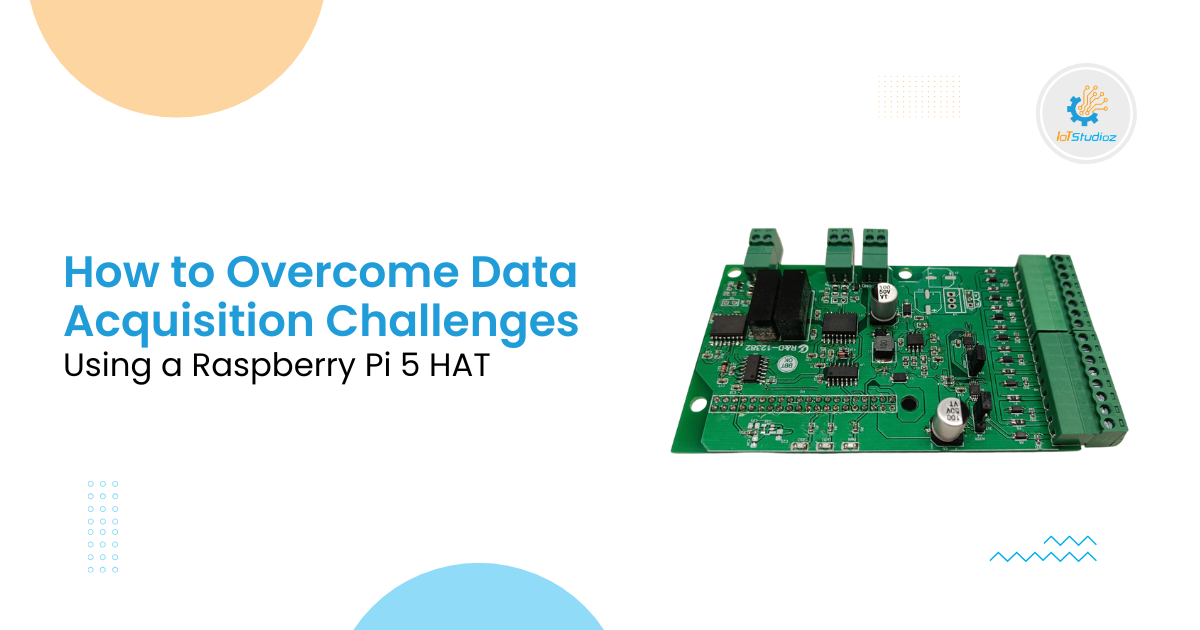
How to Overcome Data Acquisition Challenges Using a Raspberry Pi 5 HAT Leave a comment
Data acquisition plays a critical role in modern industrial and IoT systems. Every automation process depends on accurate sensor data. Engineers collect signals, convert them, and use them for monitoring or control.
Many developers now use a Raspberry Pi 5 HAT to build cost-effective and flexible data acquisition systems. It offers a compact and powerful solution for handling multiple industrial signals.
However, real-world deployment is not simple. Engineers face challenges such as noise, signal mismatch, limited inputs, and system instability. These issues affect accuracy and reliability.
Key Statistics:
- Over 60% of industrial sensors use 4–20mA signals
- RS485 supports communication up to 1200 meters
- High-resolution ADCs improve measurement precision significantly
- Systems can scale up to 64 channels or more
- Watchdog timers reduce system downtime
Understanding Data Acquisition Systems
A data acquisition system converts physical signals into digital data. This process involves sensors, signal conditioning, conversion, and processing.
Types of Signals in Data Acquisition
1. Analog Voltage Signals
- Voltage signals range from 0–5V or 0–10V. These signals come from sensors like temperature transmitters and pressure sensors.
- Voltage signals are easy to measure but sensitive to noise. Long cables increase signal distortion.
2. Current Signals (4–20mA)
- Current loops are widely used in industry. Around 60% of industrial sensors use 4–20mA signals.
- These signals resist noise and work well over long distances. Even if interference occurs, the current remains stable.
3. Digital Signals
- Digital signals represent ON or OFF states. These signals come from switches, relays, and logic devices.
- They are simple but do not provide detailed measurement data.
4. Serial Communication Signals
- Industrial systems use communication protocols such as RS485 and Modbus. These protocols transfer data between devices.
- They support multiple devices on the same network.
Core Data Acquisition Challenges
1. No Built-in Analog Inputs
The Raspberry Pi does not include an ADC. It cannot read analog signals directly.
Why This is a Problem
Most sensors output analog signals. Without conversion, the system cannot interpret real-world data.
Engineers must add external ADC modules. This increases system complexity.
Practical Impact
- More hardware components
- Increased wiring effort
- Higher chances of connection errors
2. Difficulty in Handling 4–20mA Signals
The 4–20mA standard is common in industrial systems. However, the Raspberry Pi cannot read current signals directly.
Why It Matters
Sensors like flow meters and pressure transmitters use current loops. These signals require proper conversion.
Common Issues
- Incorrect conversion leads to wrong readings
- Additional resistors or converters add complexity
- Signal accuracy may drop
3. Industrial Communication Barriers
Industrial devices rely on RS485 and Modbus protocols.
Why This is a Challenge
The Raspberry Pi lacks native RS485 ports. Engineers must use USB converters or external modules.
Practical Problems
- Unstable communication
- Data loss during transmission
- Complex configuration
RS485 supports communication up to 1200 meters, which makes it important for industrial systems.
4. Noise and Signal Interference
Industrial environments contain electrical noise from machines and power systems.
Sources of Noise
- Motors and drives
- Switching power supplies
- High-voltage equipment
Effects on Data
- Fluctuating readings
- Incorrect measurements
- Loss of signal integrity
Voltage signals suffer more compared to current signals.
5. Lack of Electrical Isolation
Direct connection between sensors and Raspberry Pi is risky.
Why Isolation is Important
High voltage spikes can damage the board. Ground loops can also affect performance.
Risks Without Isolation
- Hardware failure
- Safety hazards
- Data inaccuracies
6. Limited Input Channels
A standard Raspberry Pi supports very few inputs.
Why This Matters
Industrial systems often require multiple sensors.
Challenges
- Cannot scale easily
- Requires multiple devices
- Increases system cost
7. Software Complexity
Data acquisition requires software handling.
Common Issues
- Managing multiple inputs
- Converting raw data
- Synchronizing signals
Poor coding can lead to delays and incorrect data processing.
8. Reliability in Industrial Conditions
Industrial systems must run continuously.
Challenges
- Power fluctuations
- System crashes
- Data loss
A simple Raspberry Pi setup may not meet industrial standards.
How a Raspberry Pi 5 HAT Solves These Challenges
A Raspberry Pi 5 HAT adds specialized hardware to handle industrial requirements.
1. Enabling Analog Input Capability
A HAT includes ADC chips for signal conversion.
How It Works
The ADC converts analog signals into digital values. These values are then processed by the Raspberry Pi.
Benefits
- Accurate data measurement
- Support for multiple channels
- High resolution (16-bit or 24-bit)
Higher resolution improves precision in measurements.
2. Direct Support for 4–20mA Signals
Many HATs provide built-in current input channels.
How It Helps
The HAT directly reads current signals without external conversion.
Advantages
- Reduced wiring complexity
- Improved accuracy
- Better stability over long distances
This makes it suitable for industrial environments.
3. Built-in Industrial Communication Interfaces
A Raspberry Pi 5 HAT often includes RS485 ports.
Key Features
- Long-distance communication
- Multi-device support
- Reliable data transfer
Practical Benefits
- Easy connection with industrial devices
- Reduced need for external converters
- Stable communication
4. Noise Reduction Techniques
HATs include hardware features to reduce noise.
Methods Used
- Differential inputs
- Filtering circuits
- Shielded connectors
Results
- Stable readings
- Reduced signal fluctuation
- Improved data accuracy
5. Electrical Isolation for Protection
Advanced HATs provide isolation between input and processing units.
Types of Isolation
- Opto-isolation
- Isolated ADC channels
Benefits
- Protects Raspberry Pi from voltage spikes
- Prevents ground loop issues
- Improves system safety
6. Expanding Input Channels
HATs support multiple input channels.
Scalability
Engineers can stack multiple HATs.
Example
- One HAT = 8 inputs
- Eight HATs = 64 inputs
Benefits
- Supports large systems
- Reduces need for multiple controllers
7. Improving System Reliability
A Raspberry Pi 5 HAT includes features for stable operation.
Key Features
- Watchdog timers
- Stable voltage regulators
- Protection circuits
Benefits
- Automatic recovery from failures
- Reduced downtime
- Consistent performance
8. Simplifying Software Integration
Most HATs provide software support.
Tools Available
- Python libraries
- Node-RED integration
- APIs
Advantages
- Faster development
- Easy sensor integration
- Reduced coding effort
Real-World Example
Smart Energy Monitoring System
A factory tracks energy consumption using current sensors.
Without a HAT
- External ADC required
- Complex wiring
- Noise issues
With a Raspberry Pi 5 HAT
- Direct sensor input
- Built-in ADC and isolation
- Reliable data logging
Outcome
- Installation time reduced by 40%
- Accuracy improved
- Maintenance simplified
Best Practices for Data Acquisition
1. Use Stable Power Supply
- Provide regulated power to sensors and the Raspberry Pi.
- Avoid sharing power lines with heavy equipment.
2. Choose the Right Signal Type
- Use 4–20mA for long-distance transmission.
- Use voltage signals for short connections.
3. Ensure Proper Shielding
- Use shielded cables in noisy environments.
- This reduces interference.
4. Maintain Proper Grounding
- Use a single grounding point.
- Avoid ground loops.
5. Perform Regular Calibration
- Sensors can drift over time.
- Calibration ensures accurate readings.
6. Apply Software Filtering
- Use averaging techniques to smooth data.
- This improves signal quality.
When to Use a Raspberry Pi 5 HAT
A Raspberry Pi 5 HAT is used when a system needs to collect, process, and communicate data from sensors in a reliable and cost-effective way.
1. Industrial Automation
Industrial automation involves controlling machines and processes using sensors and controllers. A Raspberry Pi 5 HAT helps by:
- Reading sensor data such as temperature, pressure, and flow
- Communicating with industrial devices using RS485 or Modbus
- Controlling outputs based on real-time data
It fits small to medium automation systems where full PLC systems are not required.
2. Energy Monitoring
Energy monitoring tracks power usage in machines or buildings.
A Raspberry Pi 5 HAT helps by:
- Collecting current and voltage data
- Monitoring energy consumption trends
- Sending data to dashboards or cloud systems
It supports better energy management and cost reduction.
3. Smart Agriculture
Smart agriculture uses sensors to improve farming efficiency.
A Raspberry Pi 5 HAT helps by:
- Monitoring soil moisture and temperature
- Controlling irrigation systems
- Collecting environmental data
Farmers can make data-driven decisions using this setup.
4. Environmental Monitoring
Environmental monitoring tracks conditions such as air quality, humidity, and temperature.
A Raspberry Pi 5 HAT helps by:
- Collecting data from multiple sensors
- Ensuring stable readings in outdoor conditions
- Sending alerts when values exceed limits
It is useful in weather stations and pollution monitoring systems.
5. Remote Telemetry
Remote telemetry involves collecting data from distant locations.
A Raspberry Pi 5 HAT helps by:
- Reading sensor data from remote equipment
- Transmitting data using communication modules
- Supporting long-distance protocols like RS485
It is useful in oil fields, water systems, and remote plants.
Limitations to Consider
Even though a Raspberry Pi 5 HAT is powerful, it has some limitations.
1. Not a Full Replacement for PLC Systems
A PLC (Programmable Logic Controller) is built for heavy industrial use.
- PLCs handle extreme environments better
- They offer higher reliability and safety certifications
- Raspberry Pi systems may not meet strict industrial standards
A Raspberry Pi 5 HAT works better in light to medium industrial applications.
2. Requires Technical Knowledge
Engineers must understand both hardware and software.
- Proper wiring is required
- Communication protocols must be configured
- Software must be written for data handling
Without proper knowledge, system performance may suffer.
3. Needs Protection in Harsh Environments
Industrial environments can be harsh.
- Dust, heat, and moisture can damage electronics
- Electrical noise can affect performance
The Raspberry Pi and HAT must be placed inside protective enclosures. Cooling and proper grounding are also important.
Future Trends in Data Acquisition
Modern data acquisition systems continue to evolve with new technologies.
1. Edge Computing
Edge computing processes data near the source instead of sending it to a central server.
- Reduces delay in decision-making
- Improves system response time
- Reduces network usage
A Raspberry Pi 5 HAT can process data locally before sending it to the cloud.
2. Cloud Connectivity
Cloud platforms store and analyze large amounts of data.
- Data can be accessed from anywhere
- Systems can scale easily
- Historical data analysis becomes simple
A Raspberry Pi 5 HAT can send data using MQTT, HTTP, or APIs.
3. AI-Based Analysis
Artificial Intelligence helps in analyzing sensor data.
- Detects patterns and anomalies
- Predicts equipment failure
- Improves system efficiency
Edge devices like Raspberry Pi can run lightweight AI models.
4. Secure Communication
Security is critical in modern systems.
- Data must be encrypted
- Unauthorized access must be prevented
- Secure protocols like TLS are used
A Raspberry Pi 5 HAT can support secure communication methods.
Conclusion
Data acquisition presents many challenges in real-world systems. Engineers must handle signal conversion, noise, communication, and reliability.
A Raspberry Pi 5 HAT provides a practical solution. It adds analog inputs, supports industrial protocols, and improves system stability.
With proper design and best practices, engineers can build reliable and scalable data acquisition systems.
This approach improves accuracy, reduces complexity, and ensures long-term performance.