
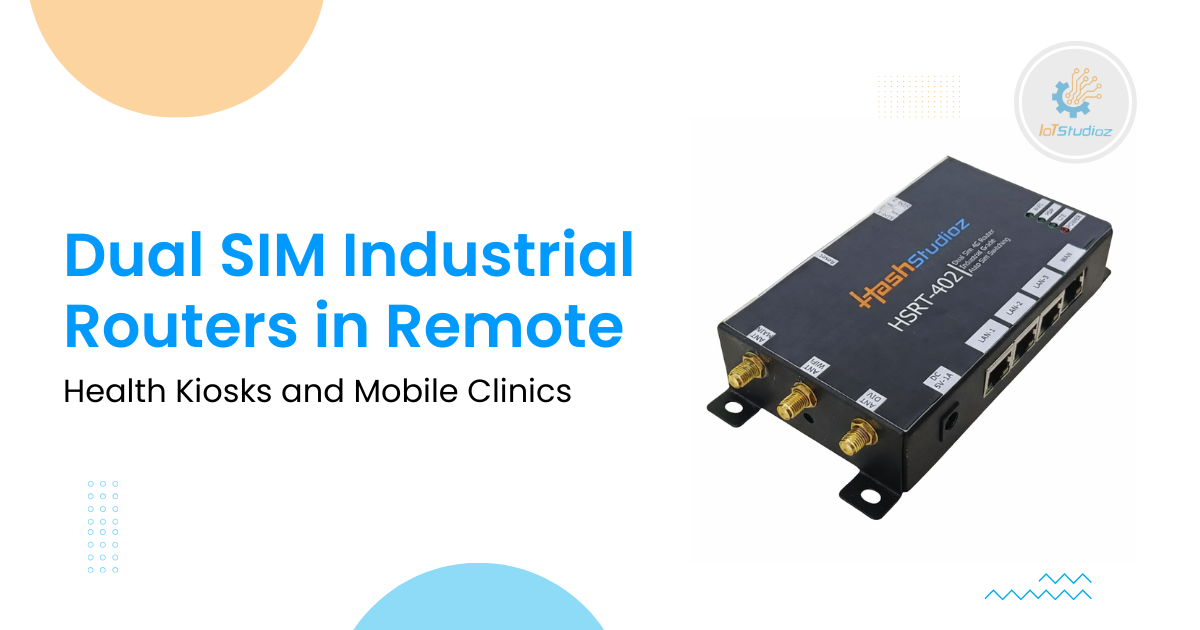
Dual SIM Industrial Routers in Remote Health Kiosks and Mobile Clinics
The healthcare sector is increasingly relying on technology to enhance service delivery, especially in remote areas. According to the World Health Organization, nearly 50% of the global population lacks full access to essential health services, making remote health kiosks and mobile clinics critical. These systems provide essential medical care where infrastructure is limited. A critical component of their operation is connectivity. A GSMA report states that rural areas experience up to 35% higher mobile network disruptions than urban regions, highlighting the need for resilient communication systems. This is where Dual SIM 4G LTE Industrial Routers play a key role. These routers ensure reliable, secure, and uninterrupted data transmission, which is essential for the continuous operation of remote healthcare solutions.
Introduction to Dual SIM Industrial Routers
Industrial routers are built to withstand harsh environments, making them ideal for use in remote health kiosks and mobile clinics. A Dual SIM Industrial Router is a specific type of industrial router that includes two SIM card slots, allowing it to connect to two different mobile networks simultaneously.
The primary benefit of a Dual SIM 4G LTE Industrial Router is redundancy. With two SIM cards from different service providers, these routers can switch between networks if one connection fails, ensuring continuous connectivity. This feature is crucial in areas where signal strength can vary and where reliable communication is critical.
Why Dual SIM Routers Are Important for Remote Healthcare
Dual SIM routers ensure uninterrupted connectivity, enhance coverage, provide network flexibility, and reduce costs, all vital for remote healthcare.
1. Ensuring Uninterrupted Connectivity
In remote healthcare applications, any disruption in connectivity can hinder the ability to transmit critical medical data, conduct telemedicine consultations, or access patient records. A Dual SIM Industrial Router provides a fail-safe by switching to the second SIM card if one network goes down. This redundancy ensures that the system remains connected and operational at all times.
Example: A mobile clinic operating in a rural region may rely on remote diagnostics. If the primary network connection fails, the secondary SIM card provides immediate access to a backup network, ensuring that doctors can still consult with patients or transmit medical data to central health systems.
2. Enhanced Coverage and Network Flexibility
Dual SIM routers allow mobile clinics and health kiosks to use two different mobile networks. This increases coverage by allowing the system to connect to the best available signal, even if one provider does not have good coverage in the area.
Stat: According to a report from GSMA, about 57% of the global population still lacks access to high-quality internet connectivity. In such regions, having the flexibility to use multiple networks through a Dual SIM Industrial Router is critical for continuous healthcare service delivery.
3. Cost Efficiency
Using a Dual SIM Industrial Router can also be cost-effective. Health organizations can choose plans from different service providers based on price, coverage, and data usage. For instance, one SIM can be dedicated to high-data applications like video consultations, while the other can be used for low-bandwidth operations like transmitting patient records.
4. Security and Privacy
Security is a significant concern in healthcare applications. A Dual SIM 4G LTE Industrial Router provides options for separating sensitive medical data transmissions from other types of communications. For example, one SIM card can be dedicated solely to secure, encrypted healthcare data, while the other can handle general administrative tasks.
Fact: The Health Insurance Portability and Accountability Act (HIPAA) mandates strict privacy and security requirements for healthcare data in the U.S. A Dual SIM Industrial Router helps meet these security requirements by providing more control over data paths and reducing the risk of data interception.
How Dual SIM Routers Work in Remote Health Kiosks and Mobile Clinics
Dual SIM routers support reliable connectivity in remote health kiosks and mobile clinics through smart network management and failover.
1. Data Collection and Transmission
In remote health kiosks, patients can receive primary healthcare services, including diagnostics, telemedicine consultations, and even prescription services. These kiosks rely on a Dual SIM 4G LTE Industrial Router to send patient data to a centralized cloud system or a remote healthcare provider.
Example: A health kiosk in a village might collect data from a blood pressure cuff, heart rate monitor, or glucose meter. This data is transmitted to a central healthcare system for review. If one mobile network is weak or unavailable, the router switches to the second SIM, ensuring that the data is sent without delay.
2. Telemedicine Services
Telemedicine involves virtual consultations between healthcare professionals and patients. Mobile clinics, especially in underserved areas, often rely on video consultations to overcome the challenge of insufficient healthcare infrastructure.
A Dual SIM Industrial Router ensures that video conferencing with a doctor or specialist can occur without interruption, even in areas where mobile network coverage is spotty.
Stat: A 2021 World Health Organization (WHO) report found that telemedicine services expanded by over 154% during the COVID-19 pandemic. In rural and underserved regions, reliable internet connections are vital for continuing this trend, which is where Dual SIM routers play a crucial role.
3. Remote Monitoring and Diagnostics
Mobile clinics often utilize various medical devices for remote diagnostics, such as portable ECG machines or ultrasound devices. These devices generate large amounts of data that need to be transmitted to central systems or specialists for interpretation.
A Dual SIM Industrial Router ensures that the large data packets from these diagnostic tools reach the destination without delay, maintaining a high level of service and diagnostic accuracy.
4. Mobile Clinic Fleet Management
For mobile clinics operating in large, rural areas, fleet management is critical. These clinics may include several vehicles that are constantly on the move, providing healthcare services to different communities.
A Dual SIM 4G LTE Industrial Router in each vehicle allows continuous communication between the clinic vehicles and the central management system. It ensures that vehicles can be tracked, and their location can be updated in real time, even if one network connection fails.
How Dual SIM Routers Enhance Reliability in Mission-Critical Systems
Benefits of Using Dual SIM Routers in Healthcare Applications
1. Redundancy and Reliability
The most significant advantage of using Dual SIM Industrial Routers is redundancy. In areas where network outages are frequent, having a secondary SIM card can ensure that services are never interrupted.
2. Greater Flexibility
Healthcare providers can switch between different network providers based on signal strength, cost, and service quality. This flexibility is particularly important in regions where different mobile networks may have varying levels of coverage.
3. Scalability
Dual SIM routers make it easier for health providers to scale operations. As the demand for healthcare services grows, more health kiosks and mobile clinics can be deployed without worrying about connectivity issues.
4. Improved Patient Care
Continuous and reliable connectivity translates to better care. In mobile clinics, for example, doctors can access patient records, transmit diagnostic results, and consult specialists instantly, improving the quality of care patients receive.
Real-World Examples of Dual SIM Routers in Healthcare
1. The Healthcare System in Sub-Saharan Africa
In many parts of Sub-Saharan Africa, mobile clinics and health kiosks are the only form of healthcare access for rural populations. These clinics often rely on Dual SIM Industrial Routers to ensure that their services remain functional. With varying network conditions across different regions, these routers allow healthcare workers to switch between networks to maintain connectivity and ensure timely data transmission.
Example: In Kenya, mobile health clinics equipped with Dual SIM Industrial Routers have helped doctors provide consultations and diagnostic services to remote villages that would otherwise have limited access to healthcare.
2. India’s Mobile Health Services
India has one of the largest mobile health service networks in the world. Mobile clinics that serve rural areas often face challenges due to inconsistent mobile network coverage. The Dual SIM 4G LTE Industrial Router has become essential in overcoming these challenges, ensuring that health services remain available even in regions with weak network signals.
Example: A mobile clinic operating in rural India uses a Dual SIM Industrial Router to maintain a reliable internet connection, enabling remote consultations and diagnostics, even in remote locations where traditional broadband connections are unavailable.
Reliable Connectivity for Remote Health Kiosks and Mobile Clinics with Dual SIM Industrial Routers
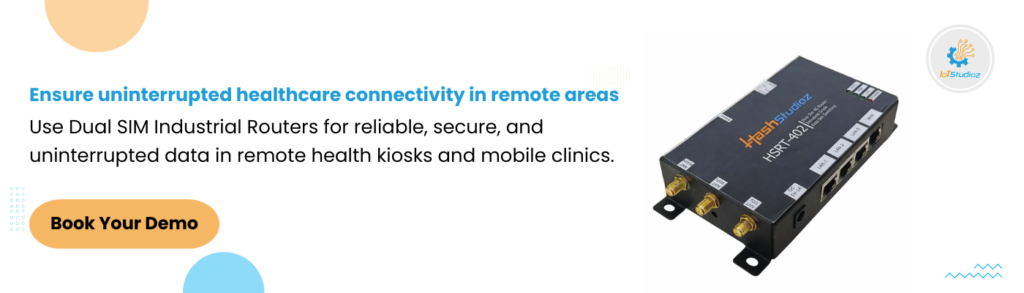
At IoTStudioz, we understand that providing continuous connectivity in remote healthcare environments can be challenging. Our Dual SIM Industrial Routers offer a secure, resilient, and easy-to-deploy solution for remote health kiosks and mobile clinics. Designed to support uninterrupted data flow from medical devices and patient monitoring systems, these routers automatically switch between networks to prevent downtime. They ensure real-time reporting, accurate patient data transmission, and reliable connectivity even in rural or low-coverage areas. Fast, reliable, and simple to install, they keep healthcare services running smoothly.
Connect with IoTStudioz today and see how our Dual SIM Industrial Routers can keep your remote healthcare operations connected and fully operational.
Conclusion
The integration of Dual SIM Industrial Routers in remote health kiosks and mobile clinics is transforming healthcare delivery in underserved and rural regions. These routers ensure that healthcare providers can maintain constant connectivity, whether they are transmitting patient data, conducting telemedicine sessions, or accessing critical healthcare information. With benefits like redundancy, network flexibility, and cost efficiency, Dual SIM 4G LTE Industrial Routers are essential for modern healthcare infrastructure, especially in areas where reliable connectivity is a challenge.
As mobile clinics and remote health kiosks become more prevalent, these routers will continue to play a vital role in bridging the gap in healthcare access, ensuring that everyone, no matter where they live, has access to the care they need.
Frequently Asked Questions
1. What is a Dual SIM Industrial Router in healthcare applications?
A Dual SIM Industrial Router is a rugged networking device that connects health systems to two mobile networks for continuous connectivity.
2. Why are Dual SIM routers preferred over single SIM routers in remote healthcare?
Dual SIM routers reduce downtime by switching networks automatically when one carrier experiences signal loss or failure.
3. How does automatic failover benefit remote health kiosks?
Automatic failover keeps medical data transmission active, ensuring diagnostics and consultations continue without service interruption.
4. Can Dual SIM Industrial Routers support real-time telemedicine?
Yes, they provide stable bandwidth for video consultations by selecting the strongest available mobile network.
5. Are Dual SIM routers suitable for mobile clinics in moving vehicles?
Yes, they adjust network connections dynamically as the clinic moves between coverage areas.
6. How do these routers improve data security in healthcare environments?
They support VPNs, encryption, and network separation to protect sensitive patient information.