
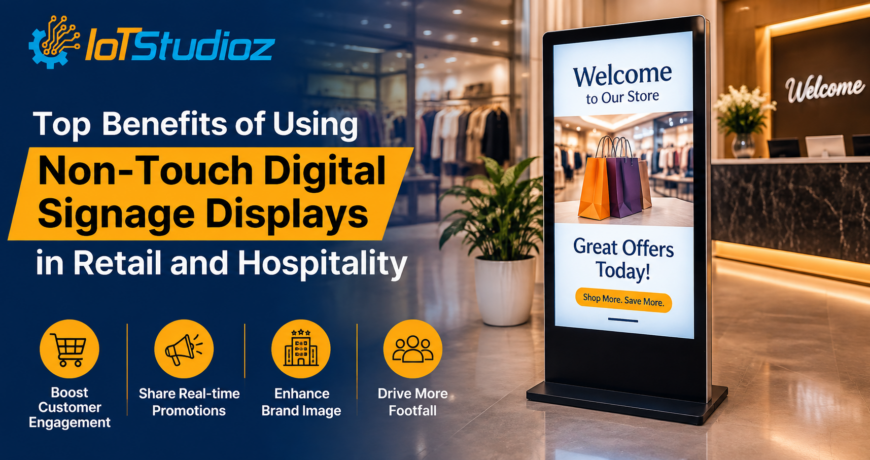
Top Benefits of Using Non-Touch Digital Signage Displays in Retail and Hospitality
Retail and hospitality businesses are constantly looking for better ways to communicate with customers, promote products and services, and create engaging experiences. Traditional posters, printed menus, and static promotional materials can deliver information, but they lack the flexibility and visual impact needed in today’s competitive environment.
Non-touch digital signage displays offer a practical solution. These displays use high-quality digital screens to present advertisements, promotions, menus, announcements, directions, and other content without requiring users to physically interact with the screen.
From retail stores and shopping malls to hotels, restaurants, and cafés, non-touch digital signage can help businesses communicate information more effectively while maintaining a clean, modern appearance.
What Is a Non-Touch Digital Signage Display?
A non-touch digital signage display is a commercial-grade screen designed to display digital content without touch functionality. Unlike interactive kiosks, users do not need to tap or interact with the screen.
Content can include:
- Promotional videos
- Product advertisements
- Digital menus
- Brand messages
- Special offers
- Product information
- Wayfinding instructions
- Event announcements
- Corporate communications
- Social media content
- Images and animations
Businesses can typically manage and update content through a connected media player, signage software, network, or content management system, depending on the display setup.
The main advantage is simple: businesses can replace static communication with dynamic, visually engaging content that can be updated whenever needed.
1. Captures Customer Attention
One of the biggest advantages of digital signage is its ability to attract attention.
Bright displays, high-resolution visuals, videos, animations, and changing content are generally more noticeable than traditional printed posters. Retailers can use these capabilities to highlight new arrivals, limited-time promotions, seasonal campaigns, or featured products.
For example, a clothing store can display a promotional video featuring its latest collection near the entrance. Similarly, a hotel can showcase its restaurant, spa, events, or special packages on a digital display in the lobby.
This makes digital signage an effective tool for communicating important messages at the right location.
2. Easy Content Updates
Printed marketing materials often need to be redesigned, printed, delivered, and physically replaced whenever information changes.
Non-touch digital signage provides a much more flexible approach.
Businesses can update digital content without replacing the physical display. Depending on the signage system, content can be changed remotely or scheduled in advance.
For example, a restaurant can display:
- Breakfast menus in the morning
- Lunch promotions during the afternoon
- Dinner menus in the evening
- Special offers during weekends
This ability to change content according to time, audience, or business requirements makes digital signage particularly useful for dynamic environments.
3. Enhances Brand Presentation
The appearance of a business plays an important role in customer perception. Modern digital displays can give retail stores, hotels, restaurants, and other hospitality spaces a more professional and contemporary appearance.
Businesses can use branded templates, high-quality product photography, promotional videos, and consistent typography to maintain a unified visual identity.
A well-designed digital signage system can therefore become more than an information tool—it can also contribute to the overall atmosphere and branding of the location.
4. Ideal for Retail Promotions
Retail businesses frequently need to promote products, discounts, new launches, and seasonal campaigns.
Non-touch digital signage allows retailers to showcase promotional content in visually compelling formats.
For example, a store can use displays to promote:
- Flash sales
- New product launches
- Festival offers
- Clearance sales
- Membership programs
- Loyalty rewards
- Product bundles
- Featured products
Instead of relying only on shelf labels or printed posters, retailers can use motion and video to explain product benefits and encourage customers to explore featured products.
5. Improves Hospitality Communication
Hotels, resorts, restaurants, cafés, and entertainment venues can use non-touch digital signage to communicate information to guests.
A hotel lobby display could show:
Welcome to (Hotel)
Check-in information | Restaurant timings | Events | Facilities | Special offers
Restaurants can use digital signage to display menus, chef recommendations, combo offers, or food photography.
Similarly, resorts can promote spa services, recreational activities, restaurants, and upcoming events.
This makes it easier for guests to discover available services without always needing assistance from staff.
6. Supports Digital Menu Boards
Restaurants and quick-service businesses can benefit significantly from non-touch digital menu displays.
Instead of using static printed menus, businesses can showcase food items with high-quality images, descriptions, prices, and promotional offers.
Digital menu boards can also help businesses organize information more effectively. Featured products can receive larger visual emphasis, while limited-time offers can be highlighted prominently.
Another advantage is the ability to update menu information when prices, products, or availability change.
7. Reduces Dependence on Printed Materials
Traditional promotional materials require ongoing printing and replacement.
Digital signage can reduce the need for frequently changing posters, banners, menu boards, and promotional displays.
Once the digital signage hardware is installed, businesses can use the same screen for multiple campaigns over an extended period.
This can be especially useful for businesses that frequently change their promotional messages.
8. Enables Scheduled Content
One of the most useful capabilities of digital signage is content scheduling.
Businesses can prepare different content for different times of the day, days of the week, or special events.
For example:
| Time | Example Content |
| Morning | Breakfast promotion |
| Afternoon | Lunch offers |
| Evening | Dinner specials |
| Weekend | Family or seasonal promotions |
Hotels and retail stores can similarly schedule different campaigns based on business hours or promotional calendars.
This helps businesses deliver more relevant information without requiring employees to manually change physical signage.
9. Makes Better Use of Available Space
Wall-mounted or strategically positioned digital displays can make effective use of available space.
Instead of placing several printed posters around a store or hotel, a single high-quality display can rotate multiple messages.
For example, one display could show a brand video, promotional offer, product information, and customer announcement at different intervals.
This allows businesses to communicate more information while maintaining a clean and organized environment.
10. Supports Video and Rich Media
Unlike traditional signs, digital signage can display multiple types of media.
Businesses can combine:
- Images
- Videos
- Animations
- Text
- Graphics
- Product demonstrations
- Promotional campaigns
Video can be particularly useful when businesses need to demonstrate how a product works or communicate a message that would be difficult to convey through static imagery.
For example, an electronics retailer could display a short demonstration of a new device, while a hotel could show a video tour of its rooms and facilities.
11. Creates a More Modern Customer Experience
Customers increasingly interact with digital technology across different parts of their daily lives. Digital signage can help businesses create an environment that feels modern and technology-driven.
In retail, displays can complement physical products with digital promotions and information.
In hospitality, digital signage can help create a polished environment in reception areas, restaurants, conference spaces, and common areas.
Although non-touch displays do not provide interactive functionality, they can still enhance the overall customer journey by providing useful information at important touchpoints.
12. Useful for Wayfinding and Information
Non-touch digital displays can also be used for informational purposes.
Hotels, shopping malls, hospitals, entertainment venues, and large retail spaces can use screens to display:
- Floor information
- Event schedules
- Room directions
- Store directories
- Meeting information
- Announcements
- Operating hours
This can help visitors find relevant information more easily, particularly in large or busy environments.
13. Helps Promote Upselling and Cross-Selling
Digital signage can also support additional sales opportunities.
For example, a restaurant can promote a dessert or beverage after displaying its main meal options. A hotel can promote spa packages, room upgrades, or dining experiences.
A retail store can display accessories alongside a featured product.
This type of content can encourage customers to consider complementary products and services while they are already engaged with the business.
14. Commercial-Grade Displays Are Designed for Continuous Use
Retail and hospitality environments may require displays to operate for long periods every day. Commercial-grade digital signage displays are designed with business environments in mind and can offer features intended for reliable operation.
Depending on the model, businesses may find features such as:
- High-brightness panels
- Full HD or 4K resolution
- Wide viewing angles
- Durable construction
- Multiple connectivity options
- Landscape or portrait installation
- Extended operating capability
- Built-in speakers
When selecting a display, businesses should consider their operating hours, installation environment, brightness requirements, screen size, connectivity, and content-management requirements.
15. Flexible Installation Options
Non-touch digital signage displays can be installed in different areas depending on the business environment.
Common installation options include:
Wall-Mounted Installation
Wall-mounted displays are useful for retail stores, hotel lobbies, restaurants, reception areas, and corridors where floor space is limited.
Floor-Standing Installation
Floor-standing digital signage can be positioned in entrances, promotional areas, shopping spaces, or other locations where visibility from multiple directions is important.
Landscape Orientation
Landscape displays are suitable for wide promotional content, menus, advertisements, and video presentations.
Portrait Orientation
Portrait displays can work well for product advertisements, promotional posters, vertical videos, and narrow spaces.
Choosing the appropriate installation style can help businesses maximize visibility while maintaining an organized environment.
16. Suitable for Multiple Retail Applications
Retail businesses can use non-touch digital signage throughout the customer journey.
Store Entrance
Display current promotions, new arrivals, and brand campaigns.
Product Sections
Show product features, demonstrations, or comparisons.
Checkout Area
Promote loyalty programs, accessories, or special offers.
Promotional Zones
Highlight seasonal campaigns, discounts, and limited-time products.
Shopping Malls
Display advertisements, store information, events, or promotional campaigns.
17. Suitable for Multiple Hospitality Applications
Hospitality businesses can also deploy digital signage across multiple locations.
Hotel Lobbies
Display welcome messages, hotel services, events, and guest information.
Restaurants
Use digital menu boards, promotional displays, and food advertisements.
Cafés
Promote beverages, seasonal products, and combo offers.
Conference Centers
Display event schedules, meeting information, and announcements.
Resorts
Promote facilities, activities, dining options, and special packages.
18. Non-Touch vs. Interactive Kiosk
It is important to understand the difference between a non-touch digital signage display and an interactive kiosk.
| Feature | Non-Touch Digital Signage | Interactive Kiosk |
| Touch Interaction | No | Yes |
| Main Purpose | Information and promotion | Self-service and interaction |
| Content | Ads, videos, menus, announcements | Applications, forms, catalogs, services |
| User Input | Not required | Required |
| Typical Use | Advertising and communication | Ordering, registration, navigation |
| Ease of Use | Passive viewing | Active interaction |
If the primary goal is to display information and promotional content, a non-touch digital signage display may be the more appropriate choice.
If customers need to search, select options, complete forms, place orders, or access applications, an interactive kiosk may be more suitable.
19. Factors to Consider Before Choosing a Digital Signage Display
Businesses should evaluate several factors before purchasing a non-touch digital signage display.
Screen Size
Choose the size according to viewing distance, available space, and the amount of content that needs to be displayed.
Resolution
Full HD may be suitable for many applications, while 4K can provide greater detail for high-quality product imagery and video.
Brightness
For areas with strong ambient lighting, a display with suitable brightness is important to ensure content remains clearly visible.
Orientation
Determine whether the installation requires landscape or portrait orientation.
Connectivity
Check available connectivity options such as HDMI, USB, Ethernet, Wi-Fi, or other required interfaces.
Operating Hours
Consider whether the display will be used for a few hours per day or for extended operating periods.
Content Management
A suitable content management solution can make it easier to schedule, update, and control content across one or multiple displays.
Conclusion
Non-touch digital signage displays provide retail and hospitality businesses with a flexible way to communicate promotions, information, menus, announcements, and brand messages.
Their ability to display dynamic content, support scheduled campaigns, reduce dependence on printed materials, and create a modern visual environment makes them valuable for a wide range of applications.
From retail stores and shopping malls to hotels, restaurants, cafés, and resorts, digital signage can be positioned at important customer touchpoints to deliver relevant information and promotional content.
For businesses that primarily need high-impact visual communication rather than customer interaction, a non-touch digital signage display can be a practical and scalable solution.