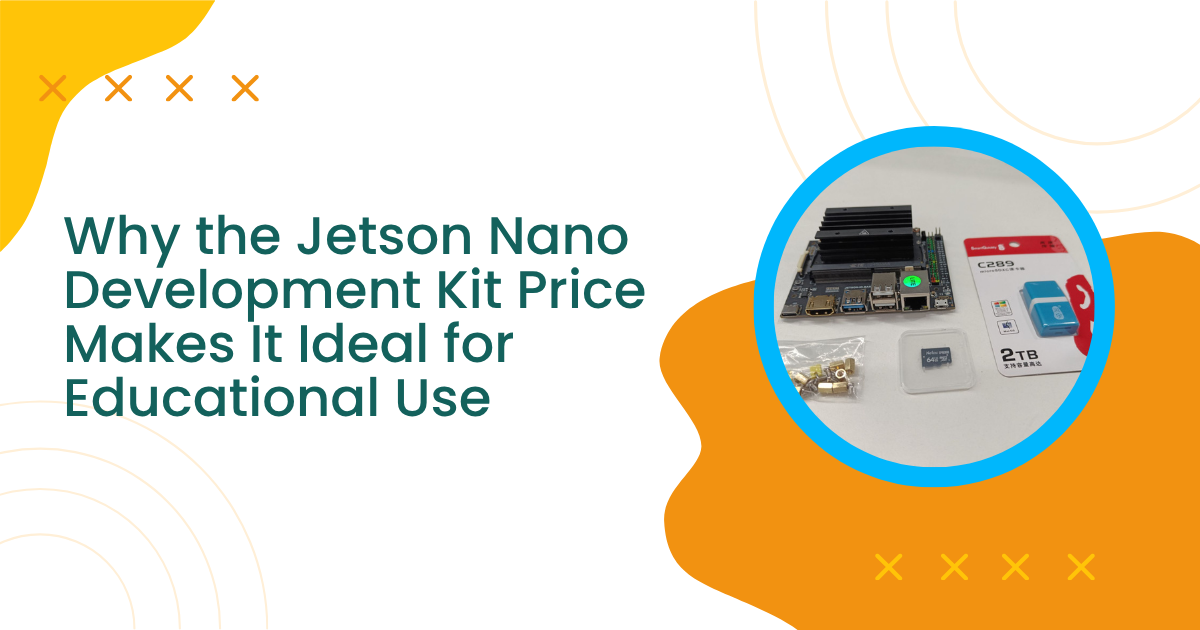
Why the Jetson Nano Development Kit Price Makes It Ideal for Educational Use
Artificial Intelligence (AI) and Machine Learning (ML) have become essential skills in today’s tech-driven world. Educational institutions are increasingly incorporating AI and robotics into their curriculum to prepare students for the future. However, cost often becomes a limiting factor — high-end AI systems are expensive, and many schools or colleges cannot afford them.
The Jetson Nano Development Kit, created by NVIDIA, solves this problem by offering high-performance AI capabilities at a budget-friendly price. This combination of affordability, performance, and ease of use makes it ideal for educational purposes. In this blog, we explore why its price is such a strong advantage for schools, universities, and individual learners.
1. Affordable Entry Point to AI and Robotics
One of the most significant advantages of the Jetson Nano Development Kit is its affordable price, generally ranging from $99 to $150.
- Cost Efficiency: This is significantly lower than the price of high-end AI hardware like GPUs or full AI workstations, which can cost thousands of dollars.
- Accessible for Classrooms: Schools can purchase multiple units for their labs without exceeding their budget.
- Student-Friendly: Learners can own personal kits, which allows them to continue learning outside the classroom and encourages experimentation.
Example: A robotics club can purchase 10 Jetson Nano kits for less than the price of a single GPU workstation, enabling multiple students to work on AI-based robot projects simultaneously.
2. High Performance at a Low Cost
Despite being affordable, the Jetson Nano packs impressive performance for its size:
- Quad-Core ARM Cortex-A57 CPU: Provides sufficient processing power for real-time AI applications.
- 128-Core Maxwell GPU: Enables acceleration of deep learning models, making it capable of handling tasks like image classification, object detection, and speech recognition.
- Support for AI Frameworks: TensorFlow, PyTorch, and OpenCV run seamlessly, allowing students to learn and deploy AI models effectively.
Example: A student can build an AI-powered camera that detects objects in real-time, running smoothly on a Jetson Nano without requiring expensive GPU setups.
3. Scalability for Educational Programs
Many educational programs require multiple kits for classrooms or labs, and the Jetson Nano’s low price makes this feasible:
- Bulk Purchases Are Affordable: Schools can equip entire classrooms with kits for project-based learning.
- Consistent Learning Environment: Every student works on identical hardware, reducing troubleshooting issues.
- Encourages Collaboration: Students can work in teams, prototyping different solutions simultaneously.
Example: A college AI course can have each group of 2–3 students working independently on different robotics projects, thanks to affordable multiple kits.
4. Open-Source Ecosystem Reduces Software Costs
The hardware cost is complemented by free software and open-source tools, which reduces overall expenses:
- Free AI Frameworks: Students can use TensorFlow, PyTorch, Keras, and Jupyter Notebooks without additional licensing costs.
- Community Support: NVIDIA Jetson forums and GitHub projects provide tutorials, pre-trained models, and problem-solving tips.
- No Extra Licensing Fees: Educators can design full courses without worrying about expensive software subscriptions.
Example: A teacher can guide students to deploy a pre-trained object detection model using OpenCV and Python on the Jetson Nano without paying for any commercial software.
5. Ideal for STEM and Robotics Education
The Jetson Nano is perfect for STEM education because it enables practical, hands-on learning:
- Real-World Applications: Students can use it to build autonomous robots, smart surveillance systems, and drone navigation projects.
- Experiential Learning: Hands-on projects improve retention of complex AI concepts.
- Integration with Other Platforms: Compatible with Arduino, Raspberry Pi, and other peripherals for expanded project possibilities.
Example: Students can create a small autonomous car using the Jetson Nano and sensors, learning both programming and robotics simultaneously.
6. Long-Term Cost Savings for Institutions
Investing in Jetson Nano kits is economical over time:
- Durable Hardware: Designed for repeated use over multiple semesters.
- Low Maintenance Costs: Requires minimal hardware upkeep.
- Reusable Learning Resources: Kits can be used across multiple courses and projects.
Example: A high school can purchase kits once and continue using them for years in AI, robotics, and IoT courses.
7. Encourages Innovation on a Budget
Affordable access allows students to experiment and innovate freely:
- Hackathons and Competitions: Schools can host events without high costs.
- Prototype Development: Students can develop AI-powered solutions and refine them affordably.
- Entrepreneurial Projects: Budding innovators can explore AI startup ideas with minimal initial investment.
Example: Students can prototype a smart home device using a Jetson Nano kit and sensors, testing their idea without expensive infrastructure.
8. Encourages Cross-Disciplinary Learning
The Jetson Nano is not limited to computer science; it encourages interdisciplinary projects:
- Combines AI with Other Subjects: Biology (plant or animal recognition), physics (robotics motion control), environmental science (smart sensors).
- Project-Based Learning: Encourages collaboration across different STEM fields.
- Bridges Theory and Practice: Students see how theoretical concepts apply to real-world AI solutions.
Example: A physics class can use the Jetson Nano to measure and analyze robotic arm motion, combining mechanics with AI vision systems.
9. Compact and Energy-Efficient Design
Its small size and low power consumption make the Jetson Nano ideal for classrooms and labs:
- Compact Form Factor: Takes minimal space, allowing multiple kits in a small lab.
- Low Energy Use: Reduces electricity costs for schools.
- Portable Learning: Students can carry the kit home or to workshops.
Example: A maker space can easily host multiple Jetson Nano kits on a single table, allowing a full class to work simultaneously.
10. Supports Lifelong Learning and Skill Development
Owning a Jetson Nano kit encourages continuous learning beyond the classroom:
- Self-Paced Learning: Students experiment independently, enhancing understanding.
- Portfolio Development: Completed projects can be included in academic or professional portfolios.
- Career Preparation: Hands-on experience with AI frameworks prepares students for AI, robotics, and edge computing careers.
Example: A student develops a portfolio project like an AI-powered home assistant using the Jetson Nano, improving employability and college applications.
Key Takeaways: Why Price Matters
| Factor | Jetson Nano Development Kit Benefit |
| Affordable Hardware | Enables wide access for students and schools |
| High AI Performance | Supports real AI applications with GPU acceleration |
| Scalable for Classrooms | Multiple units can be deployed affordably |
| Free Software Ecosystem | Reduces overall course costs |
| Long-Term Savings | Durable, reusable kits save money over time |
| Encourages Innovation | Allows experimentation without financial barriers |
| Cross-Disciplinary Learning | Integrates AI with multiple STEM subjects |
| Compact & Energy-Efficient | Easy to use in labs and portable for students |
| Lifelong Learning | Supports continuous skill development |
Conclusion
The Jetson Nano Development Kit price makes it an ideal choice for educational use. Its combination of affordability, high AI performance, and versatile features allows schools, colleges, and individual learners to explore AI, robotics, and edge computing without significant investment.
From hands-on learning to innovation, cross-disciplinary projects, and lifelong skill development, the Jetson Nano empowers students to learn, experiment, and innovate — all on a budget.
FAQs
1. How much does the Jetson Nano Development Kit cost?
Typically ranges from $99–$150, depending on the model and retailer.
2. Is it suitable for beginners?
Yes. Its beginner-friendly setup, tutorials, and community support make it ideal for newcomers to AI.
3. Can schools use it for advanced AI research?
It’s excellent for learning and prototyping. For large-scale research, higher-end Jetson models like Xavier NX may be better.
4. Does the low price compromise quality?
Not at all. The Jetson Nano delivers reliable performance suitable for educational and prototyping projects.
5. What sets it apart from other development boards?
Its balance of cost, GPU-powered AI performance, and support for open-source frameworks makes it the top choice for education.