
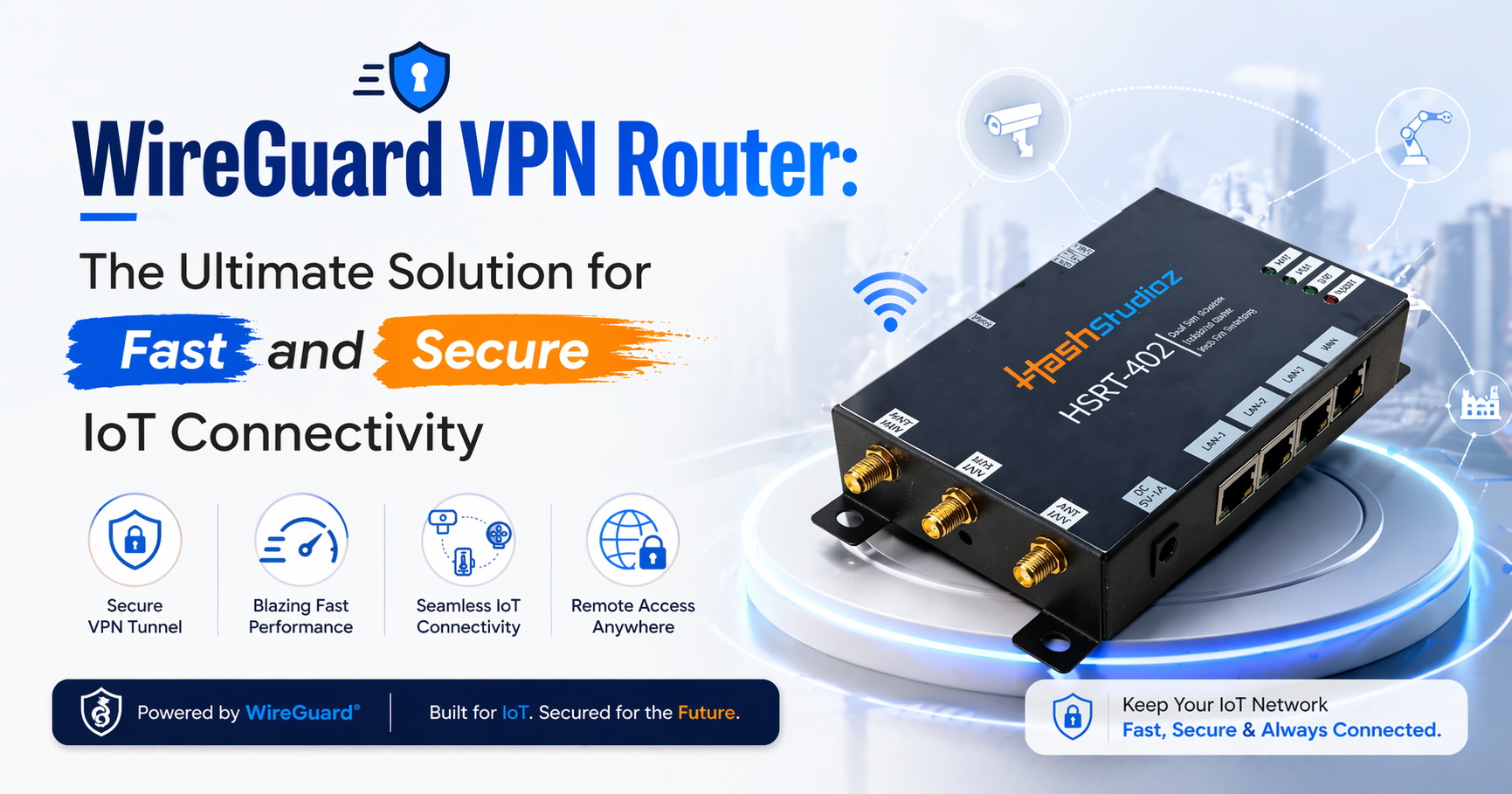
WireGuard VPN Router: The Ultimate Solution for Fast and Secure IoT Connectivity
As IoT ecosystems expand rapidly across industries in 2026, businesses are under pressure to ensure their networks are not only connected—but also secure, scalable, and high-performing. A WireGuard VPN Router addresses all these needs by acting as a secure gateway for all IoT devices, encrypting and managing traffic efficiently.
This detailed guide explores each aspect in depth so you can clearly understand why it’s the ideal solution for IoT connectivity.
Understanding IoT Connectivity Challenges
1. Massive Device Networks
Modern IoT deployments often involve hundreds or even thousands of devices such as sensors, controllers, cameras, and machines. Each device generates data continuously and needs to communicate with central servers or cloud platforms.
Without a centralized networking approach:
- Managing individual device connections becomes complex
- Security policies are difficult to enforce uniformly
- Network congestion can occur due to inefficient routing
A WireGuard VPN router simplifies this by acting as a single secure gateway, ensuring all devices communicate through one controlled channel.
2. Security Vulnerabilities
Many IoT devices are not designed with strong built-in security. They often have:
- Weak authentication mechanisms
- Outdated firmware
- Limited encryption capabilities
This makes them easy entry points for cyberattacks such as data breaches or unauthorized access.
By routing all traffic through WireGuard, a VPN router ensures:
- End-to-end encryption of data
- Protection against interception and tampering
- Isolation of devices from direct internet exposure
3. Network Instability
IoT devices are frequently deployed in remote or harsh environments where connectivity is inconsistent. Examples include:
- Industrial plants
- Construction sites
- Transportation systems
In such conditions:
- Connections may drop frequently
- Data transmission can be delayed
- Systems may fail to sync properly
A WireGuard VPN router maintains stable tunnels and quickly re-establishes connections, ensuring continuous data flow even in unstable networks.
4. Latency Sensitivity
Many IoT applications rely on real-time or near real-time communication. For example:
- Automated production lines
- Remote control systems
- Live video surveillance
High latency can lead to:
- Delayed responses
- Reduced efficiency
- Operational risks
WireGuard’s lightweight design minimizes latency, ensuring faster communication between devices and servers.
What is a WireGuard VPN Router?
A WireGuard VPN router is a router configured to use the WireGuard protocol for encrypting and routing network traffic. Instead of installing VPN software on each IoT device, the router handles all encryption centrally.
This approach offers:
- Network-wide protection
- Simplified deployment
- Reduced configuration effort
It is particularly useful in IoT environments where devices may not support VPN clients individually.
Why WireGuard is Ideal for IoT Connectivity
1. High-Speed Data Transmission
Speed is critical in IoT systems where large volumes of data are continuously transmitted. WireGuard’s streamlined architecture ensures minimal processing overhead.
- It uses a smaller codebase, which reduces computation time
- Encryption and decryption processes are optimized for performance
- Data packets are transmitted more efficiently compared to traditional VPNs
This results in:
- Faster communication between devices and servers
- Smooth operation of bandwidth-intensive applications like video streaming
- Reduced delays in data analytics and processing
For industries, this translates into improved productivity and operational efficiency.
2. Strong End-to-End Security
Security is one of the strongest advantages of WireGuard. It uses modern cryptographic techniques, including:
- ChaCha20 for encryption
- Poly1305 for authentication
These provide:
- High resistance to cyber threats
- Secure data transmission across public and private networks
- Protection against man-in-the-middle attacks
In IoT environments, where devices may lack built-in security, the router ensures:
- All outgoing and incoming data is encrypted
- Unauthorized access is prevented
- Sensitive industrial or operational data remains protected
3. Low Latency for Real-Time Applications
WireGuard is designed to deliver high performance with minimal delay.
This is achieved through:
- Efficient packet handling
- Reduced protocol overhead
- Faster handshake mechanisms
As a result:
- Real-time systems respond instantly
- Automation processes run smoothly
- Monitoring systems provide accurate, real-time insights
Low latency is especially important in industries like manufacturing, healthcare, and transportation.
4. Seamless Connectivity Across Networks
IoT devices often operate in dynamic environments where network conditions change frequently.
WireGuard supports:
- Fast reconnection when switching networks
- Persistent tunnels that remain active
- Compatibility with multiple connection types (Ethernet, Wi-Fi, cellular)
For example:
- A vehicle moving between networks can maintain a stable connection
- Remote sensors can continue transmitting data without interruption
This ensures reliability in mission-critical applications.
5. Simplified Network Management
Managing large IoT deployments can be complex and resource-intensive.
A WireGuard VPN router simplifies management by:
- Centralizing all VPN configurations at the router level
- Eliminating the need to configure each device individually
- Allowing easy addition or removal of devices
This leads to:
- Reduced setup time
- Lower maintenance effort
- Consistent security policies across the network
IT teams can focus on operations instead of troubleshooting individual device connections.
6. Efficient Resource Utilization
IoT devices and edge systems often have limited processing power and memory.
WireGuard’s efficiency ensures:
- Low CPU usage during encryption and decryption
- Minimal memory consumption
- Reduced power usage
This is particularly beneficial for:
- Embedded systems
- Battery-powered devices
- Industrial gateways
Efficient resource usage improves device longevity and overall system performance.
Key Use Cases in IoT Environments
1. Smart Manufacturing
WireGuard VPN routers enable secure communication between machines, PLCs, and control systems, ensuring efficient and safe production processes.
2. Remote Monitoring and SCADA Systems
Operators can securely access and monitor industrial equipment from remote locations without exposing systems to cyber risks.
3. Smart Cities
Applications such as traffic control, surveillance, and infrastructure monitoring benefit from secure and reliable data transmission.
4. Fleet and Asset Tracking
Vehicles and mobile assets can transmit real-time data securely, ensuring accurate tracking and management.
5. Energy and Utilities
Power plants, renewable energy systems, and grid infrastructure rely on secure communication for monitoring and control.
Deployment Architecture
A typical IoT setup with a WireGuard VPN router includes:
- Edge Devices: Sensors and controllers collecting data
- VPN Router: Encrypts and routes all traffic securely
- Cloud/Server: Processes and stores data
Here’s how it works in detail:
- IoT devices send data to the router
- The router encrypts the data using WireGuard
- Encrypted data is transmitted to the cloud or central server
- Responses follow the same secure path back
This ensures:
- Data integrity
- Secure communication
- Centralized control
Best Practices for Implementation
1. Use Reliable Firmware
Using firmware like OpenWrt provides flexibility and advanced networking features.
2. Regular Updates
Keeping firmware updated ensures protection against newly discovered vulnerabilities.
3. Strong Key Management
- Store private keys securely
- Rotate keys periodically
- Avoid sharing sensitive credentials
4. Network Monitoring
Regular monitoring helps detect unusual activity and prevents potential threats.
5. Failover Configuration
Implement backup connectivity options (e.g., dual SIM or secondary ISP) to ensure uninterrupted operation.
Future of IoT Networking with WireGuard
WireGuard is well-positioned to support future IoT advancements due to:
- Continuous development and improvements
- Compatibility with emerging technologies like 5G and edge computing
- Ability to integrate with advanced security frameworks
As IoT networks grow more complex, WireGuard’s simplicity and efficiency will become even more valuable.
Conclusion
A WireGuard VPN router provides a powerful combination of speed, security, and simplicity, making it the ultimate solution for IoT connectivity. By addressing key challenges such as scalability, security, and latency, it enables businesses to build robust and future-ready networks.
For organizations looking to enhance their IoT infrastructure, adopting WireGuard at the router level is not just a smart move – it’s a strategic necessity in 2026 and beyond.
FAQ
1. What is a WireGuard VPN Router and how does it work in IoT networks?
A WireGuard VPN router is a networking device that uses the WireGuard protocol to encrypt and route all data traffic securely. In IoT networks, it acts as a central gateway, ensuring that all connected devices communicate through an encrypted tunnel without needing individual VPN configurations.
2. Why is WireGuard better than traditional VPN protocols for IoT?
WireGuard is preferred over traditional VPNs because it offers higher speed, lower latency, and simpler configuration. Its lightweight design and modern encryption make it ideal for IoT environments where performance and security are equally important.
3. Can a WireGuard VPN Router secure all IoT devices automatically?
Yes, once configured, a WireGuard VPN router secures all devices connected to the network. Even IoT devices without built-in security features benefit from encrypted communication, as all traffic passes through the VPN tunnel.
4. Is WireGuard suitable for large-scale industrial IoT deployments?
Absolutely. WireGuard is highly scalable and efficient, making it suitable for large industrial setups with multiple devices and remote locations. It allows centralized management and consistent security across the entire network.
5. Does using a WireGuard VPN Router affect internet speed?
WireGuard is designed for high performance, so any speed reduction is minimal compared to traditional VPNs. In many cases, it actually improves network efficiency due to its low overhead and optimized data handling.