
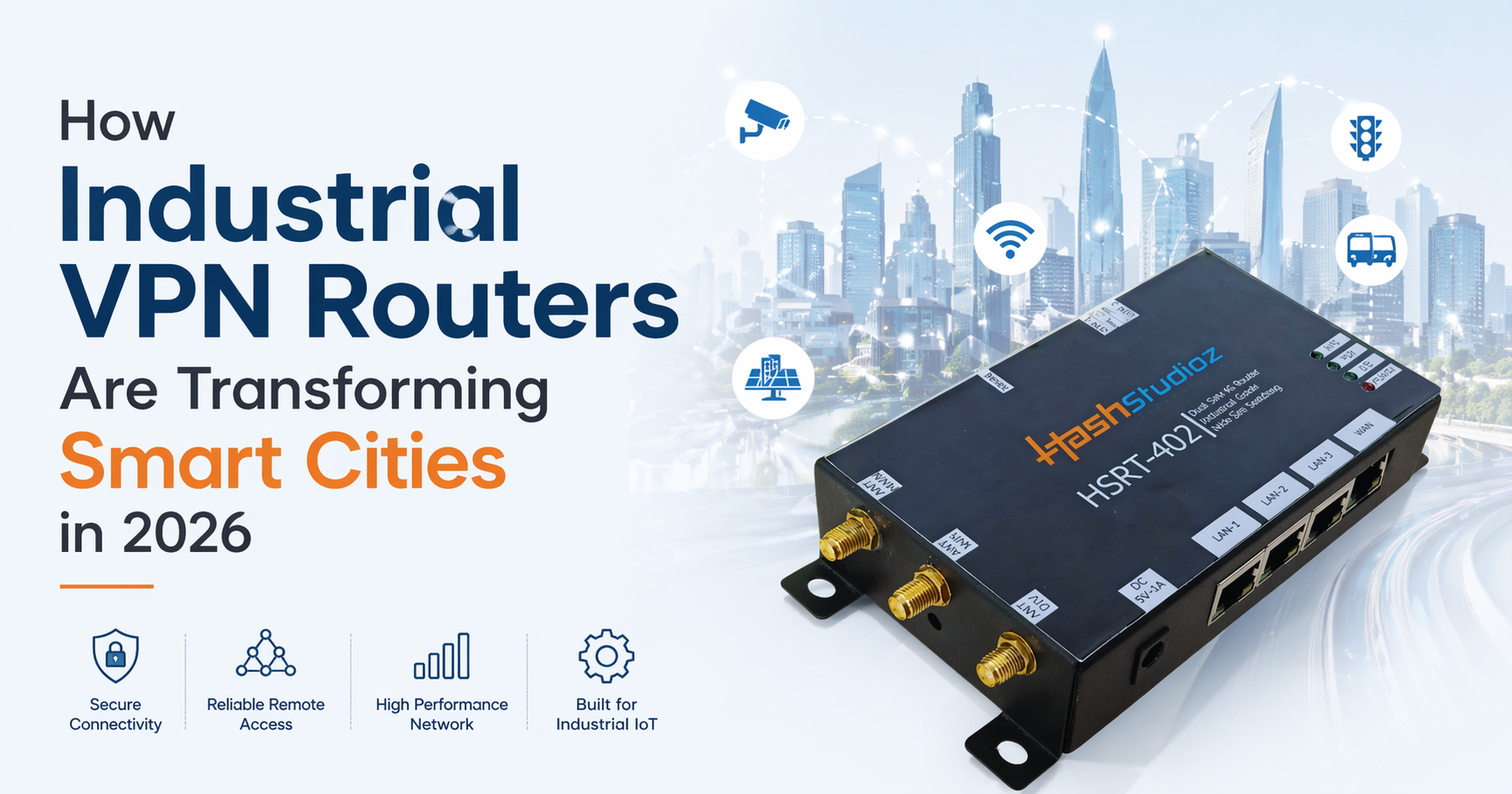
How Industrial VPN Routers Are Transforming Smart Cities in 2026
As cities evolve into highly connected ecosystems, the backbone of this transformation is secure, reliable, and real-time communication. Smart cities rely on thousands – sometimes millions – of connected devices exchanging data every second. From traffic signals to surveillance cameras and smart meters, everything must work seamlessly together.
This is where Industrial VPN Routers come into play. In 2026, they are not just networking devices – they are critical enablers of smart city infrastructure, ensuring secure connectivity, operational efficiency, and real-time decision-making.
What Makes Smart Cities “Smart”?
A smart city integrates technologies like IoT, AI, and data analytics to optimize urban services and improve citizens’ quality of life.
Key Components:
- Smart Traffic Systems: These systems use sensors, cameras, and AI algorithms to monitor vehicle flow, detect congestion, and adjust traffic signals dynamically. Real-time communication is essential to prevent delays and reduce bottlenecks.
- Public Safety & Surveillance: High-definition cameras, facial recognition systems, and emergency alert networks continuously monitor urban environments. These systems require secure, uninterrupted data transmission to function effectively.
- Smart Energy Grids: Intelligent grids track electricity consumption, detect faults, and balance loads automatically. They rely on constant communication between devices and control centers.
- Connected Transportation: Buses, trains, and taxis are equipped with GPS and communication systems to provide real-time updates, optimize routes, and improve passenger experience.
- Environmental Monitoring: Sensors measure air quality, noise levels, temperature, and humidity, helping authorities make data-driven decisions for sustainability.
All these systems depend on fast, secure, and reliable networking, which industrial VPN routers provide.
Role of Industrial VPN Routers in Smart Cities
Industrial VPN routers act as secure communication gateways between field devices and centralized systems.
Role:
- They encrypt all data transmissions, ensuring that sensitive information cannot be intercepted or tampered with.
- They connect remote devices (like sensors and cameras) to control centers over public or private networks.
- They maintain stable connectivity, even in environments where network conditions are poor.
- They enable real-time communication, which is essential for automation and instant decision-making.
Without these routers, smart city systems would be vulnerable to cyber threats and network failures.
Key Ways Industrial VPN Routers Are Transforming Smart Cities
1. Securing Critical Infrastructure
Critical infrastructure – such as power grids, water supply systems, and transportation networks – forms the foundation of any city. A cyberattack or data breach in these systems can lead to widespread disruption.
How Industrial VPN Routers Help:
- They use advanced encryption protocols (like IPsec, WireGuard, OpenVPN) to secure data in transit.
- They create private, isolated networks, reducing exposure to public internet threats.
- They enforce strict access controls, ensuring only authorized users and devices can connect.
Impact: Cities can operate essential services with confidence, knowing that their infrastructure is protected from cyber threats and unauthorized access.
2. Enabling Real-Time Traffic Management
Traffic congestion leads to wasted time, increased fuel consumption, and higher pollution levels. Smart traffic systems rely on real-time data to manage flow efficiently.
How Industrial VPN Routers Help:
- They connect traffic lights, sensors, and cameras into a unified network.
- They enable instant data transmission, allowing systems to respond immediately to changing conditions.
- They support remote monitoring and control, enabling authorities to adjust traffic patterns dynamically.
Impact: Reduced congestion, faster travel times, improved road safety, and lower emissions – making cities more efficient and eco-friendly.
3. Supporting Smart Surveillance and Public Safety
Public safety systems require continuous monitoring and rapid response capabilities. Any delay or data breach can compromise safety.
How Industrial VPN Routers Help:
- They ensure secure video streaming from surveillance cameras to monitoring centers.
- They enable real-time alerts for emergencies such as accidents or suspicious activities.
- They allow remote access for law enforcement, enabling quick decision-making.
Impact: Enhanced crime prevention, faster emergency response, and improved overall safety for citizens.
4. Powering Smart Utilities and Energy Management
Efficient management of utilities like electricity, water, and gas is essential for sustainability and cost reduction.
How Industrial VPN Routers Help:
- They connect smart meters and sensors to central systems.
- They enable remote monitoring and control, reducing the need for manual intervention.
- They ensure secure communication, preventing tampering with utility data.
Impact: Optimized resource usage, reduced operational costs, and improved service reliability.
5. Enhancing Public Transportation Systems
Modern transportation systems depend on real-time data to provide efficient and reliable services.
How Industrial VPN Routers Help:
- They enable live tracking of vehicles, providing accurate arrival times.
- They support secure ticketing and payment systems.
- They facilitate communication between vehicles and control centers.
Impact: Improved passenger experience, better route optimization, and increased trust in public transport systems.
6. Enabling Edge Computing for Faster Decisions
Sending all data to the cloud can create delays, especially for time-sensitive applications.
How Industrial VPN Routers Help:
- They process data locally at the edge, reducing the need for cloud transmission.
- They enable instant decision-making, especially for critical systems.
- They reduce bandwidth usage, improving overall network efficiency.
Impact: Faster response times, improved system performance, and reduced dependency on cloud infrastructure.
7. Ensuring Connectivity in Harsh Environments
Smart city devices are often installed in challenging environments—outdoors, on roadsides, or in industrial zones.
How Industrial VPN Routers Help:
- They are designed to withstand extreme temperatures, dust, and vibrations.
- They provide stable connectivity even in remote or low-signal areas.
- They include failover mechanisms (like dual SIM) to maintain uptime.
Impact: Reliable operation of critical systems, regardless of environmental conditions.
The Role of 5G and Dual SIM Connectivity
In 2026, 5G technology has significantly enhanced smart city capabilities.
Key Advantages:
- Ultra-fast speeds enable high-bandwidth applications like video surveillance.
- Low latency supports real-time control systems.
- Dual SIM failover ensures uninterrupted connectivity by switching networks automatically.
Impact: Smart city systems become more responsive, reliable, and capable of handling large-scale data operations.
Challenges and Considerations
While industrial VPN routers offer significant benefits, cities must address certain challenges:
- Initial Investment: Hardware and deployment costs can be high.
- Network Complexity: Integrating multiple systems requires careful planning.
- Maintenance: Regular updates and monitoring are necessary to ensure optimal performance.
However, these challenges are outweighed by long-term benefits like improved efficiency, security, and scalability.
Future Outlook
The future of smart cities will see industrial VPN routers becoming even more advanced.
Upcoming Trends:
- AI-driven network optimization for predictive maintenance
- Stronger cybersecurity frameworks to combat evolving threats
- Seamless cloud-edge integration for better scalability
Industrial VPN routers will continue to be a core pillar of smart city innovation.
Final Thoughts
Industrial VPN routers are transforming smart cities by enabling secure, real-time, and reliable connectivity across complex urban systems. From traffic management to energy optimization and public safety, their impact is profound and far-reaching.
As cities continue to grow and digitalize, investing in robust networking solutions like industrial VPN routers will be essential for building efficient, sustainable, and future-ready urban environments.
FAQ
1. What is an Industrial VPN Router and why is it important for smart cities?
An Industrial VPN Router is a specialized networking device designed to provide secure and reliable connectivity in harsh and large-scale environments. In smart cities, it plays a crucial role by enabling encrypted communication between devices like sensors, cameras, and control systems, ensuring data security and uninterrupted operations.
2. How do Industrial VPN Routers improve security in smart city infrastructure?
Industrial VPN routers use advanced encryption protocols such as IPsec, OpenVPN, and WireGuard to protect data from cyber threats. They create secure communication tunnels, restrict unauthorized access, and ensure that sensitive data from critical infrastructure like power grids and surveillance systems remains protected.
3. Can Industrial VPN Routers handle large-scale smart city networks?
Yes, industrial VPN routers are designed to support large-scale deployments. They can connect thousands of devices across different locations while maintaining stable and secure communication. Their ability to work with edge computing and cloud integration makes them ideal for expanding smart city networks.
4. How do Industrial VPN Routers support real-time applications in smart cities?
They enable low-latency communication by allowing direct and secure data exchange between devices and control centers. This is essential for real-time applications such as traffic management, emergency response systems, and smart surveillance, where even minor delays can impact performance.
5. Are Industrial VPN Routers suitable for outdoor and harsh environments?
Yes, these routers are specifically built for industrial use. They are designed to withstand extreme temperatures, dust, moisture, and vibrations. This makes them ideal for outdoor installations like traffic systems, utility poles, and remote monitoring stations in smart cities.