
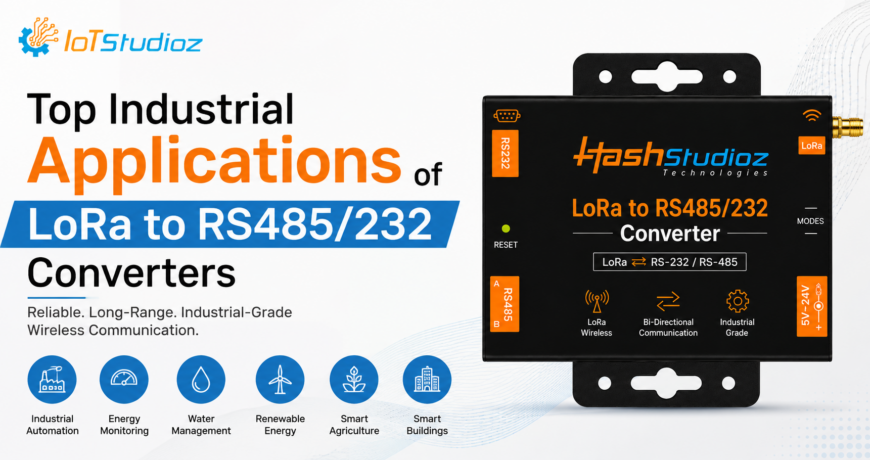
Top Industrial Applications of LoRa to RS485/232 Converters
As industries continue to embrace Industrial Internet of Things (IIoT) and Industry 4.0, connecting legacy equipment with modern wireless communication technologies has become a priority. Many industrial devices such as PLCs, sensors, energy meters, CNC machines, and RTUs still rely on RS485 and RS232 serial communication protocols. While these interfaces are reliable, they require extensive cabling, making deployment expensive and difficult across large industrial facilities.
A LoRa to RS485/232 Converter bridges this gap by enabling serial devices to communicate wirelessly over long distances using LoRa (Long Range) technology. This eliminates complex wiring while maintaining reliable communication, making it an ideal solution for industrial automation, remote monitoring, and smart infrastructure.
What Is a LoRa to RS485/232 Converter?
A LoRa to RS485/232 Converter is a communication device that converts wired serial data from RS485 or RS232 devices into LoRa wireless signals and vice versa.
It enables existing industrial equipment to exchange data over several kilometers without requiring Ethernet or cellular connectivity.
It typically consists of:
- LoRa wireless module
- RS485 interface
- RS232 interface
- Industrial power supply
- High-gain antenna
- Embedded protocol conversion firmware
The converter acts as a transparent bridge between legacy serial devices and modern wireless networks.
Why Industries Need LoRa to RS485/232 Converters
Traditional industrial communication depends heavily on long cable runs.
This approach creates several challenges:
- High installation costs
- Cable maintenance
- Difficult expansion
- Signal degradation over long distances
- Downtime due to cable failures
LoRa technology addresses these issues by providing:
- Long-range wireless communication
- Low power consumption
- High reliability
- Excellent penetration through industrial environments
- Low deployment cost
As a result, industries can modernize existing infrastructure without replacing legacy equipment.
Top Industrial Applications of LoRa to RS485/232 Converters
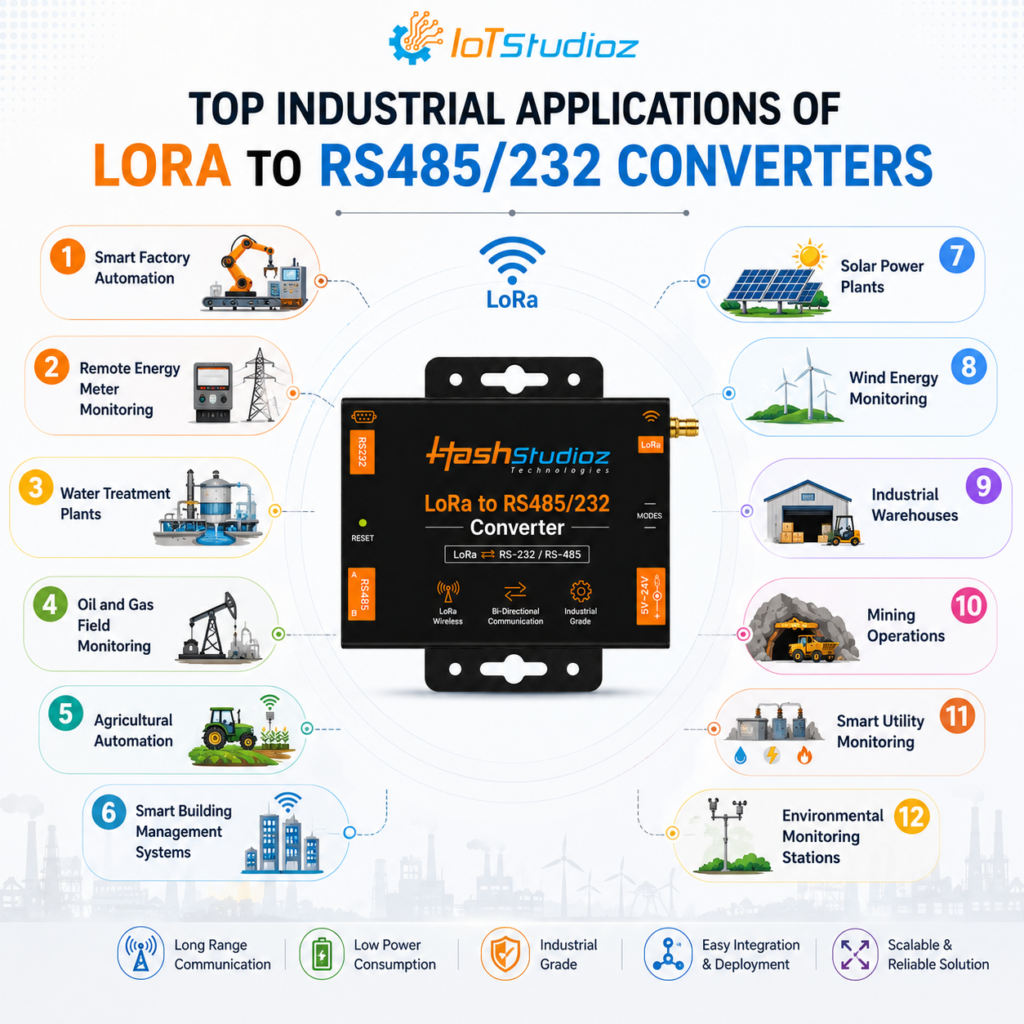
1. Smart Factory Automation
Modern manufacturing plants contain hundreds of machines connected through RS485 or RS232.
Examples include:
- CNC machines
- PLC controllers
- HMI panels
- Industrial sensors
- Variable Frequency Drives (VFDs)
Instead of installing new communication cables across the factory floor, LoRa converters enable wireless connectivity between production machines and central monitoring systems.
Benefits
- Reduced wiring costs
- Easy machine relocation
- Faster deployment
- Centralized monitoring
- Improved production visibility
2. Remote Energy Meter Monitoring
Many industrial energy meters communicate using Modbus RTU over RS485.
Installing communication cables across multiple buildings or substations is often expensive.
LoRa converters allow these energy meters to transmit real-time consumption data wirelessly.
Applications include:
- Manufacturing plants
- Shopping malls
- Universities
- Hospitals
- Industrial parks
Benefits
- Automatic meter reading
- Reduced manual inspections
- Energy consumption analysis
- Predictive maintenance
- Lower operating costs
3. Water Treatment Plants
Water treatment facilities often cover large geographical areas where running communication cables is impractical.
Equipment commonly connected includes:
- Flow meters
- Water quality sensors
- Pressure transmitters
- Pump controllers
- Level indicators
Using LoRa to RS485 converters enables operators to monitor all equipment from a centralized control room.
Advantages
- Reliable long-distance communication
- Low installation cost
- Easy network expansion
- Continuous water quality monitoring
4. Oil and Gas Field Monitoring
Oil and gas pipelines span several kilometers.
Monitoring equipment includes:
- Pressure sensors
- Flow transmitters
- RTUs
- Valve controllers
LoRa converters allow remote communication without requiring extensive communication infrastructure.
Benefits
- Real-time pipeline monitoring
- Faster fault detection
- Reduced maintenance visits
- Improved operational safety
5. Agricultural Automation
Modern farms increasingly use IoT-based monitoring systems.
Devices commonly equipped with RS485 interfaces include:
- Soil moisture sensors
- Irrigation controllers
- Weather stations
- Pump automation systems
LoRa communication enables farmers to collect data from distant fields without installing expensive wired networks.
Benefits
- Smart irrigation
- Reduced water consumption
- Better crop management
- Long battery life
6. Smart Building Management Systems
Commercial buildings contain numerous RS485-based devices such as:
- HVAC systems
- Lighting controllers
- Access control
- Fire alarm systems
- Energy meters
LoRa converters simplify communication between these systems across multiple floors or buildings.
Benefits
- Simplified installation
- Lower infrastructure costs
- Centralized monitoring
- Easy expansion
7. Solar Power Plants
Solar farms cover large outdoor areas where wiring communication networks becomes costly.
Typical devices include:
- Solar inverters
- Weather stations
- Combiner boxes
- Energy meters
LoRa enables these devices to communicate efficiently over long distances.
Benefits
- Remote performance monitoring
- Reduced installation costs
- Faster fault detection
- Higher plant efficiency
8. Wind Energy Monitoring
Wind turbines often operate in remote areas.
LoRa to RS485 converters help monitor:
- Generator status
- Wind speed sensors
- Temperature sensors
- Power output
- Gearbox condition
Operators receive real-time operational data without relying on expensive communication infrastructure.
9. Industrial Warehouses
Large warehouses use RS232 and RS485 devices for:
- Barcode scanners
- Automated storage systems
- Conveyor controllers
- Environmental monitoring
LoRa allows seamless communication across extensive warehouse spaces.
Benefits
- Inventory tracking
- Environmental monitoring
- Reduced cable clutter
- Flexible equipment placement
10. Mining Operations
Mining sites present challenging environments for wired communication.
Common monitoring equipment includes:
- Gas detectors
- Conveyor systems
- Motor controllers
- Pump stations
LoRa converters provide reliable communication even in harsh industrial conditions.
Advantages
- Long communication range
- Low maintenance
- Improved worker safety
- Remote equipment monitoring
11. Smart Utility Monitoring
Utility companies use thousands of field devices communicating over serial interfaces.
Applications include:
- Electricity distribution
- Water distribution
- Gas monitoring
- Remote substations
LoRa converters reduce infrastructure costs while providing continuous operational visibility.
12. Environmental Monitoring Stations
Government agencies and industries deploy environmental sensors for monitoring:
- Air quality
- Temperature
- Humidity
- Rainfall
- Water quality
These stations often rely on RS485 sensors connected through LoRa for long-range data transmission.
Key Benefits of LoRa to RS485/232 Converters
| Benefit | Description |
| Long Communication Range | Several kilometers in open environments |
| Low Power Consumption | Suitable for battery-powered devices |
| Reduced Wiring Cost | Eliminates expensive communication cables |
| Easy Installation | Faster deployment compared to wired networks |
| Legacy Device Integration | Connects existing RS485/RS232 equipment |
| High Reliability | Stable communication in industrial environments |
| Scalable Network | Easily add new devices without major infrastructure changes |
| Low Maintenance | Minimal cable failures and reduced downtime |
Devices That Commonly Use LoRa to RS485/232 Converters
Many industrial devices can be integrated into a wireless network using LoRa converters, including:
- PLCs
- SCADA RTUs
- Modbus RTU Devices
- Industrial Sensors
- Temperature Controllers
- Pressure Sensors
- Energy Meters
- Flow Meters
- CNC Machines
- VFDs
- Weighing Systems
- Environmental Sensors
- Pump Controllers
- HMI Panels
- Data Loggers
Why LoRa Is Preferred Over Traditional Wireless Technologies
| Technology | Range | Power Consumption | Industrial Suitability |
| LoRa | Up to 15 km (open area) | Very Low | Excellent |
| Wi-Fi | 50–100 meters | High | Moderate |
| Bluetooth | 10–100 meters | Low | Limited |
| Zigbee | 100–300 meters | Low | Good |
| Cellular (4G/5G) | Wide Area | High | Excellent but recurring SIM costs |
LoRa offers an excellent balance of long range, low power consumption, and cost-effectiveness, making it especially suitable for industrial deployments.
Choosing the Right LoRa to RS485/232 Converter
When selecting a converter, consider the following factors:
- Support for both RS485 and RS232 interfaces
- Modbus RTU compatibility
- Long-range LoRa communication
- Industrial-grade operating temperature
- Surge and ESD protection
- DIN rail mounting
- Wide power input range
- AES encryption for secure communication
- Low power consumption
- Reliable firmware with remote configuration support
Best Practices for Deployment
To achieve optimal performance:
- Install antennas at elevated positions.
- Avoid placing antennas near large metal structures.
- Use appropriate baud rate settings for serial devices.
- Verify RS485 termination and biasing.
- Perform site surveys before deployment.
- Secure the network with encryption and authentication.
- Regularly monitor signal strength and network health.
Future of LoRa to RS485/232 Converters
As Industrial IoT adoption accelerates, LoRa to RS485/232 converters will continue to play a vital role in modernizing legacy infrastructure. Emerging trends include:
- AI-driven predictive maintenance
- Integration with cloud-based SCADA platforms
- Edge computing capabilities
- Digital twin implementations
- Smart city infrastructure
- Advanced remote diagnostics
- Enhanced cybersecurity features
These innovations will further improve operational efficiency while extending the life of existing industrial equipment.
Conclusion
LoRa to RS485/232 converters provide a practical and cost-effective way to connect legacy serial devices to modern wireless Industrial IoT networks. From smart factories and energy monitoring to agriculture, water treatment, mining, and renewable energy, these converters enable reliable long-range communication without the complexity and expense of extensive cabling.
By integrating existing RS485 and RS232 equipment with LoRa technology, organizations can extend the lifespan of their industrial assets, simplify deployment, reduce maintenance costs, and gain real-time operational visibility. As Industry 4.0 continues to evolve, LoRa to RS485/232 converters will remain a key technology for building scalable, efficient, and future-ready industrial communication systems.