
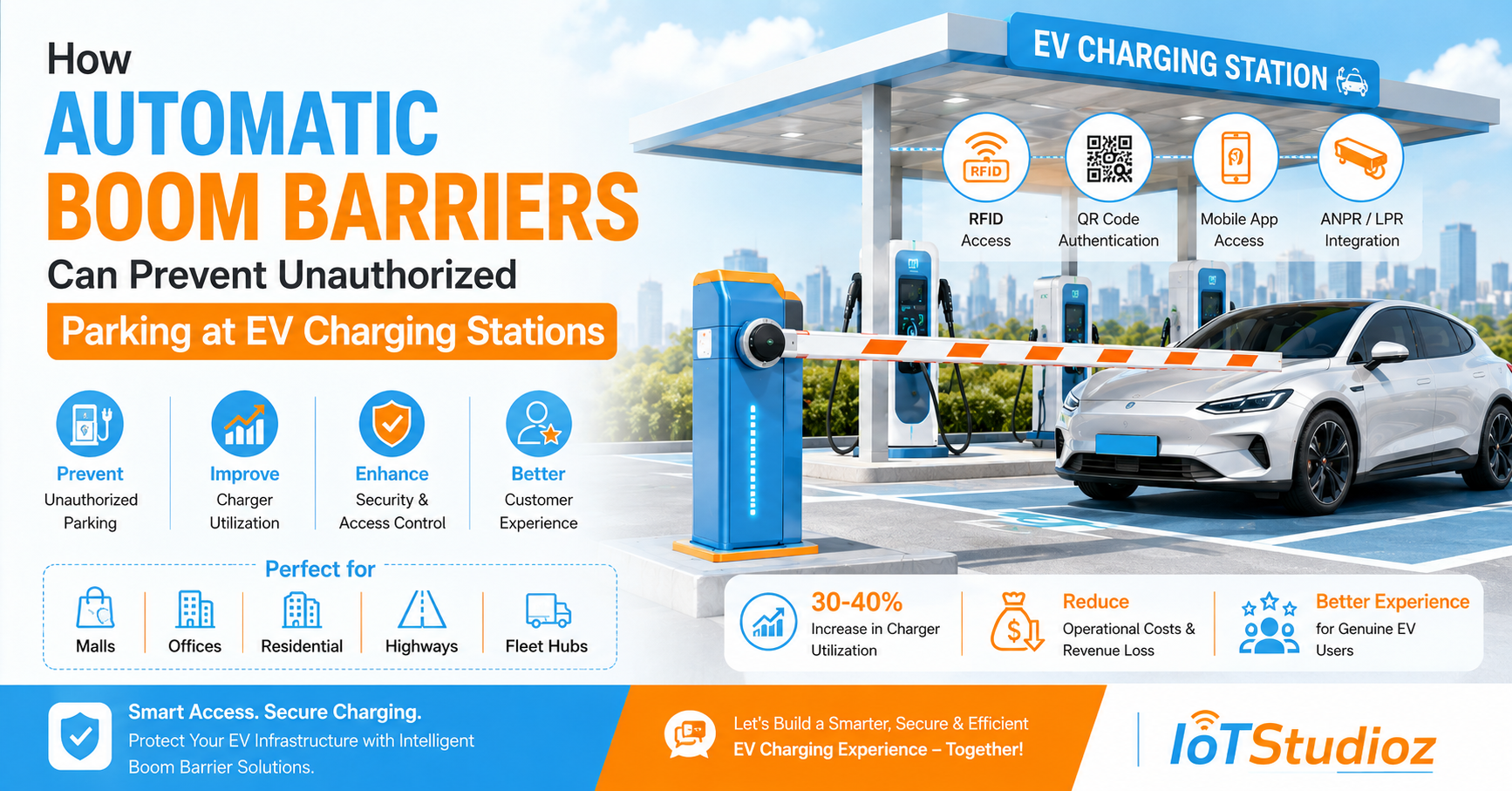
How Automatic Boom Barriers Can Prevent Unauthorized Parking at EV Charging Stations
The electric vehicle (EV) market grows rapidly each year. However, station operators face a severe physical threat to their business model. Non-electric cars frequently park in spaces reserved for charging. This action is known as Internal Combustion Engine blocking, or ICEing.
Additionally, some electric vehicle drivers treat charging bays as long-term parking spaces. They remain in the bay hours after their battery reaches full capacity. This behavior prevents other drivers from accessing the plug.
For EV charging operators, malls, corporate offices, residential societies, and fleet hubs, this issue creates clear problems. It reduces equipment utilization, cuts daily revenue, and frustrates drivers. Standard painted lines and warning signs cannot stop bad parking habits.
Operators need active, physical control over their space. Implementing an automated entry gate solves this issue. This article provides a technical overview of how an Automatic Boom Barrier resolves parking abuse.
The Problem: Unauthorized Vehicles Occupying EV Charging Bays
The global shift toward electric mobility faces a major physical bottleneck: unauthorized parking at charging bays. Non-electric cars frequently block these spots, a behavior known as “ICEing.” Additionally, many electric vehicle drivers treat charging bays as long-term parking spaces, leaving their cars parked for hours after the battery reaches 100%.
For EV charging operators, commercial malls, corporate offices, residential societies, and logistics fleet hubs, this issue creates severe operational challenges. Municipal data shows that 20% to 50% of specialized parking zones are occupied illegally on any given day. On average, unprotected public chargers experience 1.25 parking violations per day, meaning an asset sits blocked and unusable nearly 40 times every month. Standard painted lines, traffic cones, and warning signs fail to alter driver behavior. Station owners require active, physical control to prevent revenue leakage and driver frustration.
Why Use Physical Barriers Over Standard Signage?
Relying on passive signs or painted asphalt assumes driver compliance, which rarely works in high-traffic parking lots. When a bay is blocked, EV drivers face long wait times, leading to a poor user experience and lower network trust.
An Automatic Boom Barrier solves this problem by turning an open parking space into a restricted, secure zone. The automated arm remains lowered by default, physically preventing unauthorized vehicles from entering the bay. It only opens when a driver presents verified digital credentials, ensuring that every vehicle occupying the space is there exclusively to charge.
How the Automatic Boom Barrier System Solves the Problem
An Automatic Boom Barrier System integrates heavy-duty barrier hardware with smart validation technology to create an intelligent gatekeeper. The physical barrier works alongside advanced access control methods to automate entry permissions.
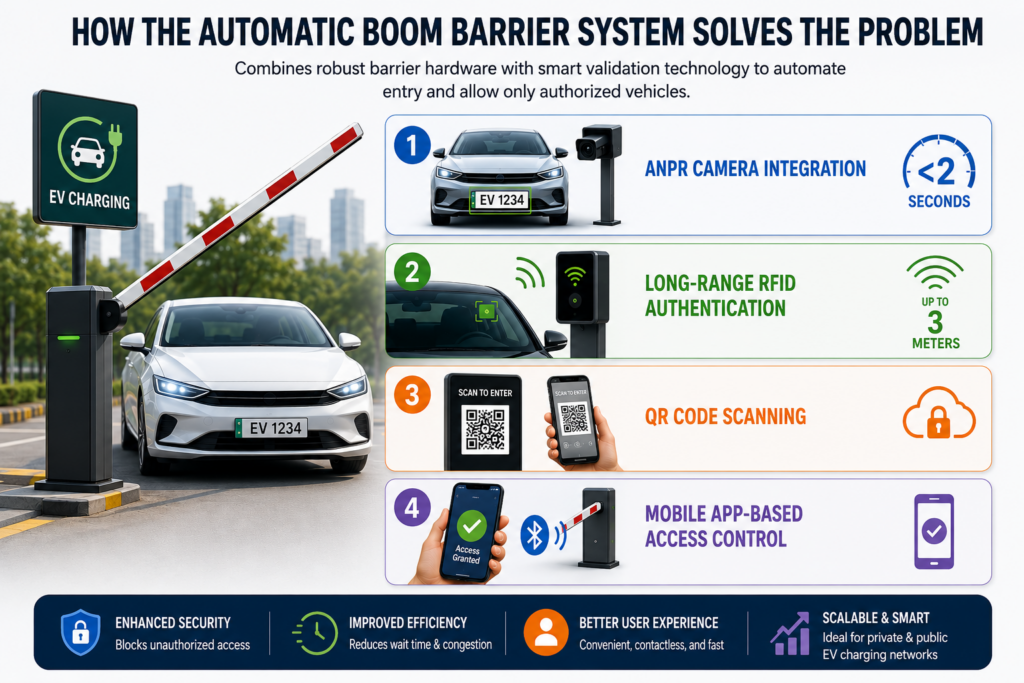
1. ANPR Camera Integration
High-definition Automatic Number Plate Recognition (ANPR) cameras scan the front license plate as a vehicle approaches. Optical character recognition software instantly matches the plate text against a local database of registered electric vehicles or active app reservations. If the system confirms a match, the controller raises the arm in under two seconds.
2. Long-Range RFID Authentication
Radio-Frequency Identification (RFID) provides an excellent solution for private, employee, or resident parking zones. Vehicles feature a passive RFID windshield tag or card. A long-range UHF reader scans the tag from up to three meters away, verifies the user profile, and opens the gate automatically without requiring the driver to roll down their window.
3. QR Code Scanning
For public charging hubs, a weatherproof display pillar at the entrance lane displays a dynamic or static QR code. Arriving drivers scan the code with their smartphone camera, which opens a secure payment portal or network validation page. Once authenticated, the cloud server sends a signal to open the gate.
4. Mobile App-Based Access Control
Integrating physical gates with charging network mobile applications provides a seamless user experience. Drivers open their app to find and reserve an available plug. Upon arrival, a single tap inside the app transmits a secure command via cellular networks or local Bluetooth Low Energy (BLE) to the barrier control board, lifting the arm instantly.
Real-World Use Cases and Implementation Examples
1. Commercial Malls and Retail Hubs
Busy shopping centers face constant parking pressure, and drivers often park gas cars in EV bays out of pure convenience. By deploying an automated entry gate for a dedicated EV parking zone, malls can link barrier access directly to their retail loyalty app or charger reservation system, ensuring premium spots remain open strictly for active charging customers.
2. Corporate Offices and Business Parks
Corporate lots often face issues with employees occupying charging bays all day long, blocking coworkers who need a quick top-up. Employers can deploy an RFID-enabled barrier system where staff tap their corporate ID badges. The backend software links the barrier to the workplace charger; if a vehicle remains plugged in after reaching a full charge, the system sends an automated notification to move the car or applies an overstay penalty fee.
3. Residential Societies and Apartments
In multi-tenant buildings where parking space is limited, residents with internal combustion engine vehicles often occupy vacant charging spots overnight. An automated barrier connected to the residential property management app ensures that only residents with registered electric vehicles can lower the barrier, protecting the infrastructure investments of eco-friendly property owners.
4. Fleet Hubs and Logistics Centers
Logistics companies operating electric delivery vans cannot afford charging delays caused by misplaced staff cars or utility vehicles. Fleet operators use heavy-duty industrial barriers paired with bumper-mounted RFID tags. The gate opens exclusively for company electric delivery assets, ensuring maximum fleet readiness and eliminating manual yard checks by security personnel.
Benefits of Automated EV Parking Management
Implementing physical access control yields immediate operational advantages for space owners:
- Increased Charger Utilization: Keeping bays clear of non-charging vehicles means your equipment is constantly available to paying customers. Real-world tracking indicates that automated access control models can lower unauthorized vehicle rates by up to 90%.
- Direct Revenue Protection: A blocked, inactive charger generates zero revenue. By ensuring high turnover and eliminating illegal parking, station operators can realize a 25% to 40% boost in daily charging transaction volumes.
- Asset Protection: Closed boom barriers physically secure expensive rapid-charging hardware from nighttime vandalism, accidental vehicle collisions, and general equipment misuse in unmonitored areas.
Revenue Protection and Cost Savings
Installing automated physical control systems directly improves the financial performance of a charging station.
1. Increasing Charger Utilization
A public charging spot blocked by a non-charging vehicle generates zero revenue. Industry statistics show that unauthorized parking can block unprotected public chargers up to 30% of the day during peak hours. An Automatic Boom Barrier keeps the space available exclusively for paying users. This continuous access maximizes daily energy sales and speeds up the return on investment for the hardware.
2. Lowering Enforcement Labor Costs
Manual parking enforcement is expensive and prone to human error. Station operators must hire security guards to patrol bays, write tickets, and coordinate towing services. Automating access control eliminates these recurring labor costs. The integrated barrier system operates independently 24 hours a day, handling vehicle verification, timing, and overstay enforcement without human intervention.
Implementation Framework
Deploying an integrated parking solution requires systematic planning, hardware placement, and software configuration.
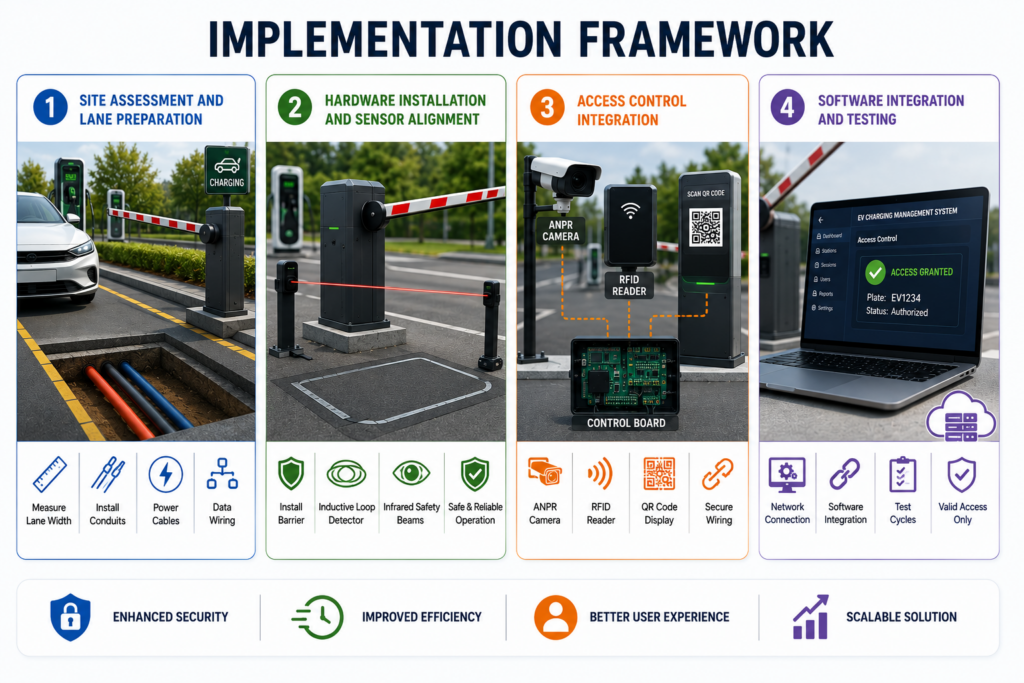
1.Site Assessment and Lane Preparation: Measure the charging lane width to select the ideal aluminum barrier arm length. Core the concrete to install underground conduits for high-voltage power cables and low-voltage data wiring.
2.Hardware Installation and Sensor Alignment: Bolt the heavy-duty barrier housing to a level concrete foundation. Cut slots into the pavement to lay inductive loop detector wires, sealing them with weather-resistant epoxy. Place infrared safety beams on opposing sides of the lane to prevent the arm from closing on any vehicle.
3.Access Control Integration: Mount ANPR cameras, RFID readers, or QR code display pillars at the bay entrance. Wire these reader modules directly to the main microprocessor control board using shielded communication cables to block electrical interference from charging cables.
4.Software Integration and Testing: Connect the barrier controller to the local network using industrial communication protocols. Link the gate mechanism to your central EV charging management software backend, and execute test cycles to confirm the arm only lifts for valid credentials.
Deploy Automated Protection Today
Relying on simple signs cannot protect your high-value electric vehicle infrastructure from unauthorized vehicles. Uncontrolled parking reduces efficiency, impacts driver satisfaction, and reduces the overall profitability of your charging hub.
At IoTStudioz, we provide complete end-to-end integration of heavy-duty boom barriers, long-range RFID readers, and intelligent smart parking solutions designed specifically for EV charging facilities. Our solutions help ensure that charging bays remain available for authorized users while improving security and operational efficiency.
Visit our specialized solution pages to explore our complete range of smart access control equipment:
- [Boom Barrier Solutions] – Explore heavy-duty, high-speed automated gate hardware.
- [RFID Access Control] – Discover hands-free, long-range vehicle identification systems.
- [Access Control Solutions] – Learn about smart camera, mobile app, QR code, and network-based integrations.
Protect your charging revenue, improve customer experience, and maximize bay availability with IoTStudioz’s advanced access management solutions. Contact our engineering team today to schedule an onsite technical assessment and design a customized protection framework tailored to your facility’s requirements.
Conclusion
Unauthorized parking at EV charging bays directly harms station infrastructure, equipment longevity, and business performance. Relying purely on visual signs or passive notifications fails to control bad parking habits. Station operators across commercial hubs, corporate settings, and fleet stations need physical, automated enforcement to protect their investments.
Integrating an Automatic Boom Barrier System creates a secure, efficient infrastructure framework. By connecting physical gates with smart technologies like RFID, ANPR, QR codes, and dedicated mobile apps, operators can restrict access solely to vehicles actively paying for energy.
This smart automation prevents bay abuse, maximizes daily charger utilization rates, and secures consistent revenue streams. Ultimately, moving from passive signage to automated hardware barriers reduces operational costs and optimizes infrastructure efficiency for long-term growth.
Frequently Asked Questions
1. How does an automatic boom barrier detect an approaching vehicle?
The system utilizes inductive loop detectors buried in the roadway or infrared proximity sensors mounted on poles. These sensors register the physical presence of a vehicle and activate the connected RFID or ANPR readers to check credentials.
2. What happens to the barrier during a power outage?
High-quality barrier systems include an internal mechanical manual override. Operators can use a physical key to disengage the drive motor, allowing staff to raise the arm manually. Systems can also connect to battery backups for uninterrupted operation.
3. Can the barrier integrate with existing EV charging software?
Yes. Modern barrier controllers utilize standard open communication APIs and Modbus protocols. This allows them to sync directly with your existing Open Charge Point Protocol (OCPP) software backend to coordinate entry permission with active charging sessions.
4. Is the barrier arm safe from hitting an electric vehicle?
Multiple layers of safety prevent accidental closure. Inductive ground loops continuously monitor vehicle presence directly under the arm, while infrared safety beams monitor the physical space. The arm automatically reverses direction if it encounters any unexpected resistance.
5. Can the barrier system link with existing OCPP charging networks?
Yes. Modern barrier controllers utilize open APIs and Modbus TCP/IP to sync with your Open Charge Point Protocol (OCPP) software backend. This allows the physical gate to coordinate access based on real-time charging and payment states.